Morning, all. Today is popularly known as Blue Monday: a day popularly regarded as the most depressing day of the year although if you google the rationale for that you’ll find it’s just as popularly debunked as an advertising gimmick from the early 2000s. Whether justified or not, it’s fair to say that the idea has taken hold in the public imagination prompting a plethora of more or less helpful social media posts on the subject of depression and this rather esoteric one on the Blue Riband.

I’d forgotten all about the Blue Riband’s existence until December when a colleague drew parallels between it and a Slovakian biscuit she’d come across. I mentally dated the brand to the late 1980s (when I might have last eaten one) but it turned out to be a lot more venerable than I’d thought. It was Scottish biscuit giant Gray Dunn who began producing these biscuits in 1936 although sadly the Glasgow-based factory was forced to close in 2017. At 92 calories per bar, the Blue Riband is admittedly a light bite with what feels like a much thinner wrap-around of chocolate than either a Penguin or a Club Biscuit but an ambitious four layers of wafer underneath it. More than the milk chocolate, it’s the wafer which makes a bid for your taste buds.

The term Riband is an old fashioned word for ribbon: a very medieval spelling dating back to the mid fifteenth century, at least in the Oxford English Dictionary’s first attested use. The term Blue Riband also has the specialist sense, popular in the 1930s, of a metaphorical prize ribbon awarded to the liner capable of making the fastest crossing of the Atlantic from New York to Southampton. I suspect this is the original inspiration for its name but it was in use more generally before this to mean a mark of quality; this is where the notion of Cordon Bleu cooking is from, a reference to France’s chivalric order of the Holy Spirit whose knights were known as Les Cordons Bleus because of their light blue ribbons and whose banquets were said to offer exceptionally top nosh.
However, Bestiary readers might be interested to know that the Blue Riband has a claim to being one – maybe even the only – biscuit whose name is mentioned, albeit indirectly, in the King James Bible: “Speak unto the children of Israel, and bid them that they make them fringes in the borders of their garments throughout their generations, and that they put upon the fringe of the borders a ribband of blue,” God tells Moses in the Book of Numbers, a practice still observed by religious Jews today in the weaving and knotting of blue threads into talits or prayer shawls. “And it shall be unto you for a fringe, that ye may look upon it, and remember all the commandments of the Lord, and do them…” (Numbers 15).

Why blue specifically? The short answer is because God said so… The speculative one opens out a lovely fan of references to this particular colour in scripture which suggests that if he has a favourite colour it might well be this one. When Moses, Aaron, and representatives of the twelve tribes meet with God on the top of Mount Sinai, we are told that “under his feet was something like a pavement made of lapis lazuli, as bright blue as the sky,” the likeness of a throne of lapis lazuli is mentioned in the revelation of God’s glory in Ezekiel, and the robe of the High Priest was made of blue cloth woven in one piece. A special shade of blue called tekhelet was used in the decoration of the temple and tabernacle as well as for the threads on the talits. It would have taken effort and expense to produce high quality blue dyes in the ancient world and in some sense that was part of the point: holiness for humans, meaning consecration or set-apartness for God, being something both costly and beautiful. As Chabad.org explains, the use of this specific blue for the prayer shawls was a mark of nobility, reminding the wearers of their place in God’s kingdom of priests.
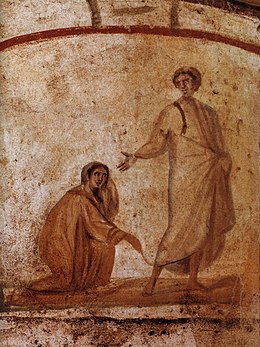
The fringe or the hem of the garment where the tassels were was an important part of the wearer’s identity, even authority in the ancient world. Knowing this casts more light on the episode of David cutting off the corner of King Saul’s garment (and his remorse afterwards). Blue tassels or tzitzit were part of the garments worn by Jews in Jesus’s day. One of the most moving stories in the gospels is the healing of a sick, socially outcast woman who reaches out through the press of the crowd to touch the hem of Jesus’s garment. “For she said to herself, ‘If only I may touch his garment, I shall be made well’…” (Matthew 9:21)
As a colour in the Middle Ages, blue has a whole range of literary associations of which my favourite is constancy or steadfastness. This is not so surprising if you consider it is also the colour of the sky and sea (on a good day) both of which remind us of immensity and eternity. Blue or sometimes blue-toned teal frequently features in cross-cultural surveys as the world’s most popular colour, which suggests it appeals to something deep within the human spirit. Maybe we’re drawn to blue out of a heavenly homing instinct? “He has set eternity in the human heart,” writes the author of Ecclesiastes, no stranger to every kind of blueness. “Yet no-one can fathom what God has done from beginning to end.”

Drawing all these threads together I hope, like me, you will think a little differently about the Blue Riband, and wish you all a tekhelet-toned Monday full of the deep consolations of God.
Further Delectation
Blue Monday or Brew Monday? Here’s a little piece from the Samaritans dispelling the myth of Blue Monday and encouraging us all to reach out and connect over a cuppa.
An excellent initiative to give out free biscuits with that cuppa this year. Coming soon to a station near Luton.
A recording of Adrian Plass’s poem A Hopeful Shade of Blue from Shipwrecks & Islands:
If you would like to see more entries more regularly and help keep this bestiary free of ads, you are welcome to contribute to the Biscuit Jar.
 The Biscuit Bestiary