Soul Cakes

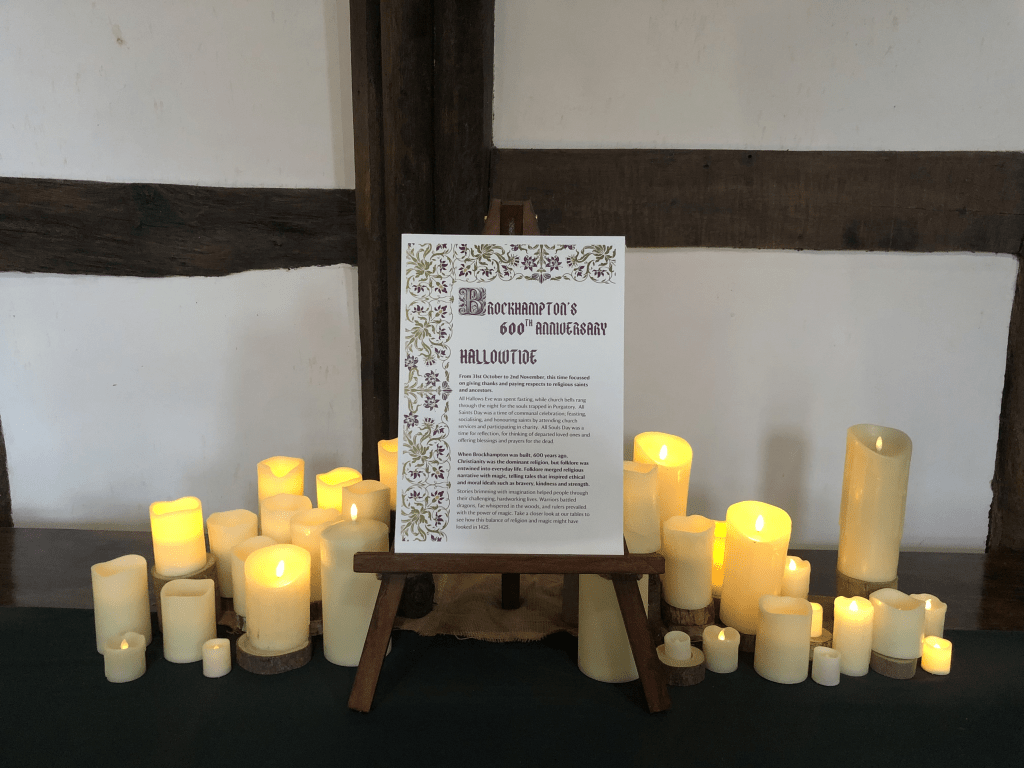
I meant to post an entry before this but life got in the way. It’s still getting in the way, but I didn’t want to pass up this opportunity to write about Soul Cakes: a biscuit traditionally made and eaten over Hallowtide and almost forgotten now but which was once a regular part of this season in medieval England. I’ve been meaning to write about this biscuit for ages and received a little kick up the backside to do it this last weekend when I visited the medieval manor house of Brockhampton, which made rather a feature of them for its 600 year anniversary.

If you’re not sure what Hallowtide is welcome to post-Reformation Britain. It does have something to do with Halloween, so called because it is the evening before All Hallows Day (also All Saints Day) on the 1st of November and All Souls Day on the 2nd, both of which the medieval Church observed with a good deal more fanfare than we do now. While all Christians are called saints in the New Testament writings, there are some who are remembered with a capital S in Catholic, Orthodox and Anglican traditions for having a profound influence for good in their lifetimes and beyond. All Saints Day was for honouring these saints who had passed into glory whereas All Souls Day (an eleventh century development) was for all souls who had died in the faith. It seems likely it was about this time that the Soul Cake tradition really came into its own…

At a time where most people in England identified as Christian and believed in a literal Heaven and Hell, there was also a common belief in a place called Purgatory where souls of the departed in need of cleansing (purgation) would be sent after death to be purified before entering Heaven. The prayers of the living were believed to help speed their progress through this realm. If you were wealthy, you might have a chantry built where prayers and masses could be offered for you or your dead loved ones. If you were poor, you could visit the wealthier houses promising to say prayers for departed souls in return for a freshly baked biscuit. In the sixteenth century Shakespeare is still referring to this custom of going from house to house like “a beggar at Hallowmass”, a practice that might include games and ‘guising’ (or disguising as we say now). Souling persisted into the nineteenth century in parts of the North and Midlands despite some Protestant disapproval. It’s hard to tell whether this was for noble reasons (concern for the dead) or more, ahem, soulish ones (a love of biscuits). Here’s a lovely little clip of Sting singing a song about Souling in Durham Cathedral:

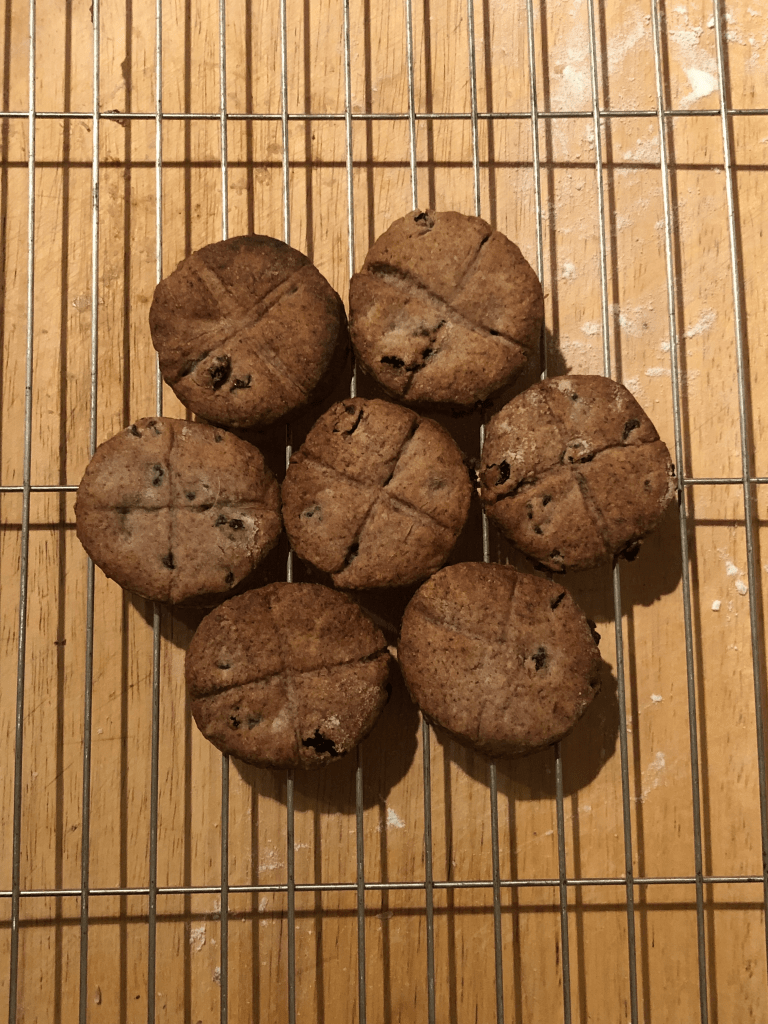
The Brockhampton estate had provided visitors with a medieval recipe for Soul Cakes which I thought I’d try on returning home to Peckham. It looked authentic as there were no measurements (always frustrating to the modern cook) so I went for pastry-like ratios of butter to flour, added the more dubious ingredients along with currants, ground cloves and nutmeg and some mixed spice in the absence of mace (another form of nutmeg). Wine and ale were included, with wine seemingly used as a mixer so I ended up using some cheap Merlot to bind it, thinking afterwards that white wine might have been better as the display cakes didn’t have the reddish tinge of mine. I used a thin wine glass to press them into rounds and marked them with a cross as instructed before trying them in the oven at Gas Mark 6 for about 12-15 minutes. They emerged pretty well cooked but didn’t seemed to rise at all in spite having a packet of dry yeast in them, but the recipe had required ‘cold’ butter and gave no time for proving. To be honest they’re tastier than I expected, even if they do taste a little like pastry soaked in mulled wine, and I look forward to offering them to any puzzled Trick-or-Treaters this weekend. 

They look a bit burnt here, don’t they?

The Bible prohibits attempts to make contact with the dead through spiritualism or occultism on the grounds that doing so attracts spiritual forces of evil (the darker side of Halloween, then and now) – a very serious warning. But praying to and for the dead isn’t forbidden, even though the more reformed churches don’t believe it to be scriptural. The Anglican Church has a beautiful prayer for the departed in its funeral liturgy: O Father of all, we pray to thee for those whom we love, but see no longer. Grant them thy peace; let light perpetual shine upon them; and in thy loving wisdom and almighty power work in them the good purpose of thy perfect will… The Old English word bereft describes the experience of grief powerfully, evoking the violent theft of something precious (‘to deprive, rob, strip, dispossess’). Death feels unnatural because it is unnatural and the heart struggles to process it. It still yearns for some kind of connection between the past and the present. It still reaches out in love.

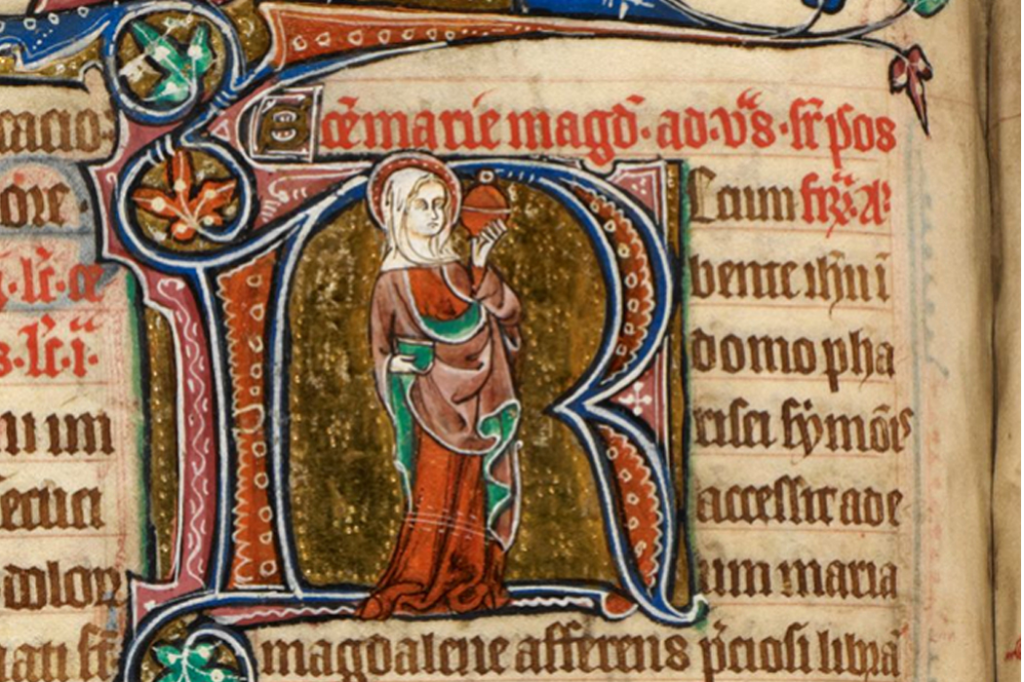
Mary Magdalene in mourning, from the fourteenth century ‘Stowe Breviary’ BL Stowe MS 12.

It is here the value of Hallowtide becomes apparent in reminding us of the Communion of Saints, “dead” and living. I put scare quotes around dead here because while Jesus grieved with those who mourned in this life, we find him arguing with the Sadducees who disbelieved in the Resurrection that “Even Moses demonstrates that the dead are raised… For he calls the Lord ‘the God of Abraham, the God of Isaac, and the God of Jacob.’ He is not the God of the dead, but of the living, for to Him all are alive.” According to St. Paul, the faithful departed are still very much in existence and part of the Great Cloud of Witnesses cheering us on. Not only are they alive with God, but in some sense they are even more alive than the living are. Whether or not they can actively help us with their prayers or we can help them with ours is just detail; the key point is that, whether we sense it or not, we are all part of this glorious Communion. 

“The Great Cloud of Witnesses” Artist unknown

This is important because, as Norwegian bishop and writer Erik Varden says, there’s an insidious voice that likes to tell us we’re alone, but the fundamental statement of Christianity is to convict that voice of lying. Love really is stronger than death and one day God will swallow up death forever (Isaiah 25). I think that’s worth celebrating with a Soul Cake or two this Hallowtide. Blessed All Hallows Eve, All Hallows Day, and All Souls (Cakes?) Day when it comes.

Further Delectation

More information on Hallowtide and Souling traditions from English Heritage and a good short article on the post-Reformation history of Hallowmass by Professor Helen Parish.

For a quick tour through a medieval landscape of Heaven, Hell and Purgatory, Dante Alighieri is your man. For a survey of the history of Purgatory (still present in a revised form in Catholic doctrine but rejected by the reformers) see this helpful explanation.

And here’s Erik Varden’s book, The Shattering of Loneliness (recommended).

And finally, nothing to do with Hallowtide per se but my friend Paul put me on to this wonderful medievalist adaptation of Billy Joel’s We Didn’t Start the Fire by those divas at Bardcore. Very funny and very clever:

If you would like to see more entries more regularly and help keep this bestiary free of ads, you are welcome to contribute to the Biscuit Jar.

Coconut and Stem Ginger Biscuits

Yorkshire being the cake capital of the world, I have struggled to find a truly Yorkshire-bred biscuit but there are some excellent contenders at Botham’s Bakery in Whitby. The ‘Betty’s of the Yorkshire Coast’ and start-up of Victorian entrepreneur Elizabeth Botham, the bakery is famous for its lemon buns, but they do nice biscuits too. On my last visit North it was their Coconut and Stem Ginger biscuits that caught my eye with their unusual ingredient base of coconut, ginger and lime, inspired by Captain Cook’s voyages of discovery.

Along with St Hild and Count Dracula (!), Cook was one of Whitby’s most celebrated residents and one part of his biography that is less commonly remembered was his success in keeping his crews for long voyages healthy. Cook was one of the earliest winners of the Royal Society’s Copley Medal due to his work in combating scurvy by adding supplements of cress, fermented cabbage and orange extract to his sailors’ diets. While I’m not sure how healthy this biscuit he inspired is, it certainly tastes fantastic. My favourite of 2025 so far and it’s suitable for vegans too as it uses plant oil rather than butter.

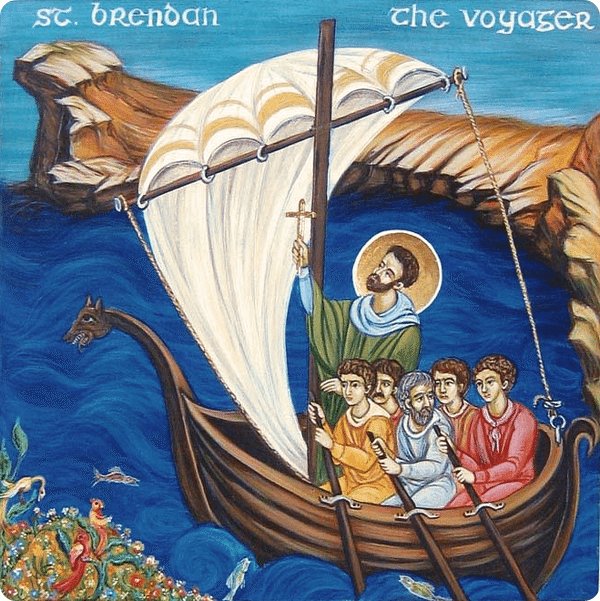
The ginger and the coconut flavours work surprisingly well together and like any decent sea-faring biscuit, they tasted even better after being exposed to the elements for a week. And if I had been paying more attention to the church calendar, I might have opened the biscuits for the feast of St Brendan of Clonfert earlier in the summer, who is also known as Brendan the Voyager or Brendan the Navigator. The 9th-century classic Navigatio sancti Brendani abbatis (or Voyage of St Brendan the Abbot) is worth a read if you’re at all interested in the lives of the early Celtic Saints and their peregrinations. As Michael Mitton writes in his tribute to Celtic Christianity, Restoring the Woven Cord, the work itself is a “highly embellished… [travelogue but] behind the parables and hyperbole, you discover a group of wonderfully open travellers who come upon small communities of monks, encountered the wonders of icebergs and great whales, and travelled vast distances in their fragile coracle.“.

St Brendan and his companions (artist unknown)

Brendan and his companions had a clear objective in their wanderings. Their imagination had been stirred by stories of a mysterious blessed isle in the Atlantic and their journey in search of it opens up Dantesque portals to heavenly and hellish experiences on the ocean as well as opportunities for fellowship with other monastic communities along the way. The idea that an Earthly Paradise, or the literal Garden of Eden, existed somewhere and you could travel to it was a familiar one to medieval readers who may have literally believed that this was so. Dante’s pilgrim gets to visit it on his journey through Purgatory and in some later medieval romances, Paradise is to be found in India and Alexander the Great is allowed a glimpse of it and given a gift – a pearl or apple – to take away.

The location of Eden according to the 13th century English ‘Map Psalter’: BL Add. MS 28681 f. 9r

After seven years, Brendan and his monks finally find the country they have been looking for. Hidden in the centre of a dense cloud of darkness, they arrive at an island full of light. In this Paradise they discover a land of fruiting trees, endless day-time, and a swiftly flowing river they are unable to cross. There they are met by a young man with a dazzling countenance (an angel?) who knows all the monks by name and who tells them the reason they could not find the island before is because Christ had hidden it from them in order that they might see the wonderful works of God displayed in the ocean.

Detail from Dante’s Earthly Paradise from the 15th century BL Yates Thompson MS 36 f. 116v.

The monks are allowed to marvel at the island but not allowed to stay, being instructed to sail back home to Ireland with their boat loaded with heavenly fruit and precious stones as proof of their sojourn in Paradise. For most devout medieval Christians, the joys of life on earth had nothing to offer in comparison to the joys of heaven and so the idea Paradise could be visited as an earthly outpost of heaven must have seemed even more tantalising than a Coconut and Stem Ginger biscuit…

Whether he found his way to a real Earthly Paradise or not, I imagine Brendan himself would have agreed with St. Augustine that in the end we come to God by love and not by navigation. “You will seek me and find me when you seek me with all your heart“, God tells the people of Israel (and all of us) in the prophet Jeremiah. If the temptation is to think of our forever home as a heavenly place, the Bible tells us it is, most of all, a heavenly person. And a heavenly person who is with us wherever we go and who we can reach for at any moment: “If I rise on the wings of the dawn, if I settle on the far side of the sea, even there your hand will guide me, your right hand will hold me fast.” David writes in Psalm 139, an excellent sentence for all voyagers and this adventurous biscuit.

Further Delectation

Planning a voyage to an Earthly Paradise this summer? You might want to stock up on some of Botham’s biscuits.

A free English translation of the Navigatio sancti Brendani abbatis if you fancy a read of it. (Its influence can be seen on much later fictional travelogues, such as C.S. Lewis’s Voyage of the Dawn Treader.)

Finally, this is a lovely little blog from the BL on the medieval locations of an Earthly Paradise for those who can’t afford to travel (or are simply interested in the history of all this!)

If you would like to see more entries more regularly and help keep this bestiary free of ads, you are welcome to contribute to the Biscuit Jar.
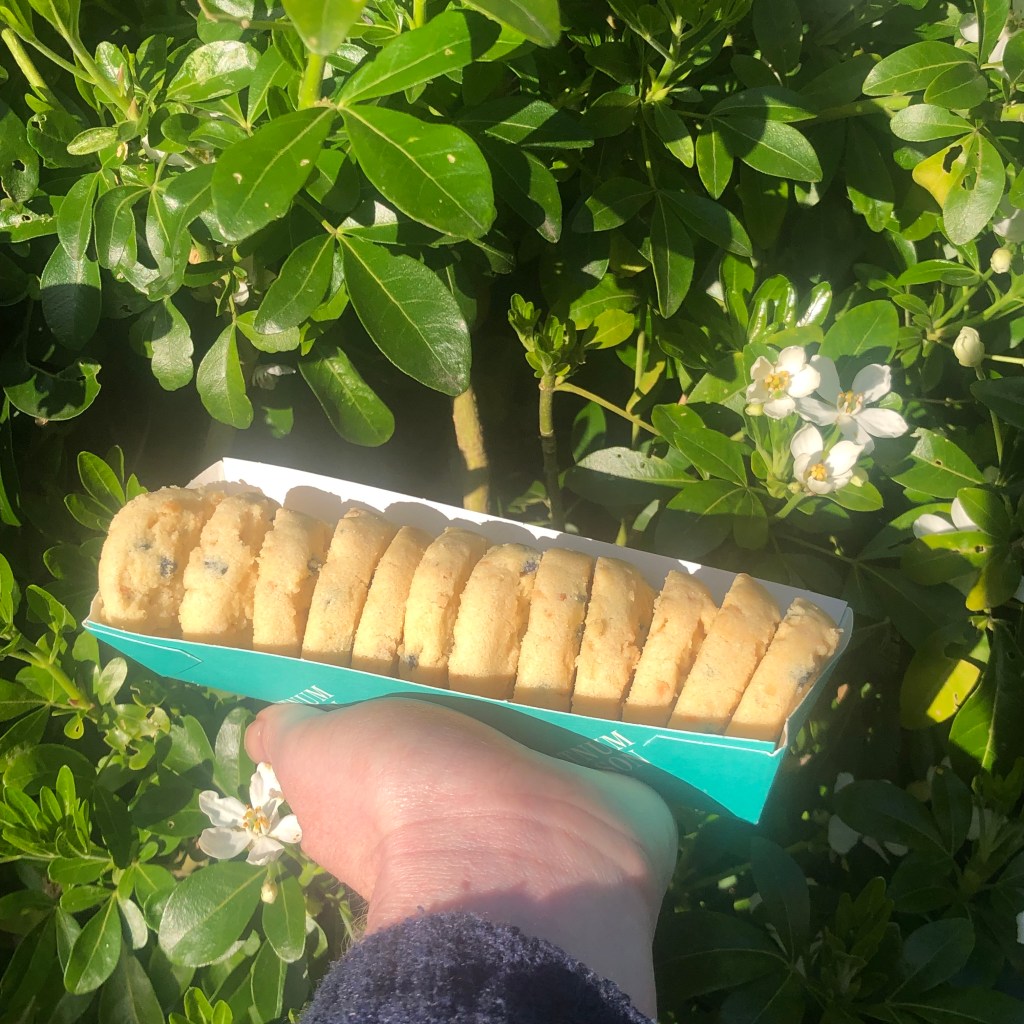
Violet Biscuits

I don’t normally shop in Fortnum and Mason’s in Holy Week – or in many other weeks – but they produce some rare and special biscuits not easy to find elsewhere. And so a few days ago, I ventured into their gleaming, plush, oppressively crowded store once again in search of an elusive biscuit quarry. The magnificent tin they came in is tall enough to house an umbrella, which I may use it for once the contents have been eaten…

At £14.95 a pop, Fortnum’s Violet Biscuits were no idle purchase but a deliberate pursuit of a creation that caught my eye. Violets for me conjure images of Wordsworth’s She Dwelt Among the Untrodden Ways, in which the poet describes the beautiful, sheltered, overlooked life of a young woman whose death he mourns as ‘a violet by a mossy stone’. And although I wasn’t consciously thinking about it at the time, I later remembered that the flower is also the name of one of my grandmothers who also died young. So young her name is the only thing I really know about her.

There is no end to the biscuits that we like to invent, and this particular example is a true original. The crisp butter biscuits are subtly flavoured with French crystallised violets for a gently aromatic taste…” is what Fortnum’s have to say about the Violet Biscuits in their marketing. (Crystallising in this context means treating cut flowers with a sugary compound.) As well as the ingredients you would expect from a regular butter biscuit, they contain violet fragments and indigo and carmine colouring. You can see the flecks of crystallised violet in the mixture but it was the taste that was the real surprise. To me these biscuits looked and sounded delicate but when you bite into them you get a powerful, almost medicinal, hit that I can only describe as an old fashioned sweet shop taste (think Swizzels’ Parma Violets which are still produced today apparently). Far from shrinking from your taste buds, these violets could definitely hold their own against a cup of Earl Grey and maybe even a cup of coffee.

So what have these Violet Biscuits to do with Holy Week? Well, for me it was the continuation of a journey that started with a flash of purple. A purple scarf to be exact and the comment of a young woman called Anna, whose church I was visiting, that purple was the colour of the robe the Roman soldiers draped Jesus in hours before he was led away to his crucifixion. An ugly moment in a series of ugly moments culminating in the appalling spectacle of the cross. I don’t know why but when she said that I found myself moved by that flash of purple. I think because it felt like a tangible link to him. The robe itself is mentioned in all four gospels. In Matthew it is described as a scarlet robe. Luke doesn’t mention a specific colour but uses a word that can mean white but is more often translated elegant or splendid, but in both Mark and John it is purple.

Purple was an expensive colour in the ancient world (and the medieval one for that matter), the colour of royalty and empire, particularly of Roman power. Tyrian Purple, a dye named after its traders from Tyre, was painstakingly produced one drop at a time from the glands of two different kinds of shellfish and restricted over time to persons of more and more influence. Shifting perceptions of colour may help to explain the gospels’ chromatic variations (although this different take on it by James Bejon is lovely too). Pliny, born around 20 years after Christ, describes imperial purple as the colour of clotted blood. Like the violet of these biscuits, the robe was (a) costly, or had probably been so once, and (b) some kind of scarlet-purple. It also would have made an impact like the strong medicinal taste these edible violets had, a connection also brought out in the medieval Anglo-Norman etymology of the word violet (and indeed, the flowers were used in medicine as well as baking).

Where the soldiers got the robe from isn’t clear but what is clear is that they were using it to make sport of their celebrity prisoner, stripping him of his clothes before dressing him in it and fashioning a circlet of thorns to ‘crown’ him too. In doing so they were mocking his claim to be the King of the Jews, the title he would shortly be crucified under and which he accepted from Pilate, the Roman governor of Judea, while stating that his kingdom was different from any earthly king’s. The encounter between Jesus and Pilate is an extraordinary one, not least because of Jesus’s behaviour under questioning. When he answers, it is collectedly, speaking always from a place of quiet assurance. When he keeps silent, the governor finds it baffling. “Don’t you realise I have power to free you or to crucify you?” Pilate asks the prisoner, bewildered. He becomes increasingly bewildered the more he questions him.

It is in John’s gospel that Jesus’s appearance in the robe is most striking, as Pilate brings him out and presents him to the crowd with the words Ecce Homo (Behold the Man). They are words that suggest Pilate was not without a sense of the drama of that moment, but he could not have anticipated how they would echo on down the years. To look at a thing is very different from seeing a thing, Oscar Wilde once wrote, and for the artist as for the contemplative the command to look becomes an invitation to pass from looking to seeing. The invitation to look – or to look again – becomes an invitation to consider what we may have missed previously.

Not surprisingly, that image of Jesus standing alone in his purple robe has been so frequently depicted by artists painting what they see, that it is now, quite literally, iconic. This is how much of the Orthodox Church depicts the bruised and bloodied figure of Christ before Pilate and the crowd. And yet it is traditional for these icons to use a different title from the one you might expect in the circumstances. Not Christ the Suffering Servant (although he is that) or Christ the King (although he is that as well) but Christ the Bridegroom. How so?

Commentators usually link this decision to the image of Christ in the Parable of the Ten Bridesmaids. However, it is the power of icons as all symbols to become rich repositories of meaning over time. As I considered the story again this Holy Week, I was reminded of one of the most famous medieval mystics’ writings on the Passion, Julian of Norwich. A remarkable woman who lived a life of religious seclusion as an anchoress for much of her life and who in seeking to understand the Passion better was granted an unusual series of beholdings in a vision of Jesus’s sufferings, later written as her Revelations of Divine Love. In one extraordinary dialogue in the text, Christ tells Julian that not only did he gladly undergo all his suffering for the sake of his creatures but Every day He is redy to the same if it myght be. For if He seyd He wold for my love make new Hevyns and new Erth, it were but litil in reward, for this might be done every day if He wold, withoute any travel. But for to dey for my love so often that the noumbre passith creature reson – it is the heyest profir that our Lord God myght make to manys soule. (Every day He would be ready to do the same, if he could. For if He said he would for my love make new Heavens and new Earth, it would be a little thing in comparison to suffer every day for me. It wouldn’t be hard for him. To die for my love so often the number passes reason is the greatest offer our Lord God could ever make to the souls of humanity). Perhaps it is her own revelation, her paraphrase, of one of the Bible’s great prophets and visionaries: “He shall see the fruit of his soul’s suffering and be satisfied; by his knowledge my righteous servant shall justify many”. Either way we seem to catch a tiny glimpse in it of the face of the blissful Bridegroom looking at us through the blood and the bruises, the scarlet and the purple. The one who, as the author of the Book of Hebrews says, “for the joy set before him endured the cross,” who both wore – and deserves to wear – the costliest robe.

“Surprised by Joy” an Easter Garden, inspired by Nine Elm’s Arts Ministry’s Soul Space.
Further Reflection

Some of the readings from Plough that have kept me company this Holy Week: In the Holy Land, Seeking the Solace of the Cross and His Cross is Every Tree: The Poetry of the Passion by Chris Zimmerman.

One of Orthodox composers John Tavener’s most haunting pieces, ‘Christ the Bridegroom’.

A link to the Middle English text of Julian of Norwich’s Divine Revelations if you want to read it and a Julian-inspired reflection on suffering and love. And here is an icon of her (rather charmingly I found out she is traditionally depicted with the little cat who kept her company in her cell!)

If you would like to see more entries more regularly and help keep this bestiary free of ads, you are welcome to contribute to the Biscuit Jar.

‘Mpanatigghi

‘Mpanatigghi are… unusual in the biscuit world. Ancestry wise, you can trace them back to early modern Sicily. If they resemble a cross between a Cornish Pasty and Spanish empanada that’s because they are far more like either of these things than a traditional (British) biscuit. Sicilian Meat Cookies is a common English translation. Dolce di carne is another Italian name for them because they’re crafted from light pastry dough, dark chocolate, winter spices, nuts and… meat. Most of the pictures of them in the wild show them folded into half-moon shapes with the chocolatey filling bursting out of a hole at the top like so:

Image from: saveur.com

The ‘Mpanatigghi give a whole new meaning to the word ‘sweetmeat’ (a medieval term) and if you’re thinking the dark chocolate-beef combo sounds rather Mexican I’m with you. Modica, the town associated with them, is famous for its Aztec-inspired chocolate and Sicily’s hispanic culinary influences – hinted at in the semantic roots of the ‘Mpanatigghi being so similar to the empanada – are a throwback to the days the island was under Spanish control. I found a recipe online that seemed easy so decided to have a go myself, mixing up ground beef, ground almonds, grated dark chocolate, sugar and cinnamon for the filling (I left out the ground cloves as these were hard to find). A new adventure for me and this was the funnest part:

The end results were more like sedate mini English pasties with a weirdly chewy chocolatey centre. They’re not unpleasant and you could get used to them as a picnic item, but it’s fair to say they were more an oddity than a triumph and as I was too shy to offer them to my lunch guests on Sunday I’ve spent the week eating them up. I suspect I could find better recipes online (the proportions of dough to filling in this one were a little suspect) but I won’t be making them twice. If I ever visit Modica I’d love to try some authentic ones.

As for the moral, well, one story has it that a community of nuns in Modica first came up with the idea for ‘Mpanatigghi, slipping small amounts of ground beef or veal into their biscotti to hide among the sweet filling of nuts and dark chocolate. The point was to break the Lenten rules without observers knowing by smuggling meat into an innocent-looking, sweet-tasting biscuit. (Before modern times, chocolate, sugar and nuts could be eaten freely during Lent for those who could afford them; it was butter, eggs and meat that were frowned on.) The most sympathetic defence I’ve seen of this culinary sleight of hand is that the nuns were worried that six weeks without any red meat would have a deleterious effect on the monks and a little boost of protein would help them fulfil their preaching duties as they travelled from place to place during the fasting season!

Detail from the Maastricht Hours: Stowe MS 17, f. 38r

With Ash Wednesday upon us and the dubious example of the ‘Mpanatigghi before us, it begs the question of how we should fast as much as what we should fast from. Is there a right and a wrong way to do it? The answer from the Bible seems to be yes. Jesus had strong words to say about those who made a religious show of fasting, calling them hypocrites who had already received their reward from men (impressing others) and so shouldn’t hope to receive any reward from God. He also didn’t have much time for those who in their religious practices sacrificed as little as they thought they could decently get away with, knowing that such sacrifices, like the innocent-looking ‘Mpanatigghi, were more about the appearance than reality, of conforming outwardly, and little to do with the heart.

God is all about the heart, and in Lent the discipline of fasting becomes a means of purifying and softening it. Whether as a private or corporate undertaking, it can involve giving up all food or just luxury foods (as in the medieval fast) or some other act of self-denial like fasting from social media. Along with delayed gratification, self-denial is not something our culture is all that good at and the long Lent fasts were traditionally meant as a reflection of, and aid towards, cultivating humility before God. But as Jesus’s words showed, it’s definitely possible to fast in the wrong spirit and in one surprising passage in Isaiah God gets very irritated with those whose fasting hasn’t improved the condition of their hearts at all:

Is not this the kind of fasting I have chosen:
to loose the chains of injustice
and untie the cords of the yoke,
to set the oppressed free
and break every yoke?

Sharing your resources with the needy, standing with those who are oppressed and afflicted, not stirring up strife or constantly accusing others, or exploiting your employees or turning away from family who need you… This is the kind of fasting that moves God most apparently, and without it any outward acts of self-humbling fail to impress him.

For those who do try to fast in Lent in some way, these words are challenging and liberating in equal measure. Challenging because, if we’re honest, most of us identify real gaps between our ideals and actual behaviour when it comes to practising our faith; we don’t always live up to own standards let alone God’s. But liberating because the God who is so tough on religious hypocrisy continually shows himself soft on those who admit the gaps and come to him humbly with them, asking his help to change.

Further Reflection

More on the history of the ‘Mpanatigghi and a recipe if you fancy having a go at making them (there are simpler versions out there but this looks a bit better than mine!)

’40’ a short animated film by Si Smith imagining Jesus’s forty day fast in the Judean desert:

If you would like to see more entries more regularly and help keep this bestiary free of ads, you are welcome to contribute to the Biscuit Jar.

Egyptian Kakh

Just when most Christians in the West are taking down their Christmas trees, Christians in the East are breaking their Advent Fast, so this 7th of January may I wish you a very happy Orthodox Christmas in the company of some Egyptian Kakh? Kakh are probably the closest Egypt comes to a national biscuit. They are traditionally made as treats for both Christian and Muslim festivals, and were probably eaten in some form or other as far back as the time of the Pharaohs, which means they may actually be the oldest biscuit to be featured on the Bestiary thus far. So it seems fitting they are associated with the High Holy Days of one of the world’s oldest Christian communities: the Coptic (Egyptian Orthodox) Church.

Disclaimer: I don’t know much about the Orthodox Church but what I do know was enriched by an ecumenically-minded ‘taster day’ of sorts at Southwark Cathedral last year (although it did not include any tasting of Kakh). The programme featured talks from representatives of the Eastern Orthodox and Oriental Orthodox Churches as well as British icon maker Aidan Hart. Brief as it was it communicated something of the understanding of the nature of God and the life of faith the Orthodox have stewarded through the ages that impressed me with its beauty, discipline, and reverence for mystery and holiness. Elements we have not always reflected as consistently in our traditions in the West. As Hart reflected, “the secular world is more likely to try to sedate us than to kill us”. One of the insights I took from his talk was that worship in the Orthodox Church is about trying to wake us up. At its best, the Orthodox imagination views everything created: people, animals, the whole of the natural world: as a mystery alive with the glory of God, who is himself the greatest mystery and source of all beauty and wonder.

The Nativity by Coptic icon-maker Isaac Fanous (1991)

In the Coptic Church, the discipline of fasting is yet another means of waking our sleeping souls a little. The meat and dairy-less fasts of Lent and Advent might seem austere to a bumbling Anglican, but there are good biscuits waiting for us on the other side: Ghorayebah and Egyptian Petits Fours, as well as Kakh: essentially a type of butter cookie filled with dates or figs or nuts. I did think about having a go at making some myself before buying this box of them from a Middle Eastern specialty supermarket near Baker Street. I couldn’t find date or fig ones which would have been my first choice, but took a punt on these Kakh with Malban (Egyptian Turkish Delight) made in Cairo by Egyptian biscuit company BiscoMisr:

The Kakh in the BiscoMisr box came separated in ones and twos in plastic compartments with packets of sugar for dusting. I’ve found out since that it’s natural for Kakh to crumble at the slightest pressure. And these ones crumbled spectacularly, not just into fragments but into a sort of biscuit dust which made eating them elegantly quite a challenge. “Not a biscuit for dipping!” remarked the friend I was taste-testing them with and she was right. The buttery flavour was pleasant but some of them could have done with a bit more of the sweet filling, as you can see from the picture below. “They might be good with coffee,” another friend suggested at a gathering at the weekend “but I’d only give them 4 out of 10” (although this relatively low score didn’t stop him going back for another one). As I’ve carried on eating them, however, I’ve grown to like them better, especially the ones with the citrus-flavoured Malban. Although they’re really meant as festive biscuits they are a handy size for work coffee breaks (and yes, probably better with coffee than tea).

The dustiness and crumbliness of the BiscoMisr Kakh reminded me of the desert fathers and mothers whose adventures with God in the Egyptian desert helped to lay the foundation for the great monastic movements of the Middle Ages. Henri Nouwen’s The Way of the Heart is a beautiful reflection on their influence and retells the story of Antony of Egypt (251-356), the Coptic Saint whose feast day is later this month. Famous for his life of asceticism and solitude, as a young man Antony sought to detach himself from the world in order to attach himself to God. His friend and biographer, St. Athanasius depicts him alone in the desert wrestling with demons. It seems the demons – imagined by Nouwen not as devils with pointy horns but as a host of addictions, fears and compulsions – became much realer to Antony in the desert. But God became realer too, until after twenty years he emerged with a new inner freedom.

Saint Anthony by Claire Barrie

I suspect Nouwen chose his title, The Way of the Heart, because so often this is also the Way of the Desert. “Remember how the Lord your God led you all the way in the wilderness these forty years, to humble and test you in order to know what was in your heart…” Moses tells the people of Israel. Moralists like to talk as if our experiences of emptiness, renunciation or deprivation are valuable aids in strengthening character but they’re also a way of exposing the character that is already there. The desert reveals the true condition of it. If there is any bitterness, pollution or debris in the soul – any flash of ego or mixture of motives – it will show it up. The Bible teaches us that the heart is the wellspring of life so if we want what flows from our hearts to be life-giving, we need to be willing to allow God to help us heal them where they are not healthy, and purify them where they are not pure.

And the moral? Like the great feast after the great fast, or the singing after the silence (or like the Malban at the centre of the Kakh), if God sends you into the desert, he will look after you there. And even if you’ve landed there without his invitation, like a depressed and depleted Elijah, he can still meet you in it. On his return from the desert, “the place of great struggle and great encounter,” Henri Nouwen writes: “Antony took his solitude with him and shared it with all who came to him. He had become so Christlike, so radiant with God’s love.”

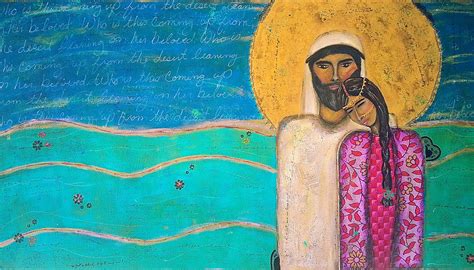
“Who is this coming up from the desert, leaning on her beloved?” Song of Songs 8:5. Credit: Danielle Bilen

Further Delectation

More on Coptic Christmas in Egypt and outside it, and on the history of Kakh and a recipe for making them.

More on icons and icon-making: “Hope and Fragility: An Interview with Coptic Iconographer Stéphane René from Orthodox Arts Journal.

More on Antony and the Desert Fathers from Bishop Erik Varden as part of a new podcast, The Desert Fathers in a Year.

More on Henri Nouwen’s The Way of the Heart.

If you would like to see more entries more regularly and help keep this bestiary free of ads, you are welcome to contribute to the Biscuit Jar.

Sju sorters kakor

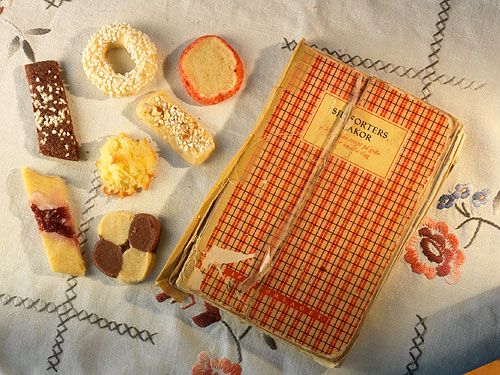
One of my favourite memories of 2024 is the Saturday in late February I joined a group of other artists for a retreat day. We spent part of the morning drinking coffee together near the ruins of a medieval monastery and I found myself in conversation with a lovely Swedish lady. The talk turned to biscuits – as it is apt to do with coffee – and she asked me if I’d ever heard of the Swedish sju sorters kakor (seven types of cookie) tradition? Reader, I hadn’t, but it’s been around since the late 19th century, becoming really popular in Swedish social circles in the first part of the 20th where it inspired the iconic cookbook Sju Sorters Kakor by Ica Provkök.

Photo credit: Paulina Bjork Kapsali

I learned the seven cookies custom is exactly what the name suggests: inviting your friends over for seven kinds of cookie. Why seven, you ask? Well, studies suggest it is the goldilocks zone of hospitality in Sweden: offering your guests only six kinds of cookie might look stingy but more than seven could be construed as over the top. Similarly, the guest’s etiquette is to sample no more than six of the seven types of biscuit offered as to gobble the full seven might suggest your host hadn’t provided enough. If all this sounds like a social minefield, it’s really not intended that way. More an opportunity to showcase seven wonderful cookies at once…

From Bageriet: Covent Garden’s Swedish Bakery

The idea of preparing seven types of cookie to offer your fika (coffee break) guests might sound daunting, but the trick is to use a base dough and add different ingredients to smaller batches to create different species from the same genus. Even with this hack in mind, I didn’t try making seven kinds of cookie on a first go but supplemented the three I’d baked with two professionally baked ones and two alternative recipes from my friend Katka, who had kindly made me some Czech biscuits as a Christmas gift (I fully appreciate that the Czech Republic is not part of Scandinavia but her Linecké Cukroví were a delicious alternative to the Swedish Hallongrottor or ‘Raspberry Caves’).

This plate of offerings was the end result. The pink-rimmed biscuits closest to the centre are courtesy of Bageriet in Covent Garden, which sells many of the traditional biscuits used in sju sorters kakor selections. Their ‘Brysselkex’ (Brussels Biscuits) look like something from a fairy tale and are dry, sugary and delightful. Clockwise around the plate we have my round version of ‘Chokladsnittar’ (Chocolate Slices). I didn’t have any nib sugar to decorate them so I opted for desiccated coconut. Next up we have Katka’s lovely little Linecke Cukrovi, followed by my rendering of Swedish ‘Gaffelkakors’ (fork biscuits) dusted with cinnamon. The biscuits with almonds on are Bagariet’s ‘Pepparnötter’ (Pepper Nuts) – possibly my favourite-tasting of the Swedish biscuits (these are traditional for Christmas and the spice combination is wonderful). Biscuit number six is another Czech masterpiece: a nut-flavoured biscuit in the shape of a star and a delicious equivalent to the Swedish ‘Nötkakor’ (Nut Biscuit). And lastly we have my rather less successful attempt at the Chessboard Biscuits popular in sju sorters selections. They seemed easy in the recipes but I hadn’t factored in the dough’s squidgy-ness, resulting in somewhat skewed boards that would have been less out of place in a surrealist painting.

St Lucia Day illustration by Petra Lefin

It feels especially fitting to write about this Swedish biscuit tradition on the Feast of St. Lucy: a feast that falls at the heart of Advent and coincides with the darkest nights in the Western calendar. While it’s not much celebrated in Britain, in Sweden Luciatag is a high point of the year. Gingerbread and saffron buns are eaten and it’s customary for girls to dress up as Lucy leading a procession of maidens, ‘star-boys’, and ‘gingerbread children’ with glowing lights. Famous for bringing food to persecuted Christians in hiding, Lucy herself is linked with both light and biscuits, the more romantic legends depicting her carrying a plate of baked goods through the catacombs wearing a wreath of candles to illumine her steps. In a country with fewer than seven hours a day of sunlight in winter, this visual reminder of the light putting the darkness to flight – literally and spiritually – provides a vision of comfort and light for the soul when it’s most needed.

And the moral? Well, seven as a number is closely associated with God’s work and spirit in the Bible, from the seven days of creation to the seven spirits and lamps before heaven’s throne. Whether or not the Swedish bakers of the sju sorters kakor traditions were aware of this their carefully specified number of biscuits signifies divine abundance, perfection, and completion. If six is man’s number, seven feels like God’s. And this brings us to the heart of Advent with its calendars and candles. The church’s great season of counting the days till Christ’s coming, and God’s doing for us what we could never do for ourselves. Waiting for humanity to save itself would be exhausting, hopeless even. But Advent is about waiting for God to act for us. “The Lord is good to those who wait for him, to the soul who seeks him…” (Lamentations 3:25) Glad Lucia to all who celebrate it and God Jul (Merry Christmas!) when it comes.

Further Delectation

More about Lucia and the sju sorters kakor tradition in Sweden.

More on Brussels Cookies from The Swedish Spoon, a great baking blog for all thing Swedish.

A little taste of St Lucy’s Day (with beautiful singing!) from Lund University:

If you would like to see more entries more regularly and help keep this bestiary free of ads, you are welcome to contribute to the Biscuit Jar.

Yorkshire Ginger Parkin Biscuits

So in England we’re expecting fireworks tonight, and I’m not talking about the American election. Guy Fawkes’ Night, or Bonfire Night as it’s better known, has been celebrated here since 1605 to mark a failed act of terrorism. James I (VI of Scotland) had scarcely been two years on the throne when a bunch of English conspirators decided the only way to return the country to its Catholic roots was by blowing up king and parliament on one of James’s state visits. His agents arrested the infamous Fawkes, ‘a very tall and desperate fellow‘, beneath Westminster Palace after he was unable to explain what he was doing in the cellars there with thirty-six barrels of gunpowder. And that might have been the end of the story if Parliament had not passed an act requiring ‘a Public Thanksgiving to God every Year on the Fifth Day of November’ to commemorate the foiled plot – an act that has been observed every year since in one form or another.

These days Guy Fawkes Night has less to do with thanksgiving (or anti-Catholic sentiment) and more to do with family fun. I can still remember the excitement as a child, letting off rockets and Catherine wheels in the back garden, or joining other families for the fireworks displays at the local school. These were warm times of gathering in what could be a drab, dark month. Interestingly, the 6th of November marks the beginning of winter in the medieval calendar so perhaps the celebration on the 5th offer us the chance to ring the changing seasons with a bang rather than a whimper (or both, if you’re spending it soothing an anxious pet).

There aren’t many British foods associated with Bonfire Night but Parkin is one of them: a dense, sticky ginger cake made in Yorkshire with oatmeal and treacle. Lottie Shaw’s Bakery produces a biscuit version I heartily recommend after being gifted some by my friend Paula. (Every purchase helps the Yorkshire Air Ambulance, which saves lives in the National Parks.)

How Parkin came by its name is a bit of a mystery but the word itself is a diminutive form of Peter. (Those with an interest in medieval history may be familiar with the name because of Perkin Warbeck, a dubious fifteenth-century claimant to the throne who tried to persuade the English establishment he was one of the lost Princes in the Tower). British food historian Neil Buttery suggests the cake recipe dates to the early 1800s and the industrial revolution, but a few online sources suggest the first mention of Parkin was in a court case in the West Riding in 1728 where a woman pleaded guilty to stealing oatmeal in order to make some!

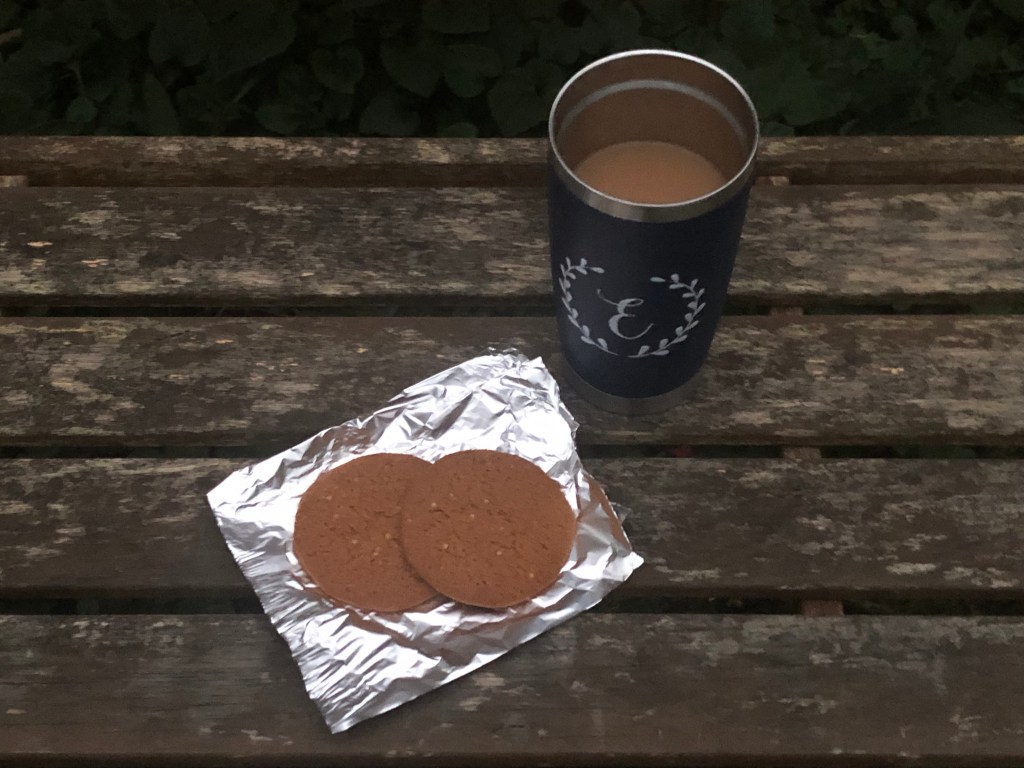
Strong flavours of dark sugar and ginger give these Yorkshire Parkin Biscuits their fantastic kick. The first pack I tried were larger and chewier but these have a brittleness which evokes the feeling of being hardened in fire. The edible equivalent of a dram of whisky, it’s perfect if you’re out in the cold watching fireworks (or trying to shake off a cold indoors): a biscuit to warm the cockles and fire the senses, ideally with a strong cup of tea (Yorkshire Red or Gold).

For the meaning, my thoughts turn naturally to the apostle Peter: an unschooled fisherman who enters the gospel narratives as Simon but receives the name Peter from Jesus (“you are Cephas (Peter), and on this rock I will build my church…”). Peter could be dense as a rock at times and headstrong, but his are the faults of the whole- not the half-hearted follower. We see this in his exchange with his master at the Last Supper, where he refuses to allow him to wash his feet. “Unless you let me wash your feet, you have no part with Me,” Jesus tells him. “Then Lord,” Peter exclaims, “not just my feet but my hands and head as well!”

Peter thought his commitment to Jesus was rock solid, which is why what happened later that evening would shake him to the core. Despite all of his protestations of being ready to die for his friend and rabbi who he believed to be the Messiah, he disowned him in the space of a few minutes in the courtyard of the house where Jesus was taken for questioning after his arrest in the Garden of Gethsemane. Three times he denied that he had had any association with his master to ward off the awkward questions of a servant girl as he was warming his hands by a fire. Before this point it seems he’d forgotten Jesus’s own prediction that Peter would disown him, until the third time his denial rang out and Jesus turned and looked him in the eye.

In the bleak hours he must have spent contemplating his sorry betrayal, did Peter remember Jesus’s words to him earlier that same evening: “Simon, Simon, Satan has asked to sift each of you like wheat. But I have prayed for you, Simon, that your faith will not fail. And when you have turned back, strengthen your brothers…” Jesus seems to have found it easier to forgive his friend than Peter would find it easy to forgive himself. Before he’d even turned away, he had laid out a path for Peter to return and when after his death and resurrection they met again, he deliberately offered Peter the chance to overwrite his story of betrayal with one of re-commitment, creating three opportunities for him to publicly affirm his commitment to him over the flames of another fire.

Why did the gospel writers record this instance of Peter’s weakness instead of glossing over it? Not for the pleasure Satan sought, of cutting him down to size. God knows our littleness, the very worst of which we are capable, and still calls us into the best he wants to build with, and in, us. Which is why Peter’s story, in the end, led him to abandon any illusions about his own strength and put his trust in another’s. David’s prayer might have found an echo in his own heart in the joy of his return and restoration: “Lead me to the rock that is higher than I.”

Further Delectation

More about the origins of Parkin and the traditions of Bonfire Night for the historians among us.

Your pet not quite themselves this evening? The Pet Classics programme, courtesy of Classic FM, is a wonderful tradition in itself and may help calm them. Callers write in with feedback from every kind of pet imaginable. Who knew Classical Music (or fireworks) had a noticeable effect on stick insects?

And finally, if you can’t get out to a display tonight, a little royal fireworks music to eat your Parkin biscuits with, courtesy of Mr Handel:

If you would like to see more entries more regularly and help keep this bestiary free of ads, you are welcome to contribute to the Biscuit Jar.

The Jaffa Cake

I write this sitting in the attic of the London Library, listening to a very young and a very old scholar talking, watching the sun following the rain, the rain following the sun, and thinking about Jaffa Cakes (as one does). It’s the layer of orange jelly sandwiched between the sponge base and chocolate covering that gives the Jaffa Cake its name, recalling the sweetness of Jaffa Oranges. I’ve waited a long time to write about the Jaffa Cake, a staple of the McVitie’s range for almost a century. These days they come in boxes of 10 (I read somewhere they used to be 12, another casualty of the metric system?) and I have 7 left in this…

I think Jaffa Cakes go best with the citrus notes of a Lady Grey tea but I’ve paired mine with a Pret filter coffee (at just 49p with a re-useable cup, it has to be the cheapest coffee in London). The more astute among my readers will have noticed the word cake where biscuit is wont to be… The question of whether the Jaffa Cake is really a cake or a biscuit has never been settled to complete satisfaction and was the subject of a somewhat divisive marketing campaign this summer, the fruit of which can be seen on the billboard below:

‘The clue is on the box’ McVitie’s tell us in an attempt to shut down any arguments to the contrary but despite being labelled as a cake on the packaging, you’ll invariably find all the Jaffa Cakes hanging out with the biscuits in the supermarket aisles…

If you take an interest in biscuit trivia, you may remember the infamous 1991 Tribunal which overturned HM Customs and Excise’s ruling that the Jaffa Cake should be classed as a biscuit for tax purposes. Noting that there is now no generally accepted definition of either a cake or a biscuit, Mr Potter QC listed a number of ways in which the Jaffa resembles both, however the evidence which finally led to its being ruled a cake was its tendency to harden over time (stale biscuits get softer apparently). McVitie’s actually baked a giant Jaffa Cake to prove it.

Given this is a Biscuit Bestiary, you might expect to find me arguing for the Jaffa Cake’s re-classification as a biscuit, but I’d like to propose a more radical solution: what if it’s both at the same time? For in my mind, the dilemma posed by the Jaffa Cake in modern philosophy bears some resemblance to that of the early church grappling with the theology of the incarnation, the doctrine at the heart of the faith expressed in the Nicene Creed:

We believe in one Lord, Jesus Christ, the only Son of God, eternally begotten of the Father, God from God, Light from Light, true God from true God, begotten, not made, of one Being with the Father…

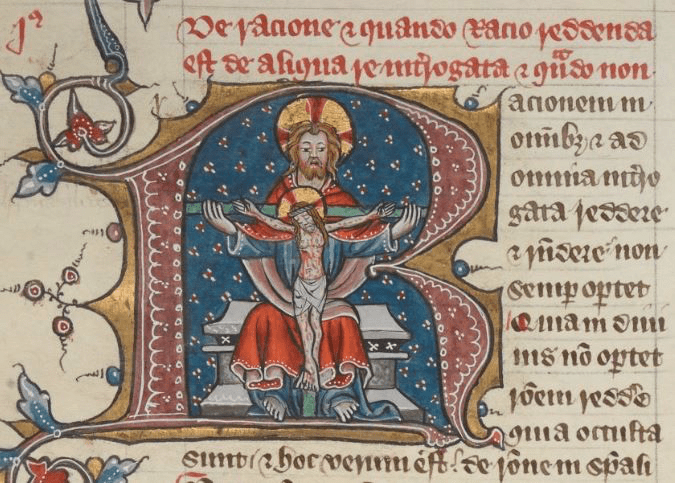
As a twelve year old attending an Anglican church that repeated the creed in its communion liturgy most weeks, I couldn’t understand the need for all these words, especially this bit. But what seems an incontrovertibly fixed doctrine to the majority of Christians today was once contested by the Arians and Docetists of the fourth century, or as I like to think of them the Exclusively-Cake and Exclusively-Biscuit camps of late antiquity. Neither camp could accept the orthodox position that Christ shared both a human and divine nature fully. The Arians emphasised the humanity of Christ at the expense of his deity (more Biscuit than Cake) and the Docetists his deity at the expense of his humanity (more Cake than Biscuit).

Historiated initial from BL Royal MS 6 E Vii2 502v

There’s a mystery to the incarnation, just as there’s a mystery to the Trinity. One evoked with the greatest poetry perhaps in the beginning of John’s gospel where the Word pitches his tent among us and the greatest warmth in St. Paul’s letter to the Hebrews, where he writes that ‘the one who makes people holy and those who are made holy are of the same family’. I won’t spend a lot of time charting the ups and downs of the Council of Nicaea, or Athanasius who bravely stood his ground contra mundum (against the world) and flipped the tables on the Gnostics by arguing that Christ sanctified the body by being in it, but rather the beauty of the second person of God coming in flesh and blood to reveal the heart of the first to us.

And here we get to the moral of the extraordinary substance of the Jaffa Cake: just as those who persist in seeing it solely as a cake struggle to encounter it in the biscuit aisle, so those who refuse to see it as anything other than a biscuit will struggle to accept the evidence of their senses on biting into its aerated sponge. An appreciation of both together allow for the richest paradox and fullest picture. So the next time someone tries to corner you on whether it’s a Cake or a Biscuit, ask them why it can’t be both at the same time?

Further Reflection

The simplest explanation I can find of the whole Biscuit-Cake court case for those who have never heard of a Jaffa Cake and are unfamiliar with British tax law. Professor Tim Crane, who discusses the philosophical conundrum of the Jaffa Cake publicly in a number of places, posts a link to the analysis of Mr Potter QC on his website here. And here’s footage of the largest Jaffa Cake since records began (maximus in mundo?) courtesy of Radio 4’s Philosophers’ Arms, Bake-Off’s Frances Quinn, the Team at Hambleton Bakery, and the Guinness Book of Records:

Lastly, and more importantly, it wouldn’t be right to let mention of Jaffa oranges pass without remembering the sadness of much that’s happened in and around Israel and the Middle East this last year. May the year to come see the first fruits towards healing and the establishment of God’s peace in the region, the only peace that is the true and deep and lasting kind.

If you would like to see more entries more regularly and help keep this bestiary free of ads, you are welcome to contribute to the Biscuit Jar.
Party Rings

Party Rings. Ring-shaped, icing glazed in colourful stripes on brittle dry shortcake biscuits. Eaten en masse at children’s parties and not many places else although I did come across a mini packet of them in Piccadilly yesterday. These mini rings are a new development on the maxi ones first circulated by Fox’s Biscuits in the 1980s. It had been years since I’d seen one much less eaten one so they seemed blander looking to me. I’d remembered the icing stripes and colours then had a much lairier 80s vibe…

A little research on the internet took me to the art hub of Hwa Young Jung, a photographer in Manchester with a sideline in rather charming biscuit illustrations. As she had a fascinating chronicle of the transformation of the Party Ring I knew nothing about, I quote here directly from her on her flickr stream because it’s the most comprehensive history I’ve come across:

Party rings were a product of the 1980s fashion for the newly developed chemical food dye system that enabled more lavish colours to be incorporated into the manufacture of biscuits. This made them a very popular choice for children's parties, where not only could the colours amuse, but the holes in the middle enabled them to be placed on a finger, often resulting in "ring races". These involved each child taking five rings and placing one on each finger of a hand. They would then proceed to eat them as fast as possible, with the inevitable danger of biting a finger a bit too hard. The crisp, hard sheen on the icing is because of the use of carob bean gum — the carob, or locust bean, is also sometimes used as a chocolate substitute.
Because of the demographic popularity of the product, most "party ring children" are now of university age, and many universities have societies to appreciate such confectionery items. These societies came to notoriety in 1999 when Fox's Biscuits changed the packaging of party rings, causing petitions, heavy leafleting campaigns and a sit-in outside their production plant in Batley, West Yorkshire. A standard pack of party rings consists of a long plastic tray containing five biscuit wells, each holding four biscuits of the same pattern, making twenty biscuits per pack. Fox's decided to remove the purple/yellow biscuit because the dyes used had been linked to certain health problems. Instead of replacing them, they removed them completely, leaving only sixteen biscuits per pack. Through their determination, the university societies not only managed to have the purple/yellow biscuit reinstated (using newer, safer dyes), but many societies received a letter of apology from the managing director of Fox's Biscuits...

I was at university in this fateful year and can safely say I would never have leafleted Batley or attended a sit-in to protest the changing packaging of the Party Ring, even if I’d known about one. Neither had I any clue the Party Ring – a cheerfully, some would say outrageously, colourful creature of the 80s – should have been issued with a health warning, but clearly one that paled into insignificance alongside the Mad Cow Disease and Salmonella scares.

This history makes more sense of the political manifesto printed on the Party Rings’s packs or the Party Ring Promise as Fox’s call it: no artificial flavours, no artificial colours, no artificial preservatives, tick, tick, tick… And all on a 91 calories budget.

The best take on Party Rings I’ve read so far was an artificial one: a spoof news item about the holy grail of biscuit collectors being a Party Ring without a hole in it. The association of Party Rings with the grail also occurs in this blog about biscuits and parenting, whose Mum-author described them as the holy grail of children’s parties (despite the muted colours apparently toddlers still go wild for them).

The grail reference is a nod to a very medieval tale that took on a life of its own after being set down in unfinished form in Chretien de Troyes’s twelfth-century Arthurian romance, Perceval. The holy grail in his story is a serving dish treated with the sanctity of a relic. In later tradition it became the vessel in which Jesus’s friend Joseph of Arimathea is supposed to have collected drops of Christ’s salvific blood, although this detail doesn’t appear in any of the gospels.

Perceval, the hero of the romance, is a goodhearted but somewhat self-willed and ignorant boy whose first encounter with a party of knights in the remote forest he lives in leads to his mistaking them for angels. When they kindly explain his error, Perceval sets his sights on becoming a knight himself and receives valuable advice from an older knight, Gorneman de Gorhaut, in how to act like one. But whether Gorneman’s advice is faulty or Perceval himself is simply unable to apply it with discernment, it later leads him to make one crucial mistake.

This is a riddle-like, indeed myth-like, part of the story in which Chretien describes the boy’s meeting with a man fishing in a river. Having been invited to stay at the man’s house nearby, Perceval discovers it is a splendid castle. His host turns out to be crippled – grievously wounded in a battle, as Perceval later discovers – and he is known as the Fisher King. During the sumptuous dinner they enjoy a mysterious procession appears with beautiful servants carrying a shining grail and bleeding lance. Perceval is longing to know who is fed from the grail but is too polite to ask. Later on he finds out he made a grave mistake in not doing so when he discusses the experience with his cousin. Here’s a part of their conversation taken from Chretien’s story, translated from the medieval French by Nigel Bryant:

"… And did you see the grail?"
"I saw it clearly."
"Who was holding it?"
"A girl."
"Where did she come from?"
"From a chamber."
"And where did she go?"


"
To another chamber."
"Did anyone go ahead of the grail?"
"Yes."
"Who?"
"Two boys, that's all."
"What were they holding?"
"Candlesticks full of candles."
"And who came after the grail?"
"Another girl."
"Holding what?"
"A little silver trencher."
"Did you ask where they were going?"
"Not a word crossed my lips."
"God help me, so much the worse. What's your name, friend?"
And the boy, who didn't know his name, guessed and said it was Perceval the Welshman - not knowing whether it was true or not. But it was true, though he didn't know it. And hearing this, the girl stood up before him and said bitterly:
"Your name is changed, my friend."
"To what?"
"Perceval the Wretched! Oh, hapless Perceval! What a disaster that you failed to ask all this! You would have healed the good crippled king - he would have regained the use of his limbs and the rule of his land - and you would have profited greatly..."

Many of the lessons that Gorneman teaches Perceval are good and necessary to his maturing physically, emotionally, and spiritually, but in the matter of social conditioning, Perceval’s efforts to adopt courtly manners and not talk too much leads him to abandon one childish instinct that could have benefited the whole kingdom. Because he fears appearing as a fool – a typically adult fear – Perceval never allows himself to question what he sees and hears, being more concerned with blending in and keeping up his public image.

Which takes us back to the Party Rings’ journey away from damaging kinds of artificiality to the natural unselfconscious responses we see in children: “Truly I tell you,” said Jesus to his disciples when he found them jockeying with each other for position: “Unless you change and become like little children you will never enter the kingdom of heaven…”

Perhaps it’s no accident that over time the Grail legend developed in such a way that it was the knights who cherished this childlike purity of heart who came nearest to achieving the Quest, which is in essence the search for wholeness and healing. Here’s one of my favourite re-imaginings of the story by Terry Gilliam in which the king’s wound is healed through the actions of a childlike ‘fool’, movingly told here by the late great Robin Williams:

I was very willing to give Mr Williams the last word, but two things have happened in the week after writing this post which have given me more material. On Monday I spent a quiet day in the Royal Foundation of St Katharine, which is the nearest place one can find to a forest hermitage in East London, and browsing the library I picked up a book of essays by Simone Weil and my eye chanced on this mention of the Grail:

Not only does the love of God have attention for its substance; the love of our neighbour, which we know to be the same love, is made of this same substance… The capacity to give one’s attention to a sufferer is a very rare and difficult thing; it is almost a miracle; it is a miracle... In the First Legend of the Grail, it is said that the Grail (the miraculous vessel which satisfies all hunger by by virtue of the consecrated host) belongs to the first comer who asks the guardian of the vessel, a king three-quarters paralysed by the most painful wound: “what are you going through?”

It’s a good question.

The second, most unexpected, thing was opening one of the later packets of Party Rings in a tea and biscuit break this afternoon and actually finding the ‘Holy Grail’ in with it – or a Holy Grail; Here’s the evidence for any doubting Thomases:

Naturally I headed down to the kitchen to show G. – who confessed herself underwhelmed by the miracle – but it certainly cheered me up on an otherwise rather gloomy day, which I think must have been the divine intention. And if a bumbling biscuit-lover like me can discover the grail without searching for it, anyone can… So I leave you on this even higher note and with the hope that whatever healing and wholeness you’re seeking, you’ll hit upon the right question – or even just the right packet – to reveal it.

Further Delectation

Fancy reading more? The story of Perceval and its medieval continuations can be found in Nigel Bryant’s The Complete Story of the Grail (2015) published by Boydell and Brewer.

Make your own Party Rings (recipe courtesy of Prue Leith from the Great British Bake-off).

For those new to Arthurian legend: the Frequently Asked Questions on Rochester University’s Camelot Project may be helpful. The project offers an accessible compendium of Arthurian fiction’s fantastic facts including this short history of superlative Grail knight, Sir Galahad.

One Ring to rule them all? C S Lewis’s excellent essay on youth, parties and power, The Inner Ring (1944) – just as relevant today as it ever was.

Feast your eyes on these beautiful illustrations from the grail quest stories from some of the Arthurian manuscripts at the British Library, of which this early fourteenth century image from BL MS Royal 14 E. iii, f. 86r is one:

If you would like to see more entries more regularly and help keep this bestiary free of ads, you are welcome to contribute to the Biscuit Jar.
S’mores

Pentecost, like Easter, is a moveable feast, celebrated each year on the Sunday fifty days after Easter. Also called Whitsun in England, it was more of a fixture in the Middle Ages than now being one of three major Church festivals that necessitated a week off along with Christmas and Easter (and the reason for the late May bank holiday next Monday). The feast celebrates the coming of the Holy Spirit after Jesus resurrection and ascension: a gift his disciples had to wait for (‘tarry for’ in some older translations) and which happened when they were together in Jerusalem celebrating Shavuot, the Festival of Weeks. Try as I might, I have been unable to find a biscuit associated with Pentecost. Not even in Catholic countries although am grateful for Italian friends’ introduction to the wonderful Colomba Pasquale (Easter Dove Cake) which would be admirably suited to a blog about cake but which I would tremble to shoe-horn into a bestiary of biscuits.

If the gentle, peaceable dove is one symbol of the Holy Spirit so too are a rushing wind and dancing flames, or more accurately something that looked like flames to the disciples in the Upper Room that first Pentecost. Luke tells us in the Book of Acts that they saw tongues of fire that came to rest on each of them and gave them the ability to declare the praises of God in unknown languages. It’s not the sort of story that sits comfortably with left-brain thinkers which may be why the Holy Spirit has remained the least known, least understood, and often sadly the least welcome person of the Trinity. The heart has its reasons that reason knows not of wrote Blaise Pascale in the seventeenth century. As a mathematician and scientist, he knew better than most how far reason can take you but it was not reason but an experience of God that convinced him of his presence on the 23rd of November 1654. FIRE, he wrote on a piece of paper he kept close to his heart sewn into the lining of successive coats. God of Abraham, God of Isaac, God of Jacob – not of the philosophers and the learned.

In googling ‘fire’ and ‘biscuits’ I inevitably came across that biscuity campfire treat S’mores, which seems to me a very American thing although apparently there’s a British version you can make with Digestive biscuits rather than Graham’s Crackers. Anyway, you put biscuits, marshmallows and chocolate together in a sandwich and toast them over an open fire like so till the contents become nice and gooey:

This photo is courtesy of Unsplash, although I missed the chance to get some more bespoke pics at my home church on Sunday when S’mores and fire pits were part of the celebrations after the service, confirming my intuition that this could be the nearest thing to a Pentecost biscuit now. The name proved a bit of a mystery till I discovered it is a contraction of ‘Some More’. The first known recipe for them appeared in a Girl Scout Magazine in 1927, although it wasn’t until 1971 that people started abbreviating them to S’mores. Here is a reproduction of that original recipe, courtesy of The Daily Meal:

But is one biscuit ever enough? For me at least, it also recalls the plea of Dickens’ wretched Oliver Twist forced into a state of slow starvation in the Victorian workhouse: ‘Child as he was, he was desperate with hunger, and reckless with misery. He rose from the table; and advancing to the master, basin and spoon in hand, said: somewhat alarmed at his own temerity: ‘Please, sir, I want some more…‘ Temerity indeed as the harsh reaction of Mr Beadle teaches him not to ask for a top-up of the pitiful gruel he and the other orphans are so inadequately fed on.

For the moral of the S’more, and asking for more, I’m still reflecting on one of the beautiful moments in the service last Sunday when one of the pastors of a neighbouring church was moved to read Jesus’s promise to his disciples the night before his death: “I will not leave you as orphans.” As their beloved teacher and hoped-for messiah, they were clearly stricken at the thought of his leaving, but it is then that he promised that God the father would send the Holy Spirit to them: God’s comforting, counselling presence who would in future live in and with them as a foretaste of that fellowship they would enjoy with him forever.

Not orphans and never alone, we can always ask God for more of his spirit knowing he is the most generous of givers. As Jesus puts it in the gospels: if even flawed earthly fathers know how to give good gifts to their children, how much more will our perfect heavenly one give the Holy Spirit to those who ask him?

Further Delectation

Some more on the history of the S’More from The National Geographic.

Some more on the art and history of Pentecost, and a beautiful rendering of an early medieval Latin hymn for Pentecost (with translation) and a rather more modern one by Fernando Ortega.

And if you still want more, here are eight incredible poems for the feast of Pentecost curated by Elizabeth Ross.

And here’s that classic “Please Sir, I Want Some More” scene from the 1968 musical version of Dickens’s Oliver Twist (1838):

If you would like to see more entries more regularly and help keep this bestiary free of ads, you are welcome to contribute to the Biscuit Jar.