Today is Anzac Day, a day I’d never heard of until a few years ago when I shared a house with a New Zealander. ANZAC is an abbreviation of the Australian and New Zealand Army Corps: those Antipodean forces who served together in the First World War’s Gallipoli Campaign in 1915 whose service and sacrifice is remembered on the 25th of April, the anniversary of their landing, along with all Australians and New Zealanders who have died in conflicts since. It’s a public holiday in both countries and one with its own traditions: attending a Dawn service to commemorate the fallen and eating Anzac Biscuits.
ANZAC veterans image from Australia’s Museums Victoria
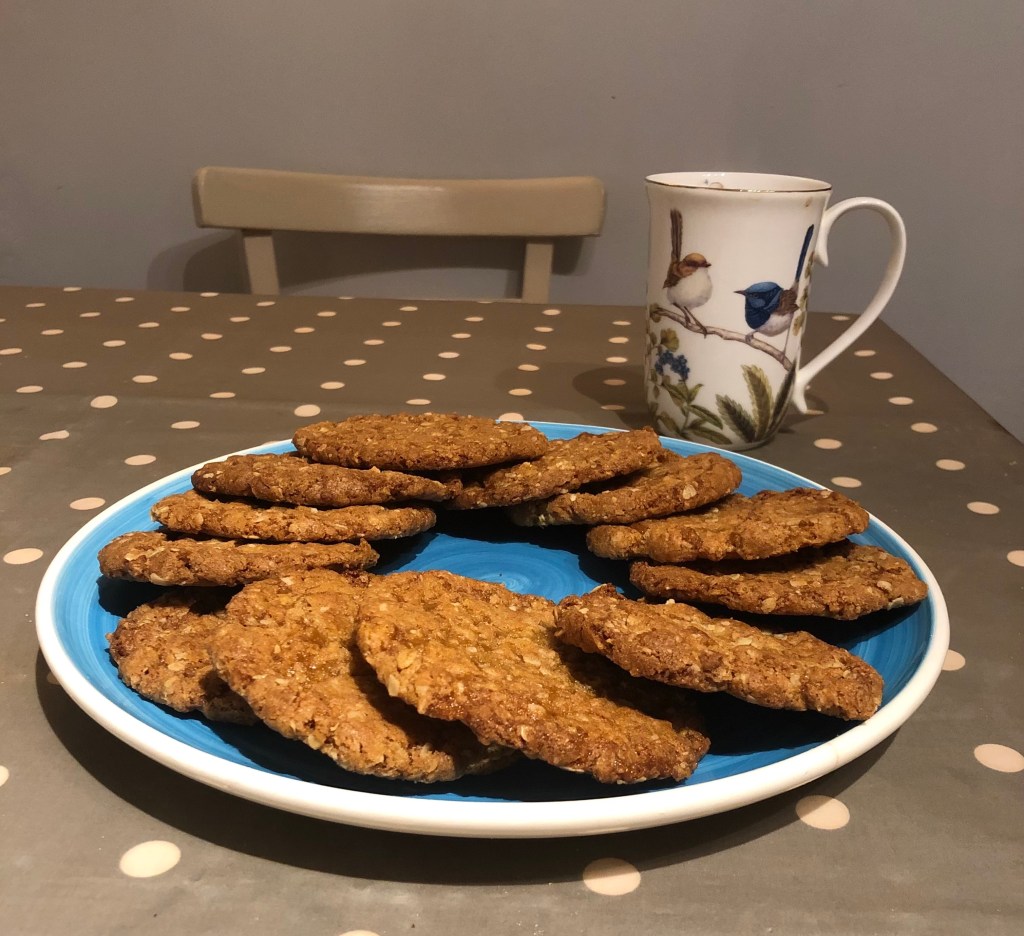
At first I had the bright idea of buying some Anzac Biscuits locally for this entry. My nearest Blackbird Bakery – a bit of a South London legend – used to sell them but somehow between this Anzac Day and the last time I checked they’d decided to remove them from their baking range. So I was left to find the best recipe I could on the internet and have a go at making a few myself — and I’m so glad I did because they were delicious. Besides being a perfect quick-bake, easy-peasy-to-make biscuit. Here’s a photo of the results. (You’ll be pleased to know I restricted myself to two in one sitting.)
According to Australian food-writer Sarah Coates, it’s customary to eat Anzac biscuits with gunfire coffee (coffee with a dash of rum) but as I had no rum on hand and no gunpowder tea either I had some very English tea with mine. The biscuits tasted sweet and pleasantly chewy, something like a glorified flapjack but it’s the addition of the desiccated coconut (just 60g in this Australian Women’s Weekly recipe I found) which gives it that extra something.
It also illustrates just how far the Anzac biscuit has come. As the recipe curators put it:
The Anzac biscuit’s story begins with its sibling, the hardtack biscuit, which was a staple ration for soldiers and sailors during the war. These biscuits were very hard and flavourless, but were eaten as a nutritional substitute for bread. The texture and hardness of the biscuits were so unpalatable that soldiers attempted to turn them into something more edible, doing things like grating them up with water to form a porridge.
Reading about the awful scale of the losses suffered by the ANZAC forces in the First World War, I couldn’t imagine hard biscuits substituted for bread made their lives any easier. But the account of this unenviable fare also reminded me of the promise of Isaiah 30: “The Lord will give you the bread of adversity and the water of affliction, but your Teacher will no longer hide Himself—with your own eyes you will see Him.” Hardship really has a way of revealing certain realities to us when we pay attention: truths about ourselves, about others and about God.
Image of an early Anzac Day Parade, Museums Victoria
Fortunately the history of the Anzac biscuit doesn’t end with makeshift porridge. From these unpalatable beginnings, the story goes, the Antipodean bakers added syrup, oats and coconut to soften and sweeten their hardtack mix. As Sarah Coates writes:
It’s a popular myth that they’re called Anzac biscuits because they were shipped to the ANZAC soldiers during the war. However, while it’s true they travel excellently and don’t contain any ingredients that easily spoil, the name “Anzac biscuits” didn’t meet up with these buttery, oaty cookies until the 1920s. In reality, the biscuits were more often made at home to sell for fundraising, or to serve at fetes and other events held to raise money for the war effort, and it’s this connection between the biscuits and the war that led to the use of the name “Anzacs”.
And the moral? This turning of something hard to swallow into something sweet brought to mind the story of Moses and the Israelites at Marah, a story that follows hard on the heels of their deliverance from Egypt and miraculous crossing through the Red Sea. After three days in the wilderness, they are craving water but when at last they find some they’re unable to drink it because it’s so bitter. In a soon-to-be-familiar pattern, poor Moses bears the brunt of their grumbling and takes the problem to God and God shows him a tree that he can cast into the Waters of Marah – perhaps a piece of bark or foliage to make the waters sweet enough to drink.
It got me thinking about what I do when I feel like I’ve come to a dead end or a bitter place in the flow of my own life. True, the answer might not be as simple as throwing a piece of tree bark into the water (or a handful of coconut into a hardtack biscuit mix) but the principle is the same. Am I tempted to complain or to blame others or give into a narrative of bitterness? Or do I go to God with the challenge – however bitter it feels – and trust him for a way around or through it?
Further Delectation
This handy tool allows you to find the Antipodes relative to your precise location (which, in London, seems to be a spot just off the South Coast of New Zealand in the Pacific Ocean).
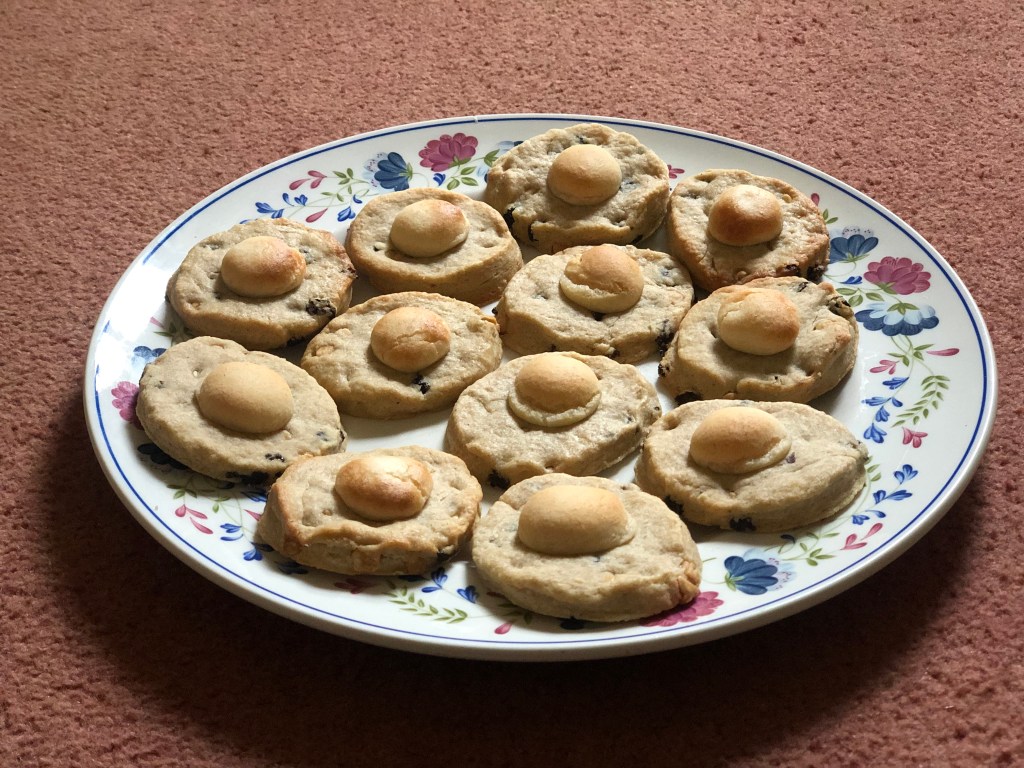
Simnel Cake is traditional in Britain and Ireland for both Easter and Mother’s Day, but it was only recently I discovered that a number of bakers have transmuted its classic flavours into Simnel biscuits. The easiest recipe I could find was this five-ingredient one by Silvana Franco. My dough produced more than a dozen biscuits and though I hadn’t intended it they do look uncommonly like fried eggs. I opted for a handful of chocolate drops and currants in mine as well as a dab of marzipan on top but if you prefer a healthier option you could stick to mixed spice with chopped almonds.
Simnel sounds like a medieval word and it is. Its earliest attested use in the OED is in Havelok the Dane in c. 1300 to mean a high-class cake or bun. The true history of the cake is harder to come by but time-honoured traditional recipes are linked to Bury, Shropshire and Devizes. I took inspiration from another baking blog in adding marzipan to each biscuit as a nod to the Simnel Cake’s decoration with eleven marzipan balls representing the twelve apostles minus Judas (or twelve if you add one in the middle for Jesus).
The Last Supper by Ugolino da Siena (c.1325) from the Met Museum. With just 12 marzipan halos…
Tonight’s the night we mark Maundy Thursday in the Western Church’s Calendar: the story of Jesus’s celebration of the Last Supper with his disciples followed by his vigil, betrayal, and arrest in the Garden of Gethsemane. The fullest account of that meal – which was no ordinary meal but the Jewish festival of Passover – and everything that followed it, can be found in the Book of John but it’s mentioned in all four of the gospels. At home I have a print of a beautiful painting by Charlotte Ashenden of the moment that Jesus offers a piece of bread to Judas (and in so doing identifies his betrayer) with verses from Matthew and John curled beneath it. It’s one of the most dramatic moments in the story before Judas departs into the night.
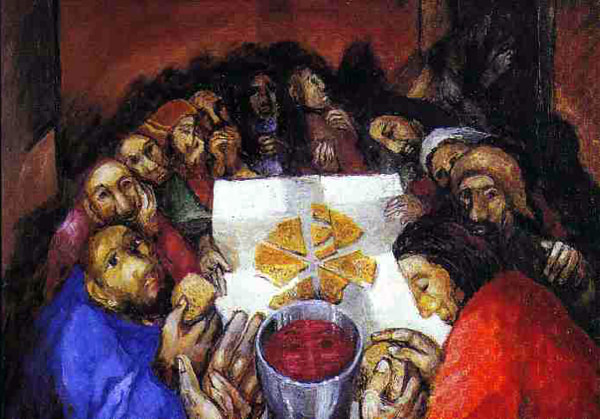
The Last Supper, by Sieger Koder (1925-2015)
As the story of the evening unfolds, John tells us that Jesus knew that the hour had come for him to leave this world and go to the Father. Having loved his own who were in the world, he loved them to the end. It’s that quality of loving to the end that was shown so abundantly in every act of his life and never more so than in Holy Week, the week of his Passion. He loved John, the beloved disciple, but he also loved Judas. Through disappointment, betrayal, rejection, condemnation, torture and death he loved unwaveringly, whether they showed themselves to be his enemies or his friends.
All are Welcome, by Sieger Koder
As Christians we’re called to love like Christ and yet without his life in us it is impossible. It humbles us – and it should humble us – that anyone could love like that in the face of every human provocation not to. “A new commandment I give to you,” Jesus taught them that evening, that you love one another as I have loved you. By this shall all men know you are my disciples.“
Further Reflection
Fernando Ortega’s moving meditation on Jesus’ vigil in the Garden of Gethsemane:
If you would like to see more entries more regularly and help keep this bestiary free of ads, you are welcome to contribute to the Biscuit Jar.
Cin Cin to the Chin Chin! This month I’m inviting readers to raise a glass to this popular West African biscuit. You can buy Chin Chin by the tub here in Peckham but I was lucky enough to sample some homemade ones gifted to guests at a friend’s church. These are a Nigerian recipe and these Chin Chin taste like small crunchy deep fried doughnuts. You can also find them in Ghana (which has its own savoury version), Togo, Benin, and Cameroon. Here’s a close-up of some imported from a local African store:
…and a close-up of the homemade ones, well suited for eating by the handful as a party snack:
And some other, slightly more rounded, Chin Chin that Immanuel from my church brought me on learning I was a fan. These have travelled all the way from Cameroon!
As the Bestiary’s first African biscuit, the Chin Chin prompted me to do some research on the history of Africa in the medieval period which some readers may not know is home to one of the world’s oldest churches. The Ethiopian Orthodox Church pre-dates the age of European colonisation and developed independently of Europe’s church after the Council of Chalcedon of 451, retaining closer links with Judaism. I knew very little about this fascinating branch of ecclesial history until I did some reading on it. My favourite discovery was Ethiopia’s Church Forests (proof that somewhere in the world the holy hermits in forests beloved of medieval chivalric fiction are alive and well). When Catholic travellers journeyed to Africa in the later medieval period, they did not – as they had hoped – find that great king of Christian legend, Prester John, but an ancient faith tradition with deep roots of its own.
Ethiopian icon of the Last Supper (artist unknown)
West Africa in the Middle Ages was a constantly changing tapestry of kingdoms and empires that had become extremely prosperous culturally and economically, viz. Mali, Benin (now in modern Nigeria) and Ife. These mainly practised African traditional religion or Islam (as in the case of Mali’s most famous king Mansa Musa) and formed into city-states governed by monarchies or mercantile republics whose independent fortunes rose and fell, either through conquering or ceding power to one another or by being colonised by European powers in later centuries. The Portuguese explorers believed to be the first Europeans to see the city of Edo or Benin in the fifteenth century thought it one of the most impressive cities of the world in its day, built on a fractal design in the middle of the West African Forest, lit by palm-oil street lamps by night and protected by a wall four times longer than the Great Wall of China.
From the Benin Bronzes (part of a collection held in the British Museum)
While the Chin Chin post-date these medieval kingdoms by a few hundred years Michael Lawanson, proprietor of Mikey’s Gourmet Chin Chin, explains how Nigeria’s beloved biscuit snack first originated with the Saro people: the descendants of freed slaves who began returning from Sierra Leone in the 1830s after Britain’s passing of the Slave Trade Act in 1807 and the British Navy’s attempts to enforce it. The Saro thrived in their new (old) home and added their own traditions into Yoruba culture, of which Chin Chin is one. Originally served as a symbol of sophistication at high society gatherings in Lagos,” Lawanson writes, chin-chin swiftly transcended its elitist origins, becoming an accessible delight for people across all social classes. Street vendors in Lagos capitalised on its popularity, frying up batches of this delectable snack to cater to locals, workers, and schoolchildren. And if you’re wondering how the name Chin Chin came about, it has nothing to do with the popular Italian toast but the crunching noise they make when you bite into them.
Being roughly a finger-tip in size, the Chin Chin are the smallest biscuits I’ve profiled on the Bestiary so far but also some of the tastiest – I can see why they’re so popular as a party food. For the moral, I wondered about Zechariah’s Who Hath Despised the Day of Small Things? Charles Haddon Spurgeon has a beautiful passage on this in one of his sermons:
“…it is usually God’s way to begin his great works with small things. We see it every day, for the first dawn of light is but feeble, and yet by-and-by it grows into the full noontide heat and glory. We know how the early spring comes with its buds of promise, but it takes some time before we get to the beauties of summer or the wealth of autumn. How tiny often is the seed that is sown in the garden, yet out of it there comes the lovely flower! How small is the acorn, but how great is the oak that grows up from it! The stream commences with but a gentle rivulet, but it flows on till it becomes a brook, and anon a river, — perhaps a mighty Amazon, ere its course is run.”
In the same way, this little tub of Chin Chin has led me on a journey of discovery I would never have anticipated when they first appeared on the kitchen table.
More on the history of Chin Chin from Michael Lawanson (and there are numerous recipes for homemade Chin Chin on the internet if you fancy having a go at making them yourself).
If you would like to see more entries more regularly and help keep this bestiary free of ads, you are welcome to contribute to the Biscuit Jar.
Morning, all. Today is popularly known as Blue Monday: a day popularly regarded as the most depressing day of the year although if you google the rationale for that you’ll find it’s just as popularly debunked as an advertising gimmick from the early 2000s. Whether justified or not, it’s fair to say that the idea has taken hold in the public imagination prompting a plethora of more or less helpful social media posts on the subject of depression and this rather esoteric one on the Blue Riband.
I’d forgotten all about the Blue Riband’s existence until December when a colleague drew parallels between it and a Slovakian biscuit she’d come across. I mentally dated the brand to the late 1980s (when I might have last eaten one) but it turned out to be a lot more venerable than I’d thought. It was Scottish biscuit giant Gray Dunn who began producing these biscuits in 1936 although sadly the Glasgow-based factory was forced to close in 2017. At 92 calories per bar, the Blue Riband is admittedly a light bite with what feels like a much thinner wrap-around of chocolate than either a Penguin or a Club Biscuit but an ambitious four layers of wafer underneath it. More than the milk chocolate, it’s the wafer which makes a bid for your taste buds.
The term Riband is an old fashioned word for ribbon: a very medieval spelling dating back to the mid fifteenth century, at least in the Oxford English Dictionary’s first attested use. The term Blue Riband also has the specialist sense, popular in the 1930s, of a metaphorical prize ribbon awarded to the liner capable of making the fastest crossing of the Atlantic from New York to Southampton. I suspect this is the original inspiration for its name but it was in use more generally before this to mean a mark of quality; this is where the notion of Cordon Bleu cooking is from, a reference to France’s chivalric order of the Holy Spirit whose knights were known as Les Cordons Bleus because of their light blue ribbons and whose banquets were said to offer exceptionally top nosh.
However, Bestiary readers might be interested to know that the Blue Riband has a claim to being one – maybe even the only – biscuit whose name is mentioned, albeit indirectly, in the King James Bible: “Speak unto the children of Israel, and bid them that they make them fringes in the borders of their garments throughout their generations, and that they put upon the fringe of the borders a ribband of blue,” God tells Moses in the Book of Numbers, a practice still observed by religious Jews today in the weaving and knotting of blue threads into talits or prayer shawls. “And it shall be unto you for a fringe, that ye may look upon it, and remember all the commandments of the Lord, and do them…” (Numbers 15).
Detail from the Codex Rossianus, c.1453
Why blue specifically? The short answer is because God said so… The speculative one opens out a lovely fan of references to this particular colour in scripture which suggests that if he has a favourite colour it might well be this one. When Moses, Aaron, and representatives of the twelve tribes meet with God on the top of Mount Sinai, we are told that “under his feet was something like a pavement made of lapis lazuli, as bright blue as the sky,” the likeness of a throne of lapis lazuli is mentioned in the revelation of God’s glory in Ezekiel, and the robe of the High Priest was made of blue cloth woven in one piece. A special shade of blue called tekhelet was used in the decoration of the temple and tabernacle as well as for the threads on the talits. It would have taken effort and expense to produce high quality blue dyes in the ancient world and in some sense that was part of the point: holiness for humans, meaning consecration or set-apartness for God, being something both costly and beautiful. As Chabad.orgexplains, the use of this specific blue for the prayer shawls was a mark of nobility, reminding the wearers of their place in God’s kingdom of priests.
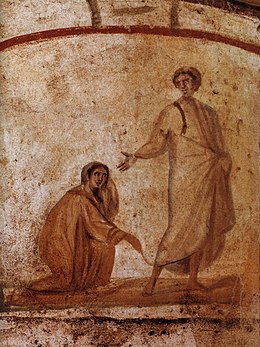
The fringe or the hem of the garment where the tassels were was an important part of the wearer’s identity, even authority in the ancient world. Knowing this casts more light on the episode of David cutting off the corner of King Saul’s garment (and his remorse afterwards). Blue tassels or tzitzit were part of the garments worn by Jews in Jesus’s day. One of the most moving stories in the gospels is the healing of a sick, socially outcast woman who reaches out through the press of the crowd to touch the hem of Jesus’s garment. “For she said to herself, ‘If only I may touch his garment, I shall be made well’…” (Matthew 9:21)
Image from a 4th century wall painting from the Catacombs of Marcellinus and Peter, near Rome.
As a colour in the Middle Ages, blue has a whole range of literary associations of which my favourite is constancy or steadfastness. This is not so surprising if you consider it is also the colour of the sky and sea (on a good day) both of which remind us of immensity and eternity. Blue or sometimes blue-toned teal frequently features in cross-cultural surveys as the world’s most popular colour, which suggests it appeals to something deep within the human spirit. Maybe we’re drawn to blue out of a heavenly homing instinct? “He has set eternity in the human heart,” writes the author of Ecclesiastes, no stranger to every kind of blueness. “Yet no-one can fathom what God has done from beginning to end.”
Wester Ross, Scotland. Photo credit: Annie Ede
Drawing all these threads together I hope, like me, you will think a little differently about the Blue Riband, and wish you all a tekhelet-toned Monday full of the deep consolations of God.
Further Delectation
Blue Monday or Brew Monday? Here’s a little piece from the Samaritans dispelling the myth of Blue Monday and encouraging us all to reach out and connect over a cuppa.
My friend Katka appeared on the doorstep early in Advent with a tub of homemade cookies and these rather impressive looking gift biscuits. I saw the tin and thought you might like it for your biscuit blog she texted me with a winking emoji 😉 and she was right. The makers of this particular brand, Amaretti Virginia, have been baking biscuits since the 1860s and are now a household name in Italy and all over the world. Virginia are famous for their soft Amaretti, ‘morbidi’ in Italian, although they also make the crunchier, drier ‘secchi’ too. Both types of classic Amaretti are included in this selection along with Baci di Dama and mini Cantucci.
I’ve always thought of Amaretti as sweet coffee or dessert biscuits so it was a surprise to find that the name means ‘little bitter things’ and derives from amaro, the Italian word for bitter. This is apparently because of the bitter almonds or apricot kernels originally used as a base but if you sampled them without knowing what the name means you’d never guess. The sugar and almond content is so high the soft Amaretti in particular taste like marzipan which gives them a distinctly Christmassy vibe.
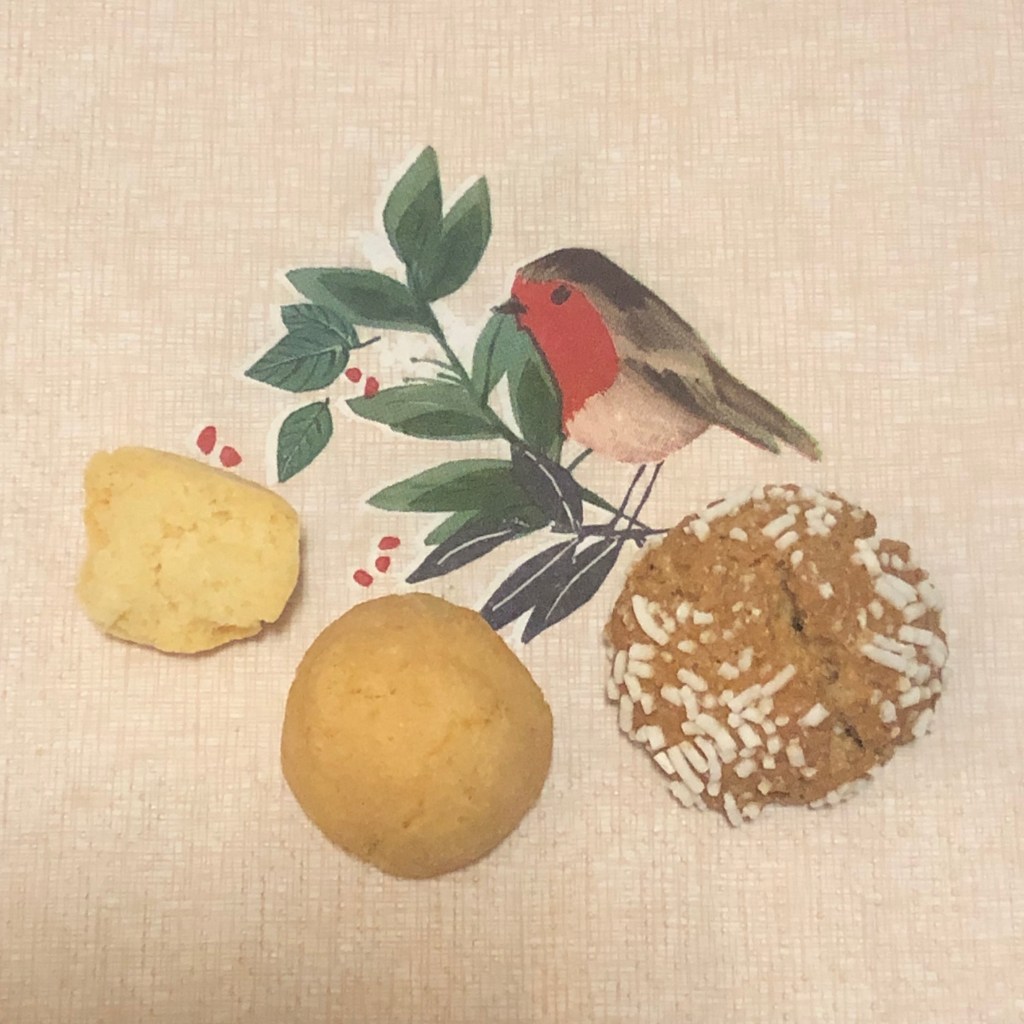
I certainly appreciated the Amaretti travelling to North Yorkshire this Thursday when the train service was subject to cancellations and delays as a result of Storm Pia. After a number of unplanned dramas at Kings Cross (including managing to lose one bag of presents in the crowded station for twenty minutes before recovering it), I eventually arrived in Leeds on a jam-packed service three hours later than planned and without a cup of tea or anything substantial in the way of lunch. But I can honestly say that I spent the journey contentedly, listening to Jonathan Ogden’s music and nibbling on the Amaretti I had stowed away in my hand luggage. Here they are arranged to best advantage on one of the Christmas napkins I’d also brought with me (morbidi on the left and crunchier secchi to the right).
One of my happiest memories of 2023 was making a retreat to a remote part of South Wales, what the old Celtic Christians would have called a thin place due to the amount of prayer that’s gone up here. I went looking for God in the stillness and found him in conversations with various people who crossed my path in the course of the week. One particular chat I keep coming back to was with a lovely Christian father from the Antipodes visiting with his family. Unbeknown to him, he was offering a masterclass in how to deal with disruptions and re-routings. I had heard that their car had developed serious problems on the journey to the retreat place which had left them all stranded in the middle of nowhere for several hours but when he talked about the experience he was full of thankfulness to God for having got them safely to their destination in spite of all the difficulties. “We didn’t even think to pray,” he told me, “but at every point we needed it help just… appeared. We were looked after every step of the way.”
Carningli (Mound of Angels), Pembrokeshire
He kept returning again and again to this theme of the goodness of God as the bedrock of the universe, not denying the pain that is also part of the human experience but focusing on the one who comes to bring us life in all its fullness – the God who is not the author of evil and is always working to bless, heal, encourage and restore. I knew this in my head, of course, but hearing this young Australian father speak so warmly about that goodness made me wonder how much I had allowed that knowledge to permeate my heart.
“Give thanks to the Lord for he is good His love endures forever…”
Psalm 136
The Psalms are full of declarations of God’s goodness. Not only because it is true but because keeping this fact continually before us actually helps us perceive more of that goodness. I got the chance to practice looking for it in the minuscule and very first world challenges of this week: to see it in the kindness of the station staff, the good humour of fellow passengers, the recovery of my lost luggage and the provision of a seat despite the train being so crowded, in the texts from concerned family and friends who remembered that I was travelling, and of course the Amaretti in my bag… Like the sweet tasting biscuits originally made from bitter ingredients, it’s all a question of where you put your focus.
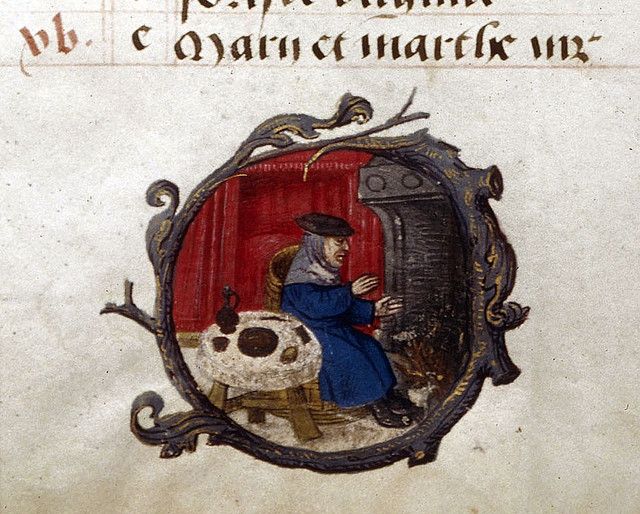
It also helps to remember that God is not only the ultimate source of all the goodness we see in the world, there’s also so much good he wants to do in it through us. And there are those who need to see God’s goodness at work in this world especially this year. As the season of goodwill, Christmas provides plenty of opportunities for making others’ lives brighter and better, whether giving time or money where it’s most needed or literally or metaphorically drawing together around a warm fire.
Illustration from a Book of Hours, Latin Belgium c. 1500-1550.
Wherever and however you are spending Christmas this year, I hope your Christmas is a good one. And whatever joys and challenges come your way in 2024, may you know the goodness of God in greater measure.
Further Delectation
Want to have a go at making your own soft Amaretti? I’ve not tried it but Gino D’Acampo’s recipe looks fairly easy.
Angela Ward’s podcast, A Beautiful Thing. Angela has been doing an Advent series on women in the genealogy of Jesus which is well worth a listen.
Finally, a bit of Yorkshire-style Christmas cheer from the wonderful Kate Rusby:
If you would like to see more entries more regularly and help keep this bestiary free of ads, you are welcome to contribute to the Biscuit Jar.
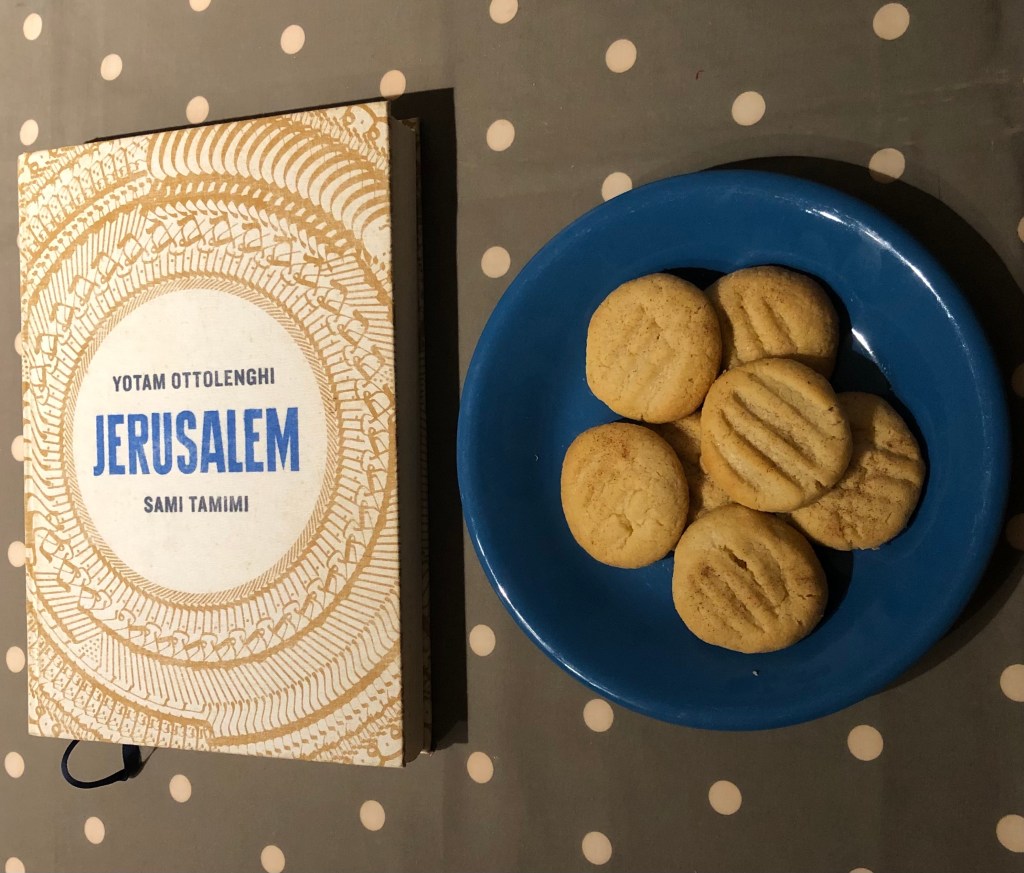
The kitchen of the house I’m living in has many reminders of Jerusalem, from the verses of Psalm 122 on the fridge in Hebrew, Arabic and English to the pottery on the windowsill to the beautiful recipe book of Jewish-Israeli chef Yotam Ottolenghi and Arab-Israeli Sami Tamimi inspired by the love of their home city. With the news so full of the conflict in the Middle East right now, my attention was drawn to the pictures of Jerusalem in happier times. One of the recipes in the book is for Tahini Cookies so I decided I’d have a go at making some…
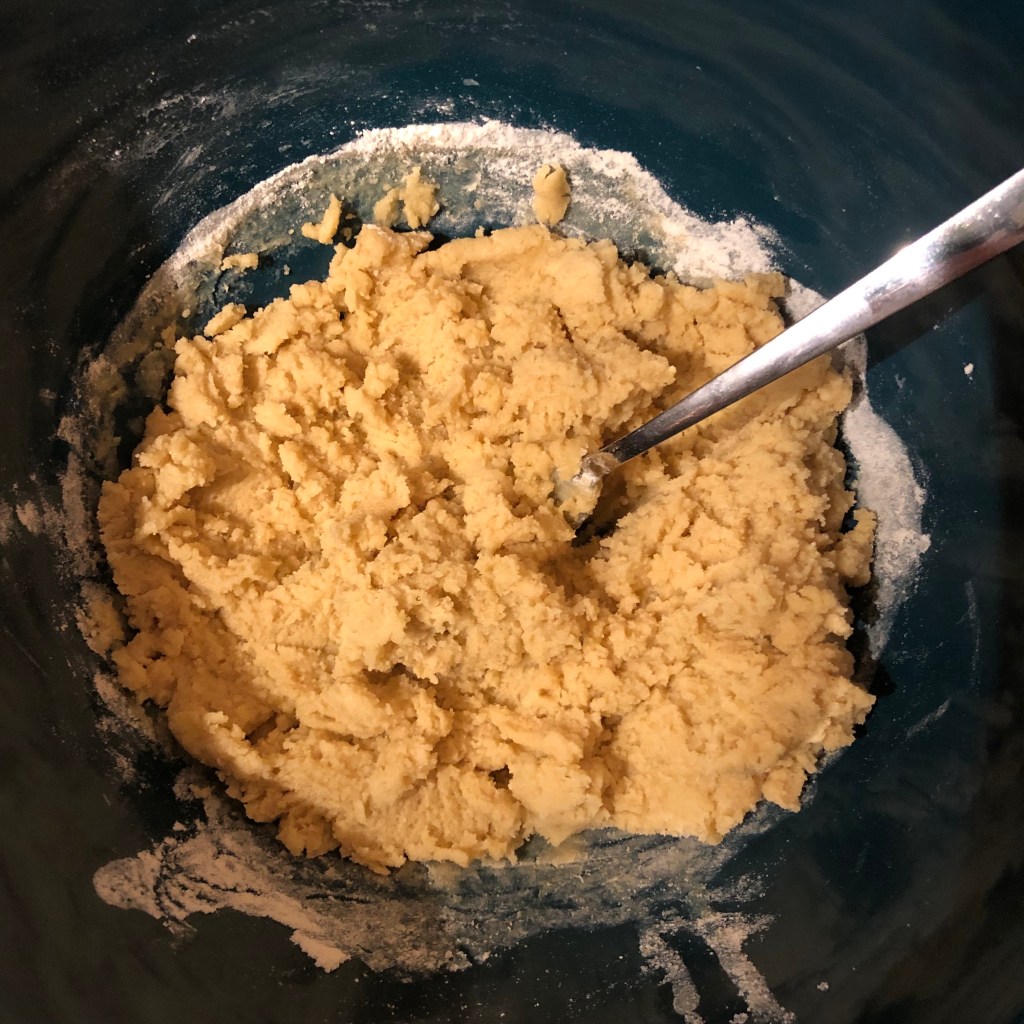
Tahini is a staple of Middle Eastern cooking: a paste or condiment made from toasted ground sesame seeds which is used in salads and savoury dishes as well as popular sweet treats like halva. Taste-wise, you won’t believe it’s not peanut butter and if you like peanut butter you’ll enjoy these. I made the dough without a food mixer and baked my cookies for a little less time than suggested after the first batch turned golden in ten minutes but followed the recipe to the letter in all other respects. The recipe makes about 35 biscuits altogether which sounds a lot but they were so tasty they had all gone to good homes within three days of making them. The finish is simple: a gentle fork pressing and a light dusting of cinnamon. Their soft texture combined with the peanutty flavour was rather special. A taste of one of the many flavours of Jerusalem.
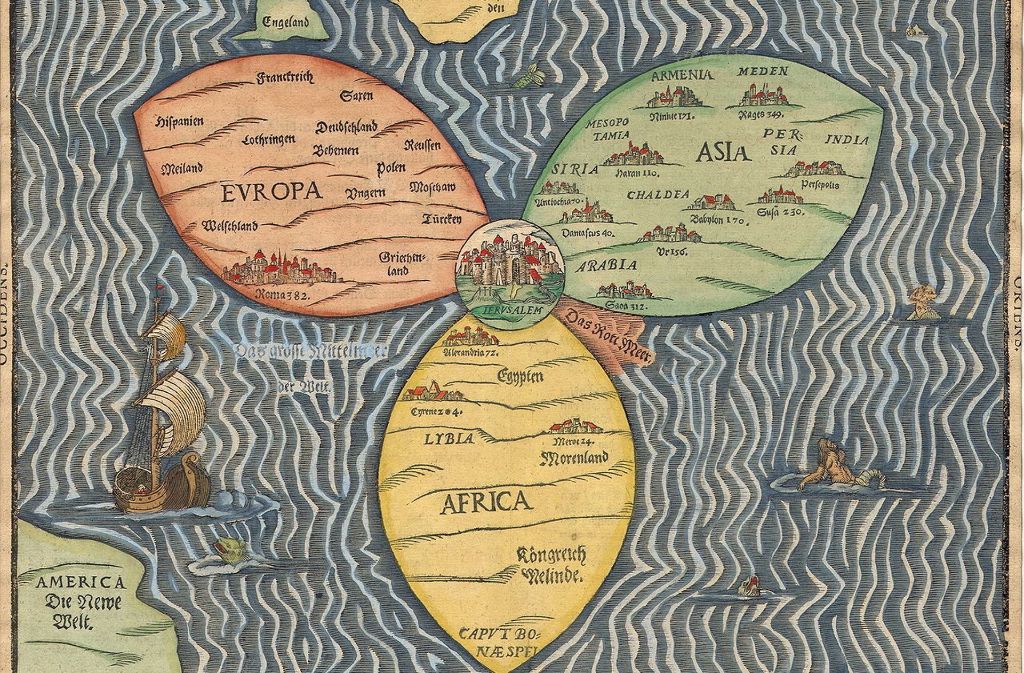
The cookies served as yet another reminder of that famous exhortation from Psalm 122 – the one up on the kitchen fridge – to pray for the peace of Jerusalem, the only city in which God says he will put his name and the only city we are called to pray for by name in the bible. The prophet Ezekiel, one of the exiles in Babylon, talks of God setting Jerusalem at the centre of the nations. Medieval Christians in Europe – who had a long, and not so admirable, history of ruling or attempting to capture the city during the Crusades – also recognised its importance as the spiritual capital of the world when they put it at the centre of their maps instead of Rome or Avignon or Constantinople. Here’s one example from the Hereford Mappa Mundi (c. 1300) where Jerusalem is depicted as a literal hub of the entire world, flanked by an image of the crucified Christ. It was also thought to be the place where Abraham offered to sacrifice Isaac and where God averted the plague in David’s time, after which it became the place the Jewish people went up to seek God: a place of longing and pilgrimage, as it still is today for many people, and as it is in Psalm 122 – a song of ascent.
Hereford Mappa Mundi (detail)
The name Jerusalemitself has a meaning to do with peace and this means peace in the fullest sense of the word in the Hebrew, encompassing a sense of wholeness, restoration and well-being, not simply the absence of tension and warfare. This may seem a bitter irony given the current state of affairs in the Middle East but in another way it is not so surprising. Both the Tanakh (the Old Testament) and the New Testament are clear that we live in a spiritual battle zone and our battle is not against flesh and blood but ‘against principalities, against powers, against the rulers of the darkness of this age and against spiritual wickedness in high places’. If Jerusalem has a special place in God’s heart, little wonder this piece of divine real estate is so contested for it is both the microcosm and measure of this greater conflict we pray for an end to every time we pray the Lord’s prayer, which asks that God’s will be done on earth as it is in heaven and that we be delivered from evil. And in praying for the peace of Jerusalem, we must not be naïve about evil. The evil we saw unmasked on the 7th of October is very real and the way we respond to it matters.
Jerusalem at the centre of Heinrich Bünting’s Clover Leaf Map (1581)
If we’re called to pray Psalm 122 in times of (relative) stability, how much more in a time of war?
Pray for the peace of Jerusalem: May those who love you be secure. May there be peace within your walls and security within your citadels. For the sake of my family and friends, I will say, “Peace be within you.” For the sake of the house of the Lord our God, I will seek your prosperity...
For the sake of the people of Israel (Christians, Arabs, Bedouins and Druse as well as Israeli Jews) and the Jewish diaspora, who are in need of comfort, strength and courage right now.
For the sake of the people of Gaza (no less loved by God, who hears the cries of the broken and destitute on both sides of the border).
For the sake of our cities, marked by disturbing expressions of violence and antisemitism.
For the sake of our churches, long divided on the issue of Israel.
For the sake of our families and friends across the globe.
Finally – and sorry to make a usually lighthearted blog serious, but these are serious times – we all have a part to play in standing up to antisemitism, especially Christians.
If you would like to see more entries more regularly and help keep this bestiary free of ads, you are welcome to contribute to the Biscuit Jar.
Sometime in the early autumn of 1226, a young noblewoman named Jacoba de Settesoli had a strange prompting to bake some almond biscuits for a friend of hers, the ‘poor little man’ (il poverello) and monk from Umbria who had often stayed at her house when he was in Rome. At the same time as she was setting out on the long journey to his friary, he was in the act of sending for her to say he was gravely ill — was dying, in fact — and would she come and visit him, bringing some of those sweet almond biscuits he liked?
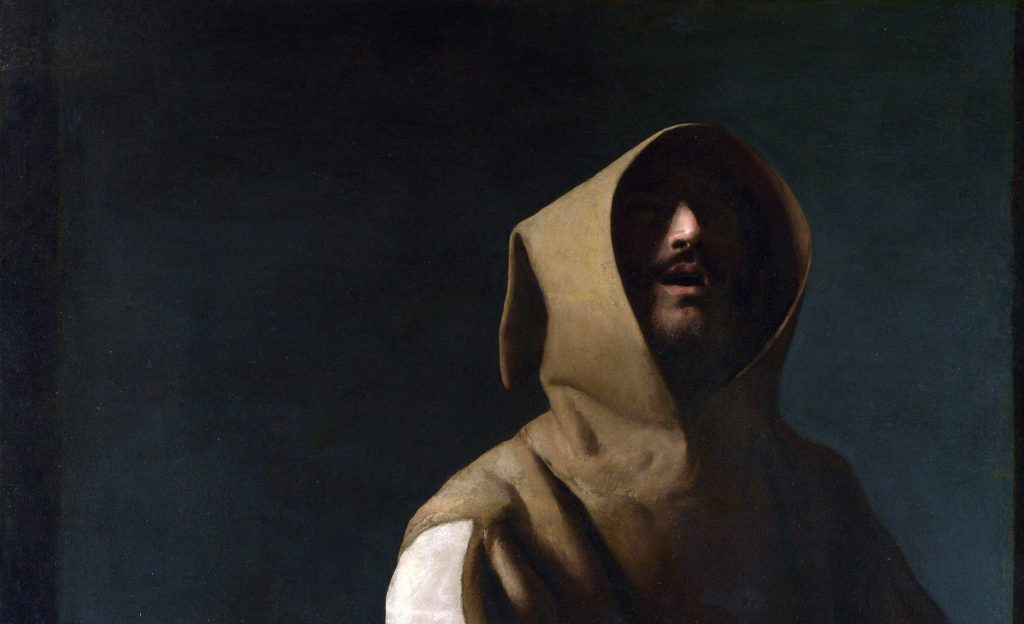
Detail from Francisco de Zurbaran’s St Francis in Meditation
It made me smile to think that as he drew close to the end of his life, the man known to future generations as St Francis of Assisi felt the need of such a friend and such a biscuit. And I had no clue biscuits featured so memorably in the biography of Francis until a few weeks ago, when I got to visit a landmark exhibition on him at the National Gallery. From facsimiles of Francis’s own letters to Antony Gormley’s untitled sculpture conveying a moving openness and vulnerability, we were lucky to have a perfect guide in Angelo, a secular Franciscan and art historian. “I try to listen for the Holy Spirit while I’m doing the tour,” he confided in me as we were leaving the gallery, which seemed like a good explanation for his sudden mention of Jacoba’s biscuits…
Image from the Basilica of St Francis in Assisi, which some believe is Jacoba due to the Seven Suns in her halo.
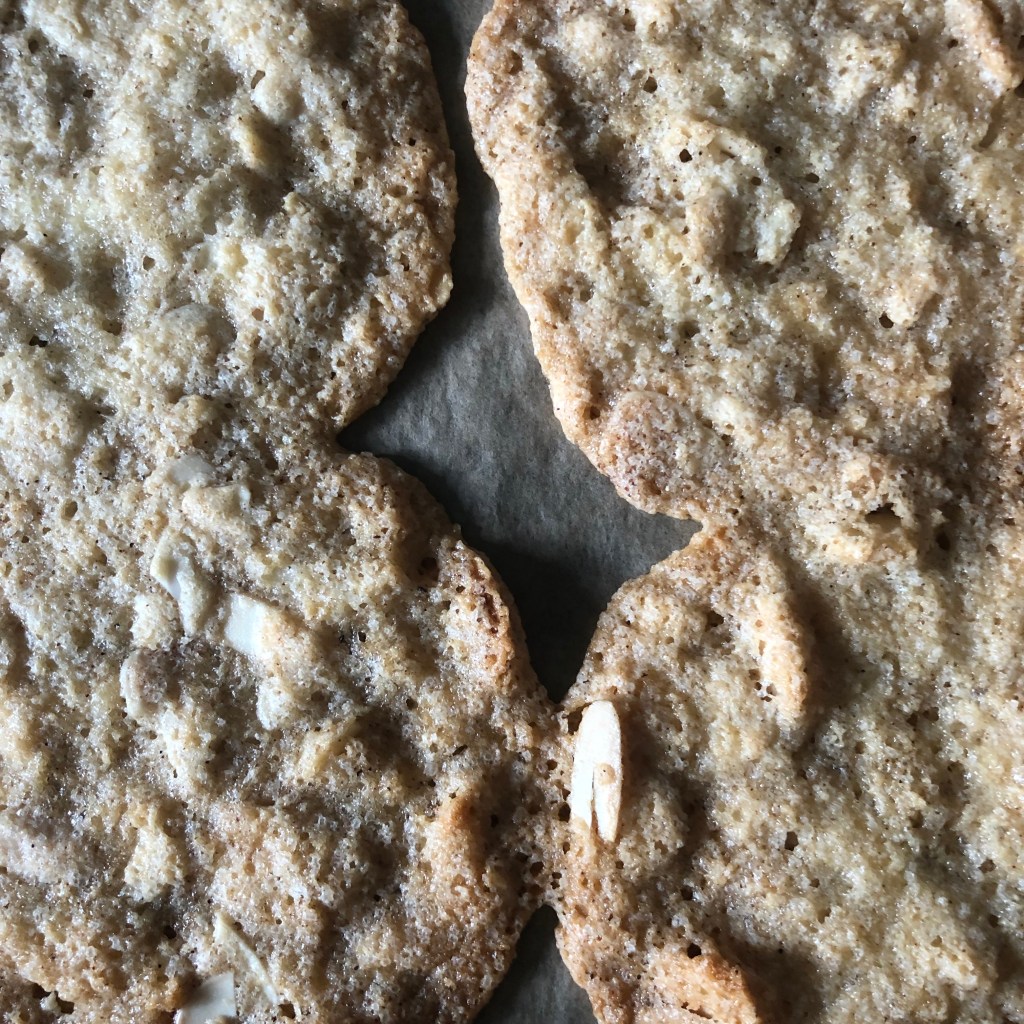
Jacoba would have been in her mid-thirties when Francis died. We know she had a family but was a young widow when Francis met her. His affectionate name for her was Brother Jacoba and he encouraged her to work out her vocation within secular life rather than joining holy orders. Sadly, the original recipe for Jacoba’s biscuits has not been preserved, but a variety of almond confections are made for St Francis’s Feast Day in the saint’s honour. This one from a modern Franciscan monastery seemed a good one to try but it’s fair to say it didn’t turn out exactly as I had envisaged. The first round soon spread out enough to fill their entire baking tray in the oven, creating what I could only describe as a cookie pizza…
I tried a second tray with smaller dollops placed further apart but the result was much the same. It’s the first time I’ve cut biscuits with a pizza wheel but they certainly tasted amazing fresh from the oven. What they lacked in shapeliness they more than made up for in tastiness however, as the generous amounts of chopped almond and half spoon of its essence brought out the almond flavour. Perhaps because I added a little extra vegetable oil, it was also pleasantly chewy. A sort of cross between a cookie and a Florentine.
For the moral, I got to thinking of that extraordinary paradox at the heart of the order that Francis founded expressed by Christ in the gospels when he says: whoever gives up his life for my sake will find it. Few people have given up so much or so gladly as Francis himself: in giving away his wealth to marry Lady Poverty and loving the misfits, outcasts and lepers of society, he came to identify less with the upwardly mobile goals of his merchant-class peers and more with the joys and pains of his divine master.
Untitled (“To Francis”) by Antony Gormley
The story of Francis as a young man divesting himself of his luxury clothes and handing them back to his astonished father is well known but in a challenge which feels topical for our own day Angelo stressed Francis’s readiness to divest himself of his natural opinions, shrugging off the weary tribalism of labels or factions that could hinder him from seeing the worth in others and relating to them in a spirit of openness and friendship. This took him into some unlikely friendships from the outlaw of Gubbio to the Sultan of Egypt, again in the footsteps of his divine master who ate with characters shunned by most of the religious leaders of his day and shocked his disciples by talking theology with a Samaritan woman.
Reflecting on Francis’s life in the visual journey of the exhibition certainly challenged me to live more simply and more generously. Sometimes that will call us to a place of radical alms-giving and sometimes a place of radical self-giving (or both in the story of Jacoba). This can feel costly at times but there’s also a freedom in it, a whisper that in the end the loss will be turned to gain in the upside down Kingdom of God. I don’t fully understand it myself, but all I know is, like the biscuits that expanded to fill every inch of the tray, the more space we give to God in our lives, the more he can fill it.
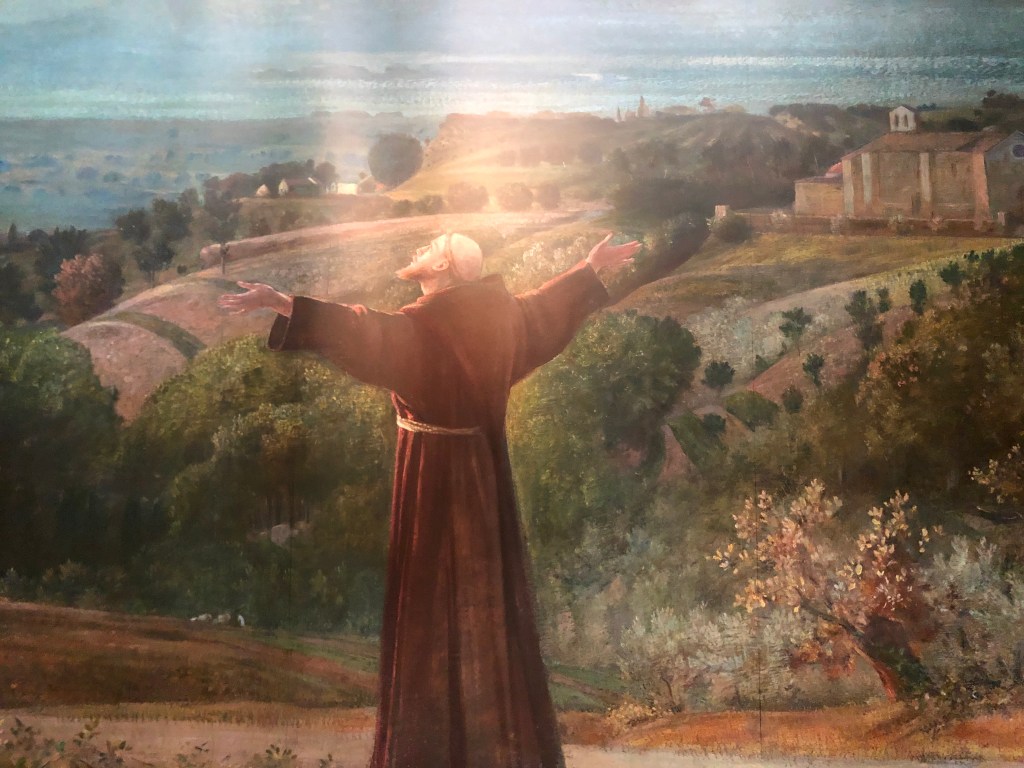
Detail from Giovanni Costa’s Brother Francis and Brother Sun (c. 1880)
A beautiful interpretation of Francis’s Canticle of the Sun (in English translation) by artist Tony Wright:
If you enjoyed this bestiary article and have donated or are considering donating to this project, I invite you to give to a charity of your choice instead this month in the spirit of St Francis. The Franciscans International, Leprosy Mission, and animal welfare charities (quick shoutout here for Hedgehog Cabin) all spring to mind as causes dear to Francis’s heart, or you may have your own charity you wish to give to.
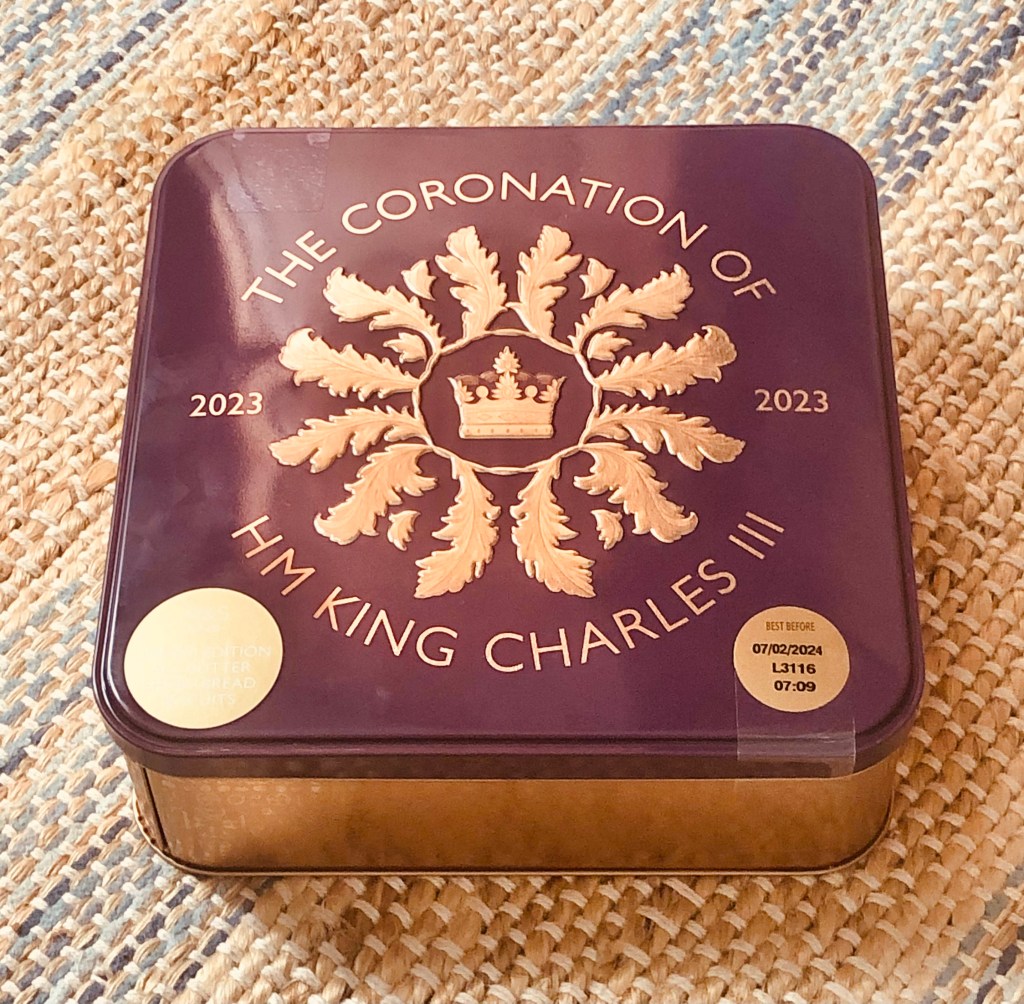
Each time there is a royal celebration of some kind there are special tins with special biscuits. I bought such a tin for the late Queen’s Diamond Jubilee, and either bought – or was given – them to celebrate the births of Princes George and Louis, and Princess Charlotte. So as this is the first time in seventy years that Britain has had a coronation I decided to purchase a Carolean one, although it still feels odd talking about the King instead of the Queen, and no longer being a noveau Elizabethan. I teetered a bit between one of Cartwright and Butler’s solemnly splendid evergreen tins and this gorgeous purple and gold affair from Marks and Spencer’s, which was twice as sumptuous at half the price:
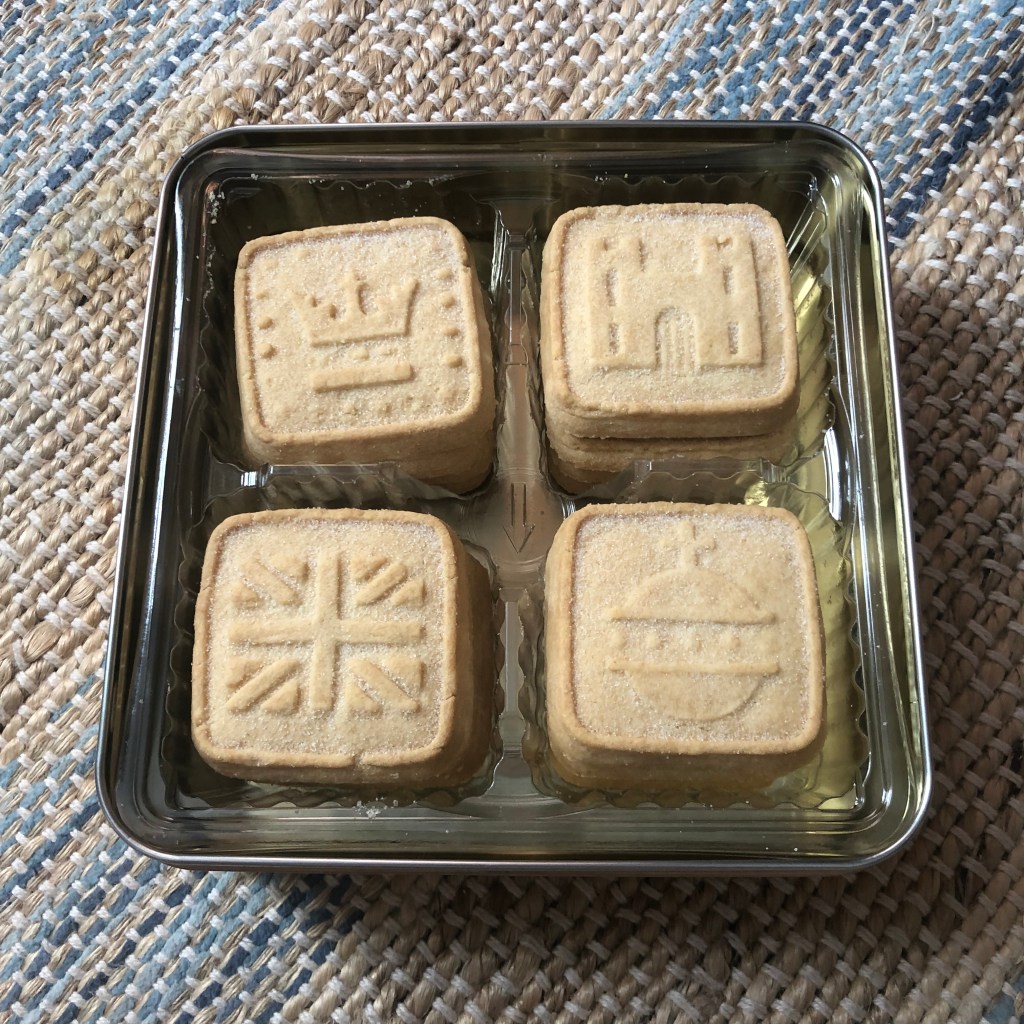
I’ve learned over the years that you can’t judge a biscuit by its tin, but I was pleasantly surprised at the quality of the shortbread inside. I’ve written about this quintessentially Scottish biscuit before so won’t go into the history of it again but where I was expecting some standard rounds or wheels the M&S bakers went with a regal theme, a kind of regalia in biscuit form if you will…
I’ll leave the crowns and palaces and flags to speak for themselves, but linger a moment on the symbol of the orb and cross. A distinctly medieval image, the orb alone was a Roman symbol of imperial power but for the Christian monarchs and emperors of Europe the addition of the cross over it refocused attention on Christ as the eternal sovereign of the world and the King to whom all earthly kings must be subject as holders of temporal and limited power.
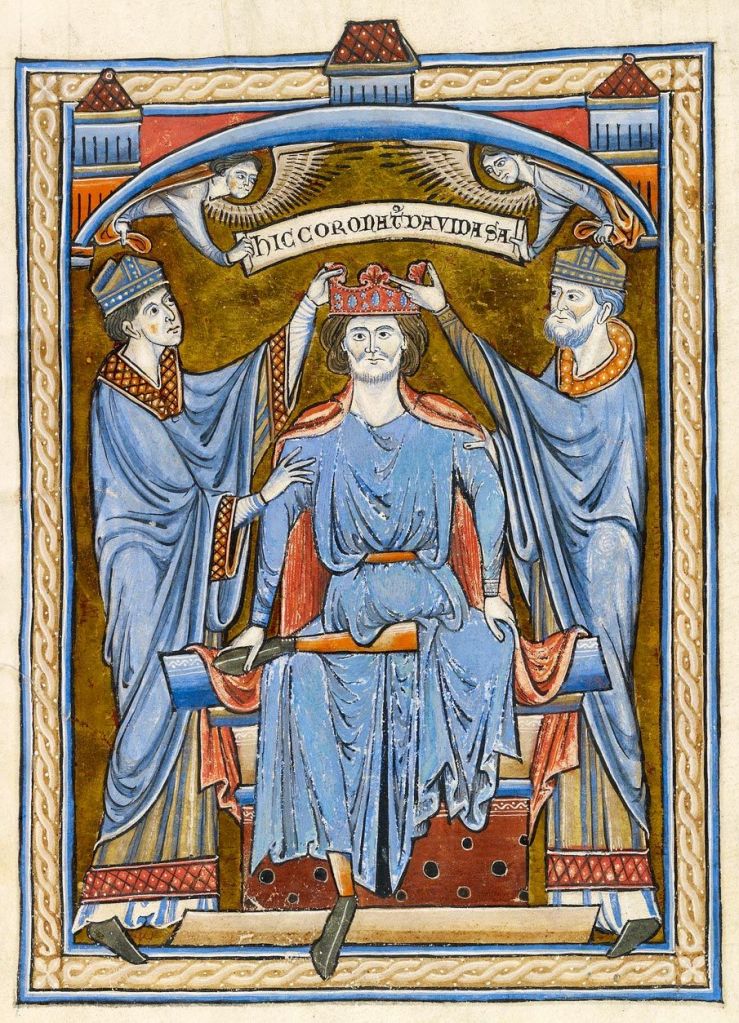
Richard II (1377-1399)
This medieval view is biblical in so far as scripture talks of all earthly powers and authorities owing their positions to God, but the bible as a whole does not offer us unqualified support for monarchy as a system either. When the Israelites petition Samuel for a king so that they can be be like the other nations, God makes it clear that if they go ahead with their plans to adopt a monarchy it will place many burdens and obligations on them and that their asking itself is a symptom of their having rejected Him as the only king they need. However, once the decision in favour of a monarchy has been made and their first king, Saul, fails several crucial tests of character, God chooses his own king for his people, the shepherd boy David, and blesses his socks off, telling him he will never fail to have a descendant on the throne of Israel. All of which suggests that God is not so much pro- or anti-monarchy as he is willing to work in whatever flawed-but-capable-of-good governmental systems we find ourselves in to help bring about the coming of his own – everlasting – kingdom.
The coronation of King David
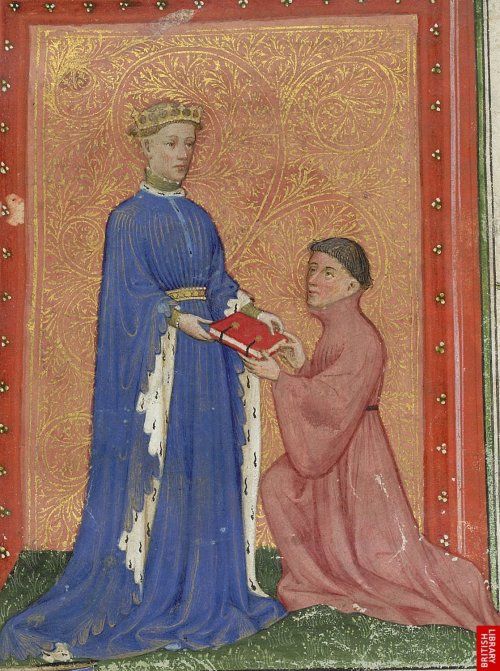
The Books of Kings and Chronicles record the deeds and characters of the kings of Israel and later of the Northern and Southern kingdoms after Solomon’s time. Some kings were outstandingly good, some were outstandingly evil, and some were fairly good or fairly evil, but for each the crucial question was whether they would worship the God of their ancestors and worship him exclusively; their success and prosperity was determined in a large part by the spiritual choices they made and on who, or what, they had set their hearts. The damage done to a nation by a weak-willed or corrupt king and conversely the good done by a virtuous one could be so great that the moral and political education of a future monarch was of the utmost importance to their subjects in medieval Europe and led to a whole genre of literature on the topic called Mirrors for Princes. Here’s an illustration of the London poet and scribe Thomas Hoccleve handing his Regement of Princes (c.1411) to the future Henry V:
Hoccleve and Prince Hal / the future Henry V
The powers of a king these days are more constrained thanks to the checks and balances of constitutional monarchy but he still possesses extraordinary influence. Pace Dieu et mon droit, less emphasis is given to his divine rights than his divine responsibilities; it is the Christian ideal of servant-hearted kingship that informs the ceremony of the Coronation in the liturgy used in Westminster Abbey this weekend, where a young person (one of the choristers of the Chapel Royal) will welcome King Charles with these words:
Your Majesty, as children of the Kingdom of God we welcome you in the name of the King of Kings
And he replies:
In his name, and after his example, I come not to be served but to serve...
Just as the best earthly marriages offer our imaginations a little glimpse of the marriage of Christ and his people, so the best earthly coronations offer our imaginations a glimpse of the glory and majesty of the King of Kings and the immense dignity and significance that he gives to us as his sons and daughters. And it’s characteristic of the best earthly monarchs that they have always understood themselves as human actors in a spiritual drama, never mistaking the shadow for the eternal reality. A perspective evident in the old Wesleyan hymn sung at the funeral of the late Queen:
Finish, then, thy new creation; pure and spotless let us be: let us see thy great salvation perfectly restored in thee; changed from glory into glory, ’til in heav’n we take our place, ’til we cast our crowns before thee, lost in wonder, love, and praise.
Tomorrow feels like more of a solemn than a celebratory moment in the life of the nation if I’m honest but one I’ll be watching with a cup of tea and a coronation biscuit.
Following the ceremony tomorrow with your choice of coronation biscuit? Here’s a link to the service guide with all the liturgy they will be using with the bible readings and songs.
Not such a fan of thrice-gorgeous ceremony? Neither was one of Shakespeare’s best loved medieval kings. ‘Tis not the balm the sceptre and the ball... A superb rendition of one of Henry V’s monologues by Sam West.
And here’s the wonderful Porter’s Gate declaring the greater glory of the King over all:
If you would like to see more entries more regularly and help keep this bestiary free of ads, you are welcome to contribute to the Biscuit Jar.
Biscuits for breakfast: OK or not OK? In Britain I don’t know a single soul who eats those Belvita biscuits although at weekends a biscuit or two might be the prelude to the Breakfast Proper. But in America a dish called Biscuits and Gravy is regularly eaten for breakfast and here we come to one of the great culinary divides between the two nations, a chasm so vast confused biscuit lovers on both sides of the pond find themselves in the position of Inigo Montoya in the cult film The Princess Bride, when he says: You keep using that word. I do not think it means what you think it means…
So what does it mean? I’ve tried before to answer the question here. To summarise: in Britain, a biscuit is what most Americans call a cookie and is (generally) sweet and (generally) smaller, flatter and tougher to bite into than a cake, but emphatically not a cake although it may at times be confused with one. To make things even more complicated in Britain a cookie is thought of as a subtype of a biscuit which means all cookies are biscuits but not all biscuits are cookies… In America, a biscuit is much closer to what we Brits call a savoury scone but (generally) lighter and fluffier and made to be eaten with a white sausagey gravy we would think of more as a sauce. As you can see the meaning is quite different, which begs the question how did such a semantic divergence come about? English Language and Usage Stack Exchange concludes:
At various times before 1800, dictionaries have used [words such as bisket, biscuit and bisquet for] a confection made with flour, eggs, sand sugar (among other ingredients). But at other times before 1800, dictionaries have applied the words bisket, biscuit, and bisquet to tiny rounds of hard-baked bread. Under the circumstances — especially in view of the equivocal treatment of the word in Samuel Johnson's tremendously influential 1755 dictionary, it is hardly surprising that British English went one way with the word biscuit and North American English went the other...
Like Robert Frost, the latter opted for the path less travelled semantically speaking. Or as one wit on the internet put it:
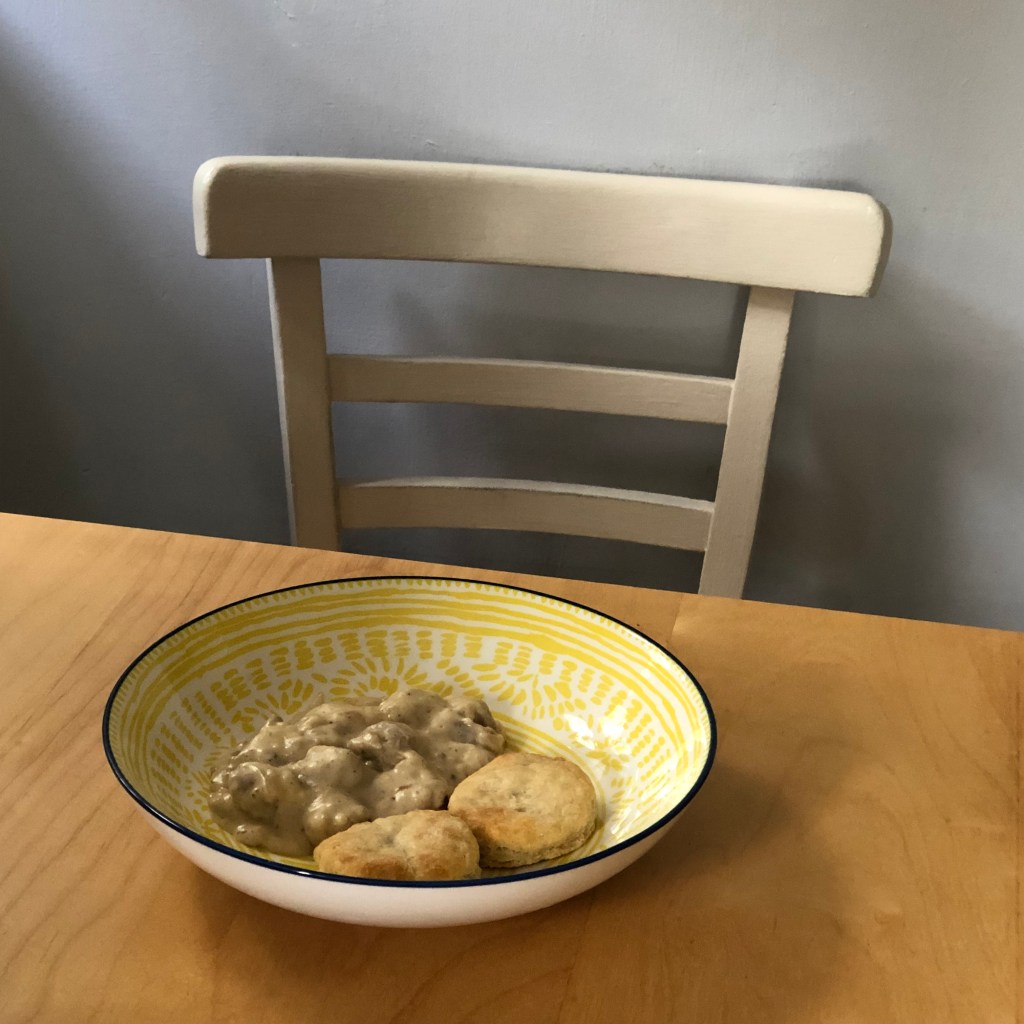
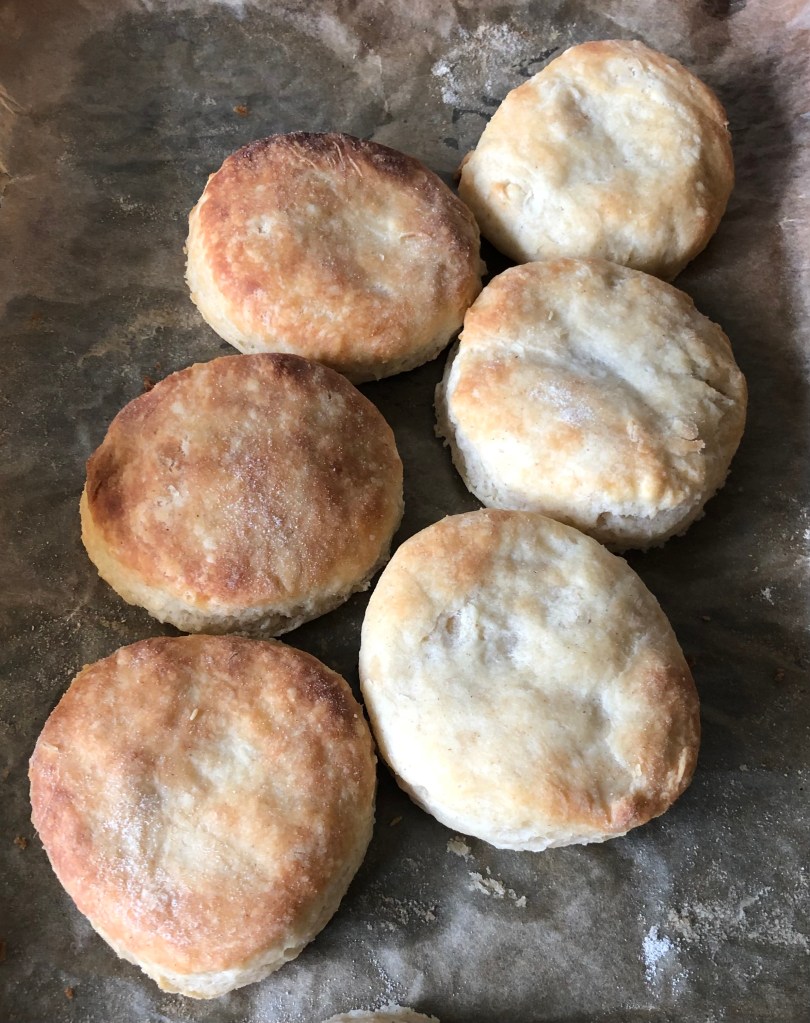
American biscuits are often thought of as a Southern staple but are now eaten everywhere in the States, where, like French onion soup, they’ve made the unexpected journey from low-cost peasants or workers’ fare to general comfort food. I’d never tried American biscuits before so wasn’t quite sure what they were meant to taste like but decided I’d have a go at making some. I think these biscuits turned out better than the gravy although to be fair I veered off the beaten track of the recipe several times, overdoing it on the buttermilk and underestimating the amount of whole milk that I needed, partly as a result of struggling to convert the measurements accurately.
There’s no doubt the biscuits were at their best fresh and I followed the advice to split them and fill them with gravy to make a delicious, if slightly gloopy, sandwich. All in all this tasted a bit like a cross between a sausage McMuffin and a plain flour dumpling, while fulfilling the same function as the wedges of thick farmhouse bread you’d use to mop up a hearty stew. While it felt odd as a breakfast option, I did enjoy it.
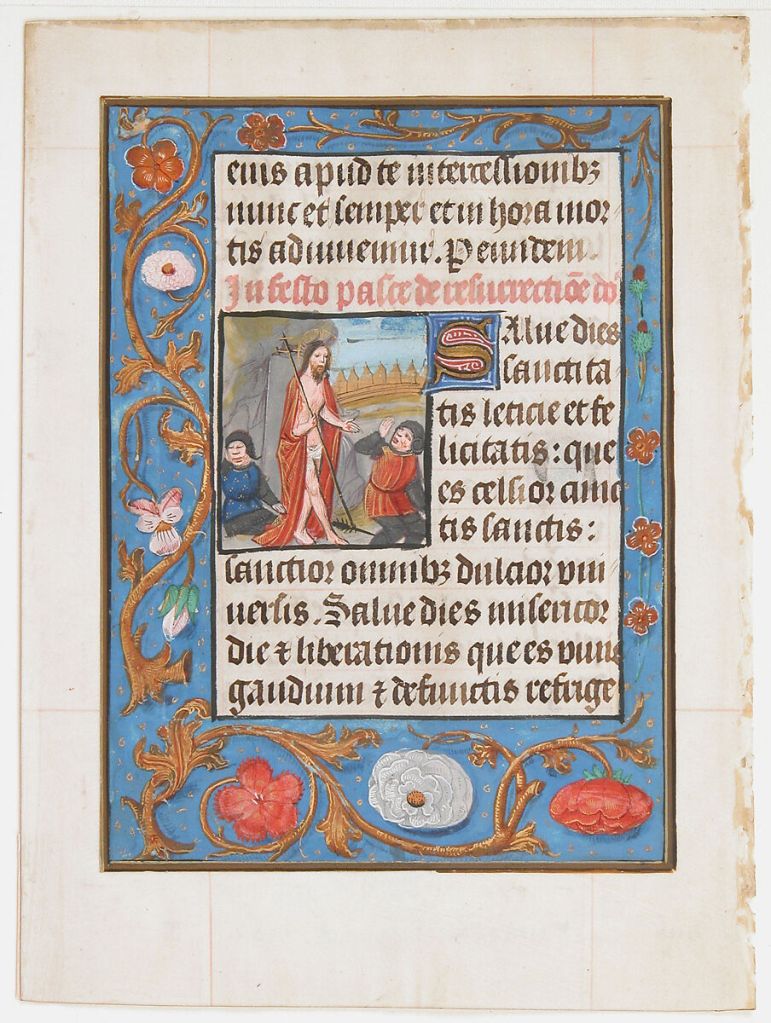
And the moral of the American biscuit? In the same way as this unusual experience (for us in England) explodes our idea of what a biscuit is, are we ready to welcome the risen Jesus if he shows up in a different way to the one we expected? In this Easter-tide it’s good to remember that those first days after his resurrection some of his closest friends didn’t recognise him to begin with and that there were aspects of his resurrected life that were very different to the one they had known before. He could meet them inside locked rooms still bearing the marks of the nails on his body. He could walk with friends who took him for a stranger until a word or touch brought the revelation of his presence, long after they had felt their hearts burning within them in their conversation on the road. He could show up on the shores of Galilee to cook his disciples breakfast (fish, not biscuits). He could appear and disappear out of nowhere (or everywhere?) There was a divine mystery in it all that they could not understand, much less control.
Incipit illustration of the Resurrection from a Dutch Book of Hours, c.1500 from www.metmuseum.org
The story of Christ’s return from the dead is exciting but it is also challenging. Are we willing to have our understanding of everything challenged, in the way that resurrection life always challenges us? In those strange, thrilling days between Easter and Pentecost, the astonished disciples hadn’t much of a clue what their risen Lord was doing (some of us still don’t) but they were learning to trust him and to recognise him whenever he appeared in their midst.
Welcome to the Club. Like the trusty Penguin, this doughty milk chocolate biscuit evokes the nostalgia of an 80s childhood and the advertising slogan sung by the kids in commercials: if you like a lot of chocolate on your biscuit join our club! I never did find out how to join exactly but if buying a packet of these is the price of entry, I’m in. In Great Britain Club biscuits are produced by McVitie’s but in Ireland – where they hail from – they’re made by Jacob’s, better known in the UK as a maker of savoury biscuits and crackers. It’s a company that still exists in name at least but sadly no longer operates from the Emerald Isle.
I must admit I only clocked that the Club was Irish when I did a little research on Irish biscuits for St Patrick’s Day. It was difficult to find recipes that seemed authentically Irish as opposed to just ordinary biscuits flavoured with a dash of Guinness or Bailey’s (an Irish cookie to go with your Irish coffee, Sir?) but I did come across a few species of biscuit I hadn’t come across before such as Lace Biscuits and the fondly remembered Mallows / Mikados. However, the Club seemed the most appropriate choice for St Patrick’s Day for reasons I hope will become apparent the deeper we delve…
As you can see from the picture below, the Club is a solid-looking biscuit: a veritable chocolate bullion in a silvery wrapper containing about the same satisfying thickness of chocolate as you’d get in a McVitie’s Gold Bar. The crunchy middle layer is entirely surrounded by a thick and delicious wall of chocolate. This mint chocolate version was so strongly scented I could smell the mint through the foil!
According to that august online authority, A Nice Cup of Tea and A Sit Down, the original Milk Club predates the First World War and creation of modern Ireland. In their 2008 entry they could only find the original Milk Clubs on Ireland’s West Coast but a recent check reassured me that Jacob’s still make them for their Irish market. (The other flavoured varieties UK biscuit lovers are more familiar with were first produced for the UK at a later date from a satellite factory in Liverpool.)
It also surprised me to discover that the reason these biscuits were known as Clubs has nothing to do with the clubbability factor. Instead, it refers to the design stamped on the wrappers of the original Milk Club, the same symbol for the Club suite on a pack of playing cards which in turn reminded me, perhaps intentionally on the Jacob brothers’ part, of the seamróg or shamrock: the three-leaved clover that, along with the harp, is a famous symbol of Ireland. Whichever type of clover it was, or if it ever actually existed, St Patrick is supposed to have used it as an illustration of the Trinity in his efforts to convert the pagan Irish to Christianity – a great story, even if it is almost certainly an early modern fabrication.
A medieval illustration of a clover from BL Egerton MS 747, c. 1280-1310.
It may also surprise some readers to discover Patrick himself was not Irish but Romano-British back in a time when relations between the two islands were freer and simpler. While the history is a little hazy, the best guess seems to be that he was Welsh or Scottish, and that he was captured by raiders and taken off to Ireland as a slave while still a young teenager. It was there, in his desperation, that he found God, who he says protected and consoled him like a father. He actually tells us a little of his story first-hand in his Confessio: an English translation can be found here and is short enough to read in a coffee break (with your choice of biscuit):
So I am first of all a simple country person, a refugee, and unlearned. I do not know how to provide for the future. But this I know for certain, that before I was brought low, I was like a stone lying deep in the mud. Then he who is powerful came and in his mercy pulled me out, and lifted me up and placed me on the very top of the wall…
While Patrick describes himself as unlearned and perhaps believed that to be true, his writing reveals him to be immersed in the scriptures. This passage reads like a vivid illustration of Psalm 40, where God lifts the despairing David ‘out of the mud and the mire’. Browsing the Confessio this week, I was struck by how similar parts of it feel to the letters of St. Paul who likewise felt caught up in a divine commission to advance a faith he’d formerly rejected. To my mind the Confessio offers us a more believable account of the career of a fifth-century missionary than the fantastical tales of evicting all the snakes from Ireland (a common story among early Celtic saints: Hild of Whitby and Columba of Iona are rumoured to have done something similar). Far from lowering him in the reader’s estimation, Patrick’s account of his life has the effect of raising it. It certainly reads like that of a very ordinary man in some respects, but the light that shines through it all is one of honesty and holiness.
St. Patrick from BL Royal MS 17 B. xliii, f. 132v
Like Paul, Patrick is candid about his hardships but also of the love that drove him to return to Ireland to preach to the people there. In another memorable passage, we get a glimpse of him doing it:
The sun which we see rising for us each day at his command — that sun will never reign nor will its splendour continue forever; and all those who adore that sun will come to a bad, miserable penalty. We, however, believe in and adore the true sun, that is, Christ, who will never perish. Nor will they perish who do his will but they will abide forever just as Christ will abide forever…
This acknowledgement that the sun would one day burn out may seem prescient in view of what is now common scientific knowledge, but the strictures against solar adoration may strike a modern reader as peculiar. It is details like this however that give the Confessio another touch of authenticity as many of the people Patrick came into contact with were still influenced by older pagan druidic cultures that had worshipped the sun. (‘They can’t have worshipped much…’ quipped the late great Terry Wogan in his commentary on the Eurovision Song Contest in one of the many years Ireland hosted it.)
Patrick’s metaphor of Christ as the true and lasting sun is a good illustration of the way in which Celtic Christianity sought to build as many bridges as walls between the pagan and Christian understanding of life which shared a reverence for the beauty and power of language and nature. Although it’s debatable whether he himself authored it, the well-known Hymn of St Patrick is in this tradition:
Christ as a light illumine and guide me. Christ as a shield overshadow me. Christ under me, Christ over me. Christ beside me on my left hand and my right…
And the moral? Just as a solid wall of chocolate covers every part of the Club biscuit so wonderfully, so in prayer we are invited to follow Patrick (and other medieval Celtic Christians) in invoking Christ’s special presence and protection. Encircling prayers, as they are sometimes called. Not a bad place to start – and end – the week (thank God it’s a Friday!) Wishing a Very Happy St Patrick’s Day to all who celebrate it.
More on St. Patrick and the Confessio from the British Library Medieval Manuscripts blog (and see the text of the original – with helpful contextual resources – here).
Stumped by Shamrocks? Here are some of the elusive facts surrounding the symbolic clover.
And finally, a chance to put on St Patrick’s Breastplate and the Armour of God for those looking for extra spiritual cover! (And a special credit is due to the musician responsible for the beautiful adaptation of the hymn in the above video: www.dwightbeal.com)
If you would like to see more entries more regularly and help keep this bestiary free of ads, you are welcome to contribute to the Biscuit Jar.