The Maple Cream Cookie

It’s autumn again and far too long since my last biscuit. This month I’m going to be blogging on the all-absorbing subject of the Maple Cream Cookie, a present from my friend Olivia who brought some back for me from a holiday to Canada in May. (Disclaimer: when I started this bestiary, it was my modest ambition to catalogue the 30 or so species of biscuit most plentiful to the British Isles, but somehow word has got around and I now have a whole shelf of offerings from America, Canada, South Korea and the Czech Republic so hold on to your hat-boxes, dear readers, we’re going to be travelling a lot further than planned).

img_2996

It would be hard to find a biscuit more Canadian-looking than this one, shaped to resemble a maple leaf albeit a little less delicately than the real McCoy. These have survived the voyage across the pond magnificently with only one hairline crack to show for it. The packaging also gets a thumbs up from this Brit: focused as I was on the comestibles, it was only when I went to photograph it that I noticed the picture of the Niagara Falls.

As this is the first ‘sandwich’ this bestiary has featured, it’s worth saying a bit about this special branch of the biscuit family (a branch big enough to embrace both the Oreo and the Custard Cream). The obvious advantage is that you get TWICE the biscuit in one mouthful, plus a delicious filling used as a kind of confectionary mortar to cement them together (although really the whole product is less like a sandwich than a heavy-weight macaroon).

img_3007

Even after five months on the shelf in our kitchen these still smelt strongly of maple syrup which is another plus point in my book, maple syrup being some ambrosia of the gods. Unlike the gods of the Greek Pantheon, however, these cookies had softened with age, so although they were still comfortably within their use-by-date it would be best to eat these straightaway for maximum pleasure.

I don’t have to look too far from the tree for a moral for this biscuit. Sic gloria transit mundi: like the leaves of autumn and the Maple Cream Cookie, thus passes the glory of this world. A medieval rejoinder can be found in the Book of Isaiah (a prophet and a poet): exsiccatum est faenum cecidit flos verbum autem Dei nostri stabit in aeternum/ ‘the grass withers and the flowers fade, but the word of our God stands for ever.’ To my mind, the awareness of autumn’s decay and winter’s mortality has the tendency to alter almost every perspective on life as we’re living it in the present: sometimes for the sadder and sometimes for the better, but always for the wiser in the end.

This slideshow requires JavaScript.

Further Delectation

What, it’s not enough that you get a slide-show of biscuits and flowers? How about a few exciting things to do with Maple Syrup then…

A glimpse of a summer beyond the grief of winter (music from the Medieval Baebes and lyrics from the Middle English Pearl, with various images from YouTuber Arthur Foster).

Is that the time? If you don’t have any cookies to hand, you can still feast your eyes on this month’s illumination from the Middle Age’s most famous book of hours (grâce à iBiblio.org).

october.jpg

If you would like to see more entries more regularly and help keep this bestiary free of ads, you are welcome to contribute to the Biscuit Jar

Selga Biscuits

This month saw the arrival of a parcel of biscuits from Latvia courtesy of my friend Gareth, whose name will be added to the Fig Roll of Honour in due course. I suspect the Latvians are bigger coffee than tea drinkers but as it was National Tea Day when I first tried these Selga biscuits, I thought it best to put them through their paces with an afternoon brew. Taste-wise, they could be first cousins to the Malted Milk, although they’re slightly thinner and crumblier. Escher might have admired their squareness – I’ve never known any biscuit tesselate so beautifully on a plate.

IMG_0247 (2)I can see why travel is supposed to broaden the mind. It was the squareness of the Selga that first alerted me to the fact that all the biscuits I’ve seen in the UK have been round or oblong or uneven. Not only do square biscuits not exist here it seems, but worryingly for the geometricians whosoever googles ‘square British biscuits’ finds nothing but images of Nice and Custard Creams.
Gareth kindly sent me two different varieties of Selga for comparison. So far I think I prefer the slightly mellower condensed milk to the plain/classic version, but could see myself hoovering up either in large quantities given a fair wind and a good writing day. All of the biscuits he sent me are made by Laima, a chocolate manufacturer that celebrates its 60th anniversary this year. (I have two smaller chocolatey-looking specimens to try as well, but as these look like a different species I have reserved them for a separate entry!)

“Laima is also the name of one of ‘God’s’ daughters. The pagan God. But the word for God is the same in Christianity or Latvian paganism,” Gareth told me. Isidore of Seville would have approved of this attention to names. If the Latvian word for God casts light on that culture’s transition to Christianity, the meanings that emerged when I typed ‘Selga’ into the online Latvian-English translators were still more unexpected. As far as I can tell, it’s a Latvian noun that has variously been translated as ‘deep-sea’, ‘seaway’ or ‘offing’ in the sense of casting off into the deep.

It’s hard to imagine Captain Ahab wolfing these sedate little biscuits on the Pequod but the idea of launching out upon the seaway reminded me of early medieval poetry in Old English where the sea is described as the sail-road or the whale-way (or is that too great a semantic leap?). Pending Dan Isidore’s approval, I’m going to take the opening of Psalm 130 for the Selga’s moral sentence. De profundis clamavi (‘Out of the depths, I cry to you, O Lord’). It’s one of the most moving cries of the Psalter, rendered powerfully here by another great gift from the Baltics: Arvo Pärt.

Further Delectation

The late, great and sadly missed Victoria Wood chats to Dr Who’s Matt Smith about the British obsession with tea and tea-time.

Not sure what to bake for the Elizabethan in your life? Try celebrating 400 years of bardery with this 17th-century biskit cake or this royal biscuit cake in honour of the Queen’s 90th birthday.

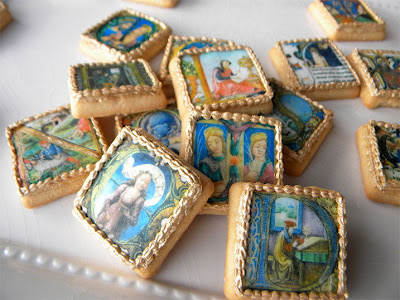
My friend Donata sent me this wonderful blog post on cookies modelled to look like the historiated initials in medieval manuscripts. Also square, and much too wonderful to eat!

medieval-alphabet-cookies-3.jpg
Image by the talented chef at Luminarium, Anniina Jokinen.

If you would like to see more entries more regularly and help keep this bestiary free of ads, you are welcome to contribute to the Biscuit Jar

The Rich Tea

The ‘richness’ of the Rich Tea Biscuit remains a mystery, howbeit great sages have  explained it thus: first, that it originates from the county of Yorkshire which is richly famed for its teas; second, it was associated with the wealthy, having been contrived as something for the upper crust to peck at between meals; third, the late lamented Sir Terence Wogan did once describe it as the Lord of Biscuits. Still, overall it does seem a tad… bland.

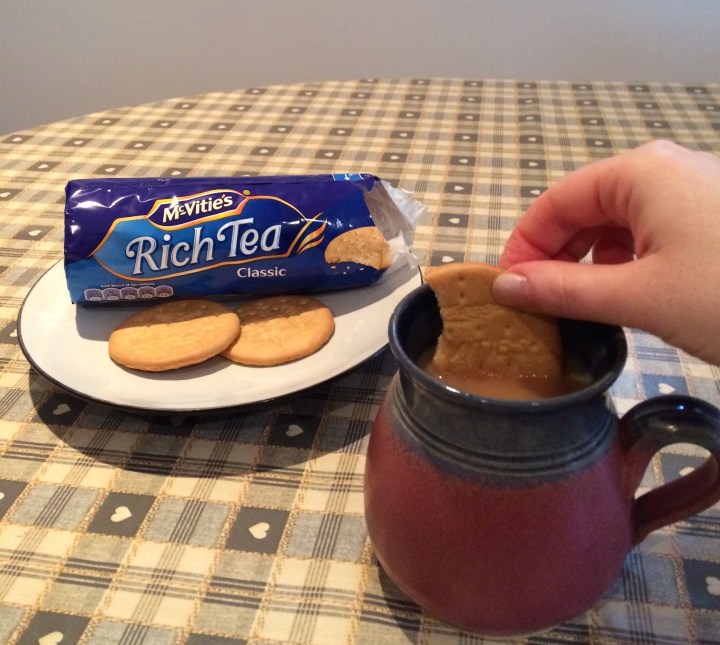
Nowadays the Rich Tea is less associated with the life of Riley and more with the life of, well, anybody who’s spent any time in Britain. Over the years I’d got into the habit of thinking of it as a standard, inoffensive, community filler of the biscuit world – the patron biscuit of mass catering on a budget – but having made myself eat three or four in succession to get the shot below I was surprised to find the experience pleasanter than anticipated (although I still can’t say I’m a major fan).

IMG_0146 (2)

Both its friends and foes agree that the Rich Tea is more palatable when dipped in a cup of cha and that there’s definitely an art to the dipping process; the Rich Tea is not a biscuit for amateur dunkers as there’s a high chance you’ll lose it if you dip it too long. There are parallels with the sacrament of baptism, but this species is pretty Anglican when it comes to full immersion (an honour reserved for non-conformists and ginger nuts).

And the moral of this biscuit? Just as the goodness of the Rich Tea is most apparent when you hold its feet in hot water, so there are some qualities in the spiritual armoury that only appear under pressure. Love can exist without hatred, but courage can’t exist without some degree of risk (‘grace under fire’, Hemingway called it). Forgiveness is perhaps the best and hardest of these, but endurance also counts for something. The silence of the medieval commentators is telling but I suspect it may well have been the Rich Tea Shakespeare’s Henry V was talking about when he said: ‘We would not seek this biscuit as we are, / Nor, as we are, we say we will not shun it.’

Further Delectation

I’ve included a few pictures of the Rich Tea in its natural habitat (the one on the top left is from Alamby). If you don’t have access to a Country Pile combine your McVitie’s Rich Tea with even richer tea from Yorkshire and a mental romp through Blandings Castle.

Which of the following best describes your feelings towards the Rich Tea biscuit:

(1) ‘Rich Tea? Ooh, I don’t mind if I do…’ Try this master class on the art of dunking.

(2) ‘I’d rather eat my own eyeballs.’ This article will confirm your prejudices (although you might want to look away if you’re a fan of (i) Malted Milks; (ii) Britishness; (iii) Bristol).

(3) ‘Faute de mieux, dear hearts.’  Work up a stomach to the fight with Tom Hiddleston.

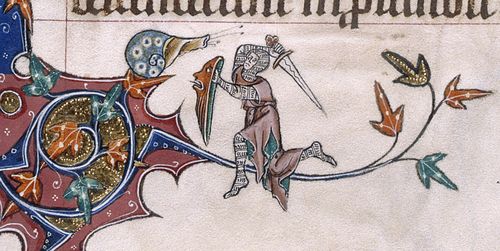
(4) ‘Eh?’ Have a look at these epic battles between knights and snails:

6a00d8341c464853ef019aff95ab29970c-500wi

If you would like to see more entries more regularly and help keep this bestiary free of ads, you are welcome to contribute to the Biscuit Jar

The Humble Digestive

mcvities_3
1930s McVitie’s advert

Sweet, wholesome, and amiable, the digestive is nothing if not well-rounded in character. Durable too with its Scottish roots, it’s successfully transitioned from a poster boy of the industrial revolution to tea-time staple. These days you rarely see digestives thrust into the limelight yet in a time of crisis few sights are more reassuring. It’s one of the first things you offer anyone in a state of shock, being right up there with other life essentials like tea, blood and oxygen.

As with most heroes of the bestiary, the digestive is renowned for its medicinal qualities and folk legends abound with tales of sudden miraculous recoveries attributed to its invigorating powers. In medieval tradition, a special place is reserved for St Timothy’s Biscuit. After St Paul advised the younger man to drink a little wine for his stomach trouble, it was only a hop, skip and jump to luxury cheese. This seems to be the explanation for the otherwise puzzling reference in Chaucer’s The Camembert’s Tale: ‘some bisquite take yow, by St Timothee / For shame yt is such cheses should go fre’.

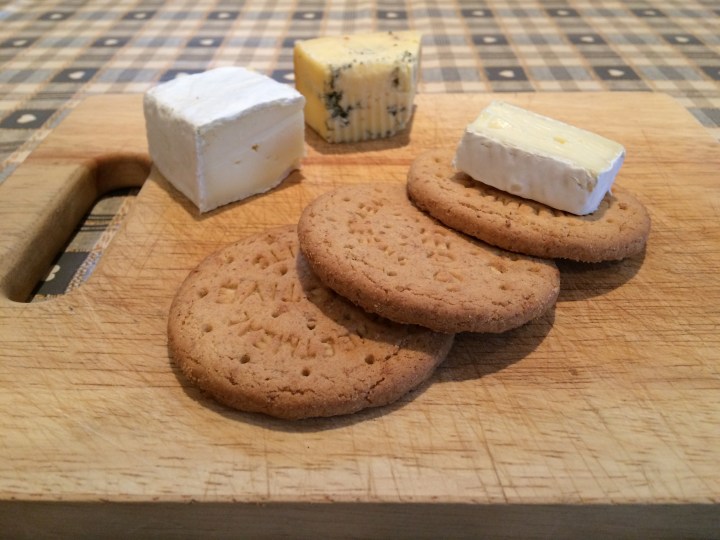
IMG_0051

Of late the free-flow of digestives through these isles has led some to assert that this is the most popular biscuit in our history: a claim that is the less astonishing when you consider the role of the digestive as the natural companion of cheese and chocolate. Like a  faithful friend, this modest soul is never happier than when promoting the excellence of others. If it has any lesson to teach us it’s that humility has its pleasures and one of them may be making opportunities for others to shine.

Further Delectation

Read this charming post on the digestive’s history or watch this digest of Victorian biscuit mania first screened on The Great British Bake Off.

Try these ingenious recipes including passionfruit meringue and other biscuity trifles.

Been redirected here from the fourteenth century? You may wish to pair your cheese and wafers with some spiced Ypocras.

Has a digestive saved your life? Send a message of thanks to McVitie’s as they need cheering up right now.

If you would like to see more entries more regularly and help keep this bestiary free of ads, you are welcome to contribute to the Biscuit Jar

The Prince of Biscuits

img4535
From BL Royal MS 12 C. XIX

All the bestiaries I’ve read begin with the Lion as the King of the Beasts or, as T. H. White puts it, the Prince of all Animals. If there was a Prince of Biscuits, I’d never heard of it, although it never hurts to make enquiries.

Tell me, kind citizens of Peckham and Camberwell, and all ye strangers who dwell upon the North side of the Thames. Tell me, time-honoured visitors to London and all souls I speak to through an immense dish in the sky. Have you heard of a regal biscuit that is tough, brave, merciful and aloof in equal measure? A true monarch, as it were, among biscuit-kind?

Thus accosted, some people took the opportunity to make a plea for the great worthiness of the biscuits they esteemed most highly. Every hobnob was exalted. Every jammy dodger had its moment in the sun. Some, like the best exam candidates,  focused carefully on the terms of the question, debating amongst themselves which biscuit was the toughest, the scarcest or most closely associated with a royal life.

Like the bestiarists past, I was fact-gathering the good old way, racking numerous brains and ovens before I even thought of consulting the net. When I did, I quickly discovered the Prince of Wales biscuit which I’m proud to present to you here on the Feast of St David. Historically, it’s the nearest equivalent to a princely biscuit I can find (with due credit to Ivan Day for his research and very beautiful photo).

Prince of Wales Biscuit

Still, if you don’t mind, I’m not going to start with all these lions, plumes and feathers but with a biscuit that is almost the archetype of the species in its simplest form. Before you accuse me of bigging up the rusk, I’ll just say this is a biscuit that knows when to crumble. For some it’s a tea-time staple; for others a modest addition to the savoury end of a meal.

If you can’t guess what it is, I’ll leave you to digest these clues at leisure.

Further Delectation

The recipe for Prince of Wales Biscuits can be found in Joseph Bell’s A Treatise of Confectionery. (Newcastle: 1817) and via the Food History Jottings blog here along with more royal biscuit lore.

The Good Old Way (also featured in the folk album And We’ll All Have Tea, 2000).

An excellent dragon for St David’s Day from BL MS Add. 16577:

Ccdkk1IW4AEQMw3

If you would like to see more entries more regularly and help keep this bestiary free of ads, you are welcome to contribute to the Biscuit Jar.