Violet Biscuits

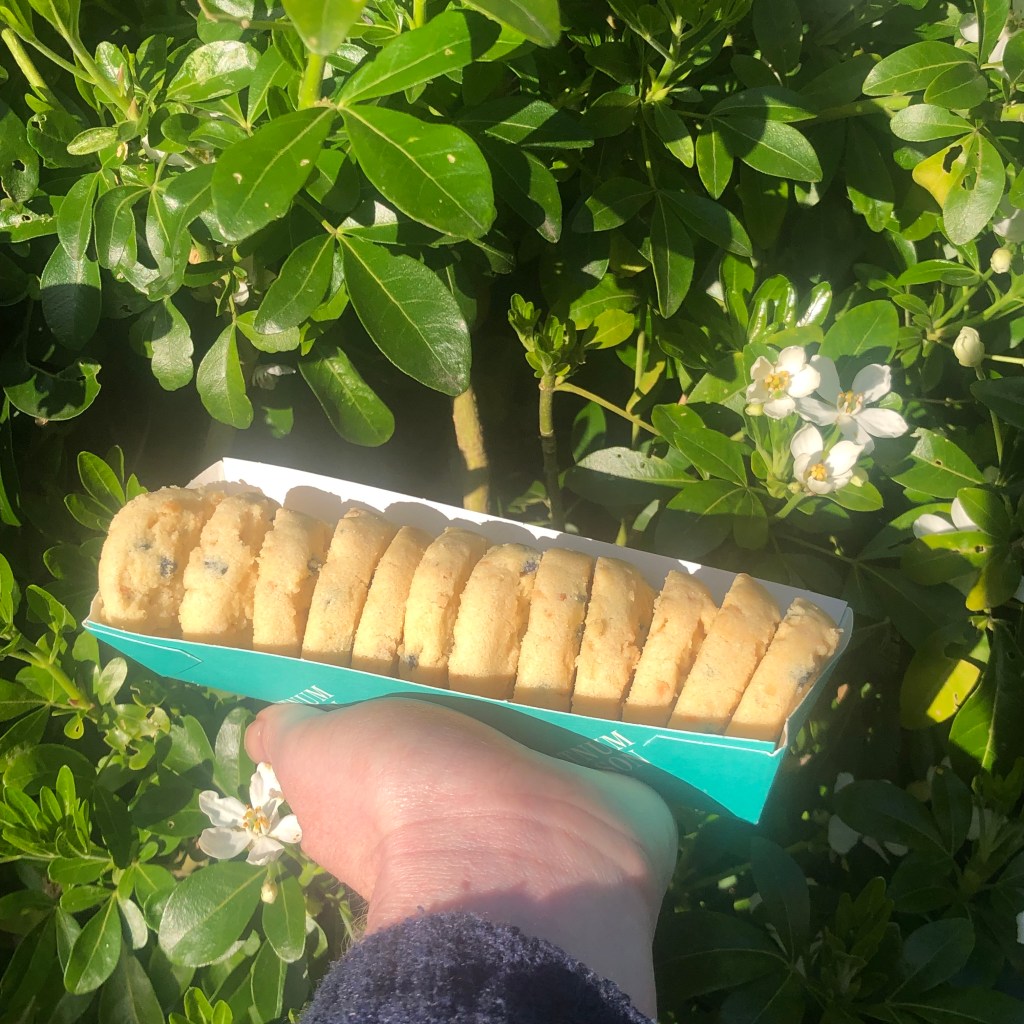
I don’t normally shop in Fortnum and Mason’s in Holy Week – or in many other weeks – but they produce some rare and special biscuits not easy to find elsewhere. And so a few days ago, I ventured into their gleaming, plush, oppressively crowded store once again in search of an elusive biscuit quarry. The magnificent tin they came in is tall enough to house an umbrella, which I may use it for once the contents have been eaten…

At £14.95 a pop, Fortnum’s Violet Biscuits were no idle purchase but a deliberate pursuit of a creation that caught my eye. Violets for me conjure images of Wordsworth’s She Dwelt Among the Untrodden Ways, in which the poet describes the beautiful, sheltered, overlooked life of a young woman whose death he mourns as ‘a violet by a mossy stone’. And although I wasn’t consciously thinking about it at the time, I later remembered that the flower is also the name of one of my grandmothers who also died young. So young her name is the only thing I really know about her.

There is no end to the biscuits that we like to invent, and this particular example is a true original. The crisp butter biscuits are subtly flavoured with French crystallised violets for a gently aromatic taste…” is what Fortnum’s have to say about the Violet Biscuits in their marketing. (Crystallising in this context means treating cut flowers with a sugary compound.) As well as the ingredients you would expect from a regular butter biscuit, they contain violet fragments and indigo and carmine colouring. You can see the flecks of crystallised violet in the mixture but it was the taste that was the real surprise. To me these biscuits looked and sounded delicate but when you bite into them you get a powerful, almost medicinal, hit that I can only describe as an old fashioned sweet shop taste (think Swizzels’ Parma Violets which are still produced today apparently). Far from shrinking from your taste buds, these violets could definitely hold their own against a cup of Earl Grey and maybe even a cup of coffee.

So what have these Violet Biscuits to do with Holy Week? Well, for me it was the continuation of a journey that started with a flash of purple. A purple scarf to be exact and the comment of a young woman called Anna, whose church I was visiting, that purple was the colour of the robe the Roman soldiers draped Jesus in hours before he was led away to his crucifixion. An ugly moment in a series of ugly moments culminating in the appalling spectacle of the cross. I don’t know why but when she said that I found myself moved by that flash of purple. I think because it felt like a tangible link to him. The robe itself is mentioned in all four gospels. In Matthew it is described as a scarlet robe. Luke doesn’t mention a specific colour but uses a word that can mean white but is more often translated elegant or splendid, but in both Mark and John it is purple.

Purple was an expensive colour in the ancient world (and the medieval one for that matter), the colour of royalty and empire, particularly of Roman power. Tyrian Purple, a dye named after its traders from Tyre, was painstakingly produced one drop at a time from the glands of two different kinds of shellfish and restricted over time to persons of more and more influence. Shifting perceptions of colour may help to explain the gospels’ chromatic variations (although this different take on it by James Bejon is lovely too). Pliny, born around 20 years after Christ, describes imperial purple as the colour of clotted blood. Like the violet of these biscuits, the robe was (a) costly, or had probably been so once, and (b) some kind of scarlet-purple. It also would have made an impact like the strong medicinal taste these edible violets had, a connection also brought out in the medieval Anglo-Norman etymology of the word violet (and indeed, the flowers were used in medicine as well as baking).

Where the soldiers got the robe from isn’t clear but what is clear is that they were using it to make sport of their celebrity prisoner, stripping him of his clothes before dressing him in it and fashioning a circlet of thorns to ‘crown’ him too. In doing so they were mocking his claim to be the King of the Jews, the title he would shortly be crucified under and which he accepted from Pilate, the Roman governor of Judea, while stating that his kingdom was different from any earthly king’s. The encounter between Jesus and Pilate is an extraordinary one, not least because of Jesus’s behaviour under questioning. When he answers, it is collectedly, speaking always from a place of quiet assurance. When he keeps silent, the governor finds it baffling. “Don’t you realise I have power to free you or to crucify you?” Pilate asks the prisoner, bewildered. He becomes increasingly bewildered the more he questions him.

It is in John’s gospel that Jesus’s appearance in the robe is most striking, as Pilate brings him out and presents him to the crowd with the words Ecce Homo (Behold the Man). They are words that suggest Pilate was not without a sense of the drama of that moment, but he could not have anticipated how they would echo on down the years. To look at a thing is very different from seeing a thing, Oscar Wilde once wrote, and for the artist as for the contemplative the command to look becomes an invitation to pass from looking to seeing. The invitation to look – or to look again – becomes an invitation to consider what we may have missed previously.

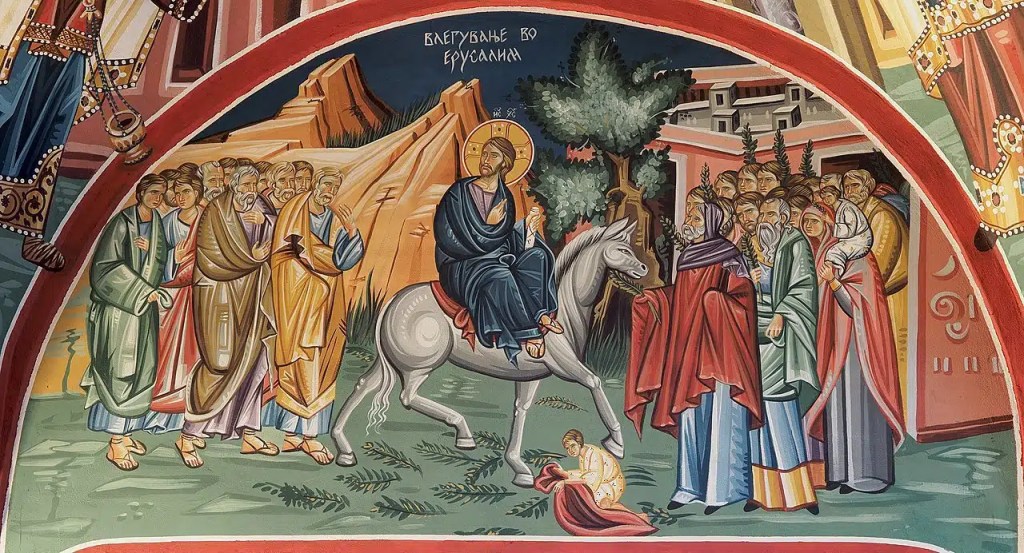
Not surprisingly, that image of Jesus standing alone in his purple robe has been so frequently depicted by artists painting what they see, that it is now, quite literally, iconic. This is how much of the Orthodox Church depicts the bruised and bloodied figure of Christ before Pilate and the crowd. And yet it is traditional for these icons to use a different title from the one you might expect in the circumstances. Not Christ the Suffering Servant (although he is that) or Christ the King (although he is that as well) but Christ the Bridegroom. How so?

Commentators usually link this decision to the image of Christ in the Parable of the Ten Bridesmaids. However, it is the power of icons as all symbols to become rich repositories of meaning over time. As I considered the story again this Holy Week, I was reminded of one of the most famous medieval mystics’ writings on the Passion, Julian of Norwich. A remarkable woman who lived a life of religious seclusion as an anchoress for much of her life and who in seeking to understand the Passion better was granted an unusual series of beholdings in a vision of Jesus’s sufferings, later written as her Revelations of Divine Love. In one extraordinary dialogue in the text, Christ tells Julian that not only did he gladly undergo all his suffering for the sake of his creatures but Every day He is redy to the same if it myght be. For if He seyd He wold for my love make new Hevyns and new Erth, it were but litil in reward, for this might be done every day if He wold, withoute any travel. But for to dey for my love so often that the noumbre passith creature reson – it is the heyest profir that our Lord God myght make to manys soule. (Every day He would be ready to do the same, if he could. For if He said he would for my love make new Heavens and new Earth, it would be a little thing in comparison to suffer every day for me. It wouldn’t be hard for him. To die for my love so often the number passes reason is the greatest offer our Lord God could ever make to the souls of humanity). Perhaps it is her own revelation, her paraphrase, of one of the Bible’s great prophets and visionaries: “He shall see the fruit of his soul’s suffering and be satisfied; by his knowledge my righteous servant shall justify many”. Either way we seem to catch a tiny glimpse in it of the face of the blissful Bridegroom looking at us through the blood and the bruises, the scarlet and the purple. The one who, as the author of the Book of Hebrews says, “for the joy set before him endured the cross,” who both wore – and deserves to wear – the costliest robe.

“Surprised by Joy” an Easter Garden, inspired by Nine Elm’s Arts Ministry’s Soul Space.
Further Reflection

Some of the readings from Plough that have kept me company this Holy Week: In the Holy Land, Seeking the Solace of the Cross and His Cross is Every Tree: The Poetry of the Passion by Chris Zimmerman.

One of Orthodox composers John Tavener’s most haunting pieces, ‘Christ the Bridegroom’.

A link to the Middle English text of Julian of Norwich’s Divine Revelations if you want to read it and a Julian-inspired reflection on suffering and love. And here is an icon of her (rather charmingly I found out she is traditionally depicted with the little cat who kept her company in her cell!)

If you would like to see more entries more regularly and help keep this bestiary free of ads, you are welcome to contribute to the Biscuit Jar.

Border Lemon Drizzle Melts

I was lucky enough to take a little holiday in a remote part of Argyll this month, and the owners of the cottage we rented provided us with complimentary biscuits. Border is a well-known, well-loved Scottish biscuit brand although I didn’t recognise them at first because of the new packaging. I’m very partial to their Dark Chocolate Gingers but this was the first time I’d come across a Lemon Drizzle Melt on either side of the border.

The LDM is an exceptionally soft, citrusy butter biscuit with the sort of ‘drizzle’ icing you associate more with lemon cakes in a satisfyingly regular zig zag pattern. These really are melt-in-your-mouth good and with the Argyll weather being drizzly for at least a few hours on most days, it seemed appropriate to retreat to the attic now and again with a LDM and a cup of tea. Although they may be harder to come by in England, I’m going to have to search for them here now I know they exist. In the end I think I managed to put away three from our complimentary box, not without strong competition from the rest of the family.

It didn’t occur to me at the time but the LDM’s citrus flavours and drizzle motif are in keeping with some of themes prevalent in the festival of Tabernacles or Sukkot, which fell in the week I was on holiday. Sukkot is the one festival in the Old Testament or Jewish Bible the Gentiles (i.e. the non Jewish nations) are enjoined to celebrate – so much so that in Zechariah 14 we are told that any nation that does not send representatives up to Jerusalem for it will get no rainfall! I don’t suppose people pray for rain much up in Scotland, but in a hot and dusty Middle Eastern country it’s customary to pray for it during Sukkot. In Jesus’s time, on the last and greatest day of the feast, the offerings in the temple would have included lavish libations of water drawn from the spring of Gihon. It was this day of the festival that was the context for his promise that all who believed in him would flow with living water…

These days many Jewish families construct their own sukkah, an open-air booth or hut covered with branches, and take their meals (and sometimes sleep in it) during the eight day holiday, to remind them of the temporary dwellings their ancestors lived in for forty years in the wilderness. It’s meant to be a joyful festival, but there is also an important life lesson here: “a tutorial in how to live with insecurity,” as the late great Jonathan Sachs put it.

…we sit in a sukkah, the tabernacle itself, which is just a shed, a shack, open to the sky, with just a covering of leaves for a roof. It’s our annual reminder of how vulnerable life is, how exposed to the elements. And yet we call Sukkot our festival of joy, because sitting there in the cold and the wind, we remember that above us and around us are the sheltering arms of the divine presence…

Illustration of a sukkah (1300s Italy) from the British Library.

Perhaps that message has greater resonance for us all this year, certainly in Britain when in the space of just a few weeks we have been subject to rapid change in government. The phrase ‘safe as houses’ no longer seems to apply to many bastions of security, not even our Houses of Parliament. And yet we are truly fortunate in being preserved from greater insecurity still: from the devastations of war, of natural calamities and the civil unrest we are seeing elsewhere in the world.

Amid all this shaking – national and global – there is an invitation to put our trust in God: “Oh Lord, you have been our dwelling place for all generations,” Psalm 90 tells us, one of the prayers of Moses who led the Israelites when they lived in their temporary dwellings in the wilderness. Come rain or shine, sweet or sour, maelstroms or meltdowns – he is our refuge – our forever home. Not a bad takeaway for the Lemon Drizzle Melt (which also makes a good takeaway with a strong cup of tea this rainy October!)

Further Delectation

When life gives you lemons make lemon biscuits… Here’s a tasty looking recipe.

Know your Etrog – some handy information on the ancient citrus fruit associated with Tabernacles.

Drawn to Celtic Climes? Pray through the changing seasons with Celtic Daily Prayer.

For when you just need to escape for a bit… Some beautiful music from House of Waters:

If you would like to keep this bestiary free from ads and see more entries more regularly you are welcome to contribute to the Biscuit Jar.

Baked Apple and Custard Biscuits

I’ve yet to delve very deeply into the subject of Artisan Biscuits but earlier this year my friend Rachel gave me a box of these Baked Apple and Custard Biscuits from Bath’s Fine Cheese Company. It’s no secret I’ve eaten a lot of biscuits over the years but these are so good they immediately found a home in my Top Ten Biscuits Ever*. Adding dried apple pieces to a butter biscuit recipe produces a biscuit which tastes a lot like Apple Crumble, which is an excellent thing if you like that dessert as much as I do. Here they are in the garden sitting in the shade of the fig, the very image of biblical prosperity and contentment:

The only down side to these biscuits is that they’re so Elegant and English they give off a slightly formal afternoon tea vibe when arranged on a plate which makes you feel you should limit yourself to two or three while inwardly wrestling your inner cookie monster. If you want to eat a few more of them without feeling it incumbent on you to move on to the cucumber sandwiches, I recommend serving them in their rustic-looking container.

An irresistible apple-flavoured biscuit seemed a natural set-up for the story of the Fall, however if you read the account in Genesis 3 no apple is mentioned. Exactly what sort of fruit caused humankind to crumble doesn’t concern us here but this post provides an excellent opportunity to discredit the rumour – probably put about by the same serpent that got Adam and Eve into trouble – that apples get a bad press in the bible.

In fact, apples get an overwhelmingly good press in the bible. Here are just a few of the references to them from The Song of Songs: “Refresh me with apples for I am faint with love.” “Like an apple tree among the trees of the forest is my beloved among the young men. I delight to sit in his shade, and his fruit is sweet to my taste.” Solomon must have been a fan of the humble pippin as they appear in Proverbs as well, where “a word fitly spoken is like apples of gold in settings of silver” (25:11). And they are frequently used idiomatically in the idea of a person or a people being the dearest objects of God’s care and attention: “Keep me as the apple of your eye, hide me in the shadow of your wings,” is the prayer of Solomon’s father David in Psalm 17, familiar from the liturgy of Compline.

Detail of God planting the Garden of Eden, Naples c. 1350. Paris, BnF, Français 9561, fol. 7r

There’s more than a hint too that God has a soft spot for fruit trees and their cultivation. “The Lord planted a garden” must be one of my favourite lines in the bible, offering a glimpse of what he was doing at the dawn of human history: making trees grow. Years later, Mary Magdalene mistook the risen Christ for a gardener and it’s Jesus who offers us one of the most beautiful gardening metaphors for the work of the kingdom: “I am the true vine, and my Father is the gardener. He cuts off every branch in me that bears no fruit, while every branch that does bear fruit he prunes so that it will be even more fruitful.”

“If you abide in me, and I in you, you will bear much fruit…”

John 15

I’m still learning what this means to be honest but part of it is recognising that it’s only in so far as we make time to attend to God that we’ll be able to communicate something of his presence to others and cultivate the fruit of the spirit: those refreshing characteristics of love, joy, peace, patience, kindness, goodness, faithfulness, gentleness, and self-control. While it can be hard to remember this truth let alone feel it to be true on a Monday morning, the spiritual life consists in waking up, looking up and engaging with this life that is the wellspring of our lives, however hidden. So much joy, strength and purpose flows from this connection that it’s worth cultivating. Not by straining but by resting. Not by fretting but by trusting. Not by leaning on our own strength but in drawing on his – and the fruit will come.

Further Delectation

Wondering what artisan food is? You can find a helpful discussion here (lots of foods would have qualified as artisan in the Middle Ages!)

BBC Good Food’s guide to throwing an afternoon tea party (how high?) Topical as this is supposed to be #AfternoonTeaWeek.

Try this recipe for Apple Crumble Cookies (a good way to occupy small hands on school holidays) courtesy of Jamie Oliver. Only five ingredients needed.

A lovely song inspired by the abiding theme of John 15 by Aaron Williams.

Me Want It But Me Wait“. Cookie Monster cultivates self-control as a fruit of the spirit.

In medieval bestiaries, hedgehogs were thought to use their spines to gather up fallen apples (a story that may have originated with Pliny the Elder, and which was used as a warning against devilish thefts). Here are some ways to support hedgehogs in real life and a fantastic image of them rolling in apples from a thirteenth-century bestiary:

From BL MS Royal 12 F XIII, fol. 45r

* a highly selective and subjective list, but a list nonetheless.

If you would like to keep this bestiary free from ads and see more entries more regularly you are welcome to contribute to the Biscuit Jar.

The Elisabeth Biscuits

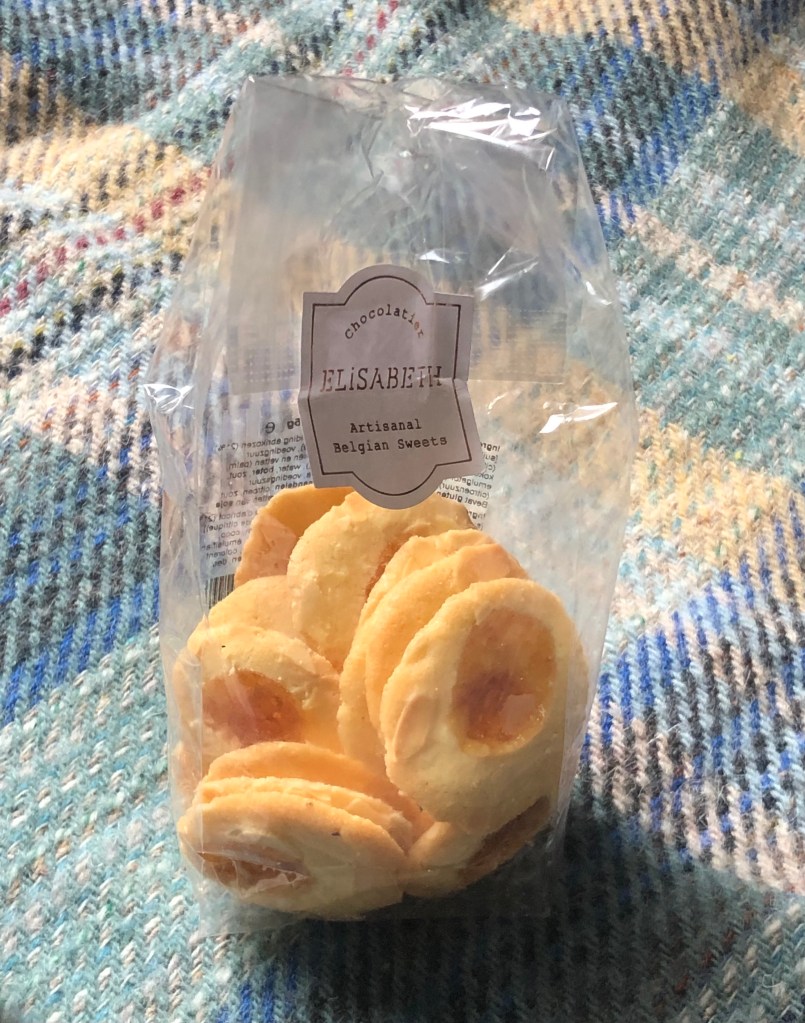
My sister and brother-in-law went on a little break to Bruges in May, making up for lost travelling time during the pandemic. I caught up with them briefly at St Pancras on their way back and they gifted me these goodies from Elisabeth, a chocolatier with outlets across Belgium. According to their website, “Elisabeth’s lady owner travels all over the country to taste and select famous Belgian delicacies as well as long forgotten local culinary traditions” and this carefully curated collection includes these Aprikozenkoejke (apricot cookies) which I now think of as the Elisabeth Biscuits. Small delicate buttery drops with flaking of almonds and a pane of apricot jam in the middle, suspended like stained glass in a window… I’m quietly fascinated by the jam’s viscosity set in just such a way that it holds its shape.

It was a few days after I’d received the Elisabeth biscuits that I thought to connect them with that other Elizabeth whose seventy year Platinum Jubilee is being celebrated in the UK over four days of holiday this week with numerous street parties, beacon-lightings, pageants, fly-overs, and so on. Although differently imagined in our day, this sort of spectacle is one of the threads that connects modern Britain with its medieval past as the monarchy itself does (also differently imagined). And of course festive food…

More than ever these last few years I have appreciated the Queen’s dignified compassionate influence on public life, especially when those qualities have felt in short supply elsewhere. The steadfast manner in which she’s weathered so many storms and the whole character of her reign is proof that the art of viscosity – of holding firm under pressure – can be incredibly valuable in the right cause. There’s a verse in Psalm 15 where David asks who is worthy to dwell in God’s tent (i.e. in God’s presence) and one of the answers is a person who keeps their oath, even when it hurts – a line I’ve always found strangely moving. Ultimately of course it’s only God who is able to keep all of his promises perfectly, but whenever we find human examples of promises faithfully kept over many years it’s worth celebrating.

It’s hard to think of anyone who has kept a weightier promise as long or as faithfully as the Queen, so I find it apt that her name signifies oath-keeping. ‘God’s promise’ or ‘God is my oath’ are frequent translations of the name Elizabeth in Hebrew, as well as ‘God of the Seven’ which makes more sense when you realise that it’s the biblical number of completeness, abundance, or divine perfection. Seven cycles of seven years is also the number for a biblical jubilee: a year set apart for the returning of mortgaged lands, the freeing of slaves and prisoners, and the cancelling of all debts from the years preceding it. While this Jubilee is more about giving thanks for this particular milestone in the Queen’s long life of dedicated service, both uses of it carry the idea of a window of blessing and favour.

Restore our fortunes, O LORD,
like streams in the Negev.
Those who sow in tears
will reap with shouts of joy…

And in all these threads we touch into the great themes of redemption and covenant that make up the heart of God towards each and every one of us: of the freedom he works for us if we’ll let him and the promises he makes to us if we’ll have him – of his longing always to redeem, restore and relate. The Elisabeth biscuits for me are another reminder of that faithfulness over the years and the faithfulness it inspires in others. I hope Her Majesty gets the chance to enjoy a well-deserved biscuit or two this Jubilee weekend, and the esteem in which she’s held by so many of us.

Further Delectation

I’m glad I got the chance to watch the Thanksgiving Service in St Paul’s yesterday with a friend and more of the Elisabeth biscuits (I’ve taken them on several lovely outings this week and still not come to the end of them). The sermon from the Archbishop of York is worth a listen/reflection.

Baking for the holiday? The official dessert thing looks a bit fiddly so here’s the recipe for Her Majesty’s favourite chocolate biscuit cake instead (excellent choice, Ma’am). And for anyone who missed it, here’s a clip of her party at the palace with Paddington Bear.

I’m old enough to remember the Jubilee 2000 campaign in which many churches in the UK mobilised to help petition the richest countries in the world to cancel the debts of the poorest. The work it started is far from over. Learn more about it here.

A nice royal coat of arms from one of the British Library’s royal manuscripts:

Detail from BL Royal MS 18 A XII f. 1

If you would like to keep this bestiary free from ads and see more entries more regularly you are welcome to contribute to the Biscuit Jar.