Egyptian Kakh

Just when most Christians in the West are taking down their Christmas trees, Christians in the East are breaking their Advent Fast, so this 7th of January may I wish you a very happy Orthodox Christmas in the company of some Egyptian Kakh? Kakh are probably the closest Egypt comes to a national biscuit. They are traditionally made as treats for both Christian and Muslim festivals, and were probably eaten in some form or other as far back as the time of the Pharaohs, which means they may actually be the oldest biscuit to be featured on the Bestiary thus far. So it seems fitting they are associated with the High Holy Days of one of the world’s oldest Christian communities: the Coptic (Egyptian Orthodox) Church.

Disclaimer: I don’t know much about the Orthodox Church but what I do know was enriched by an ecumenically-minded ‘taster day’ of sorts at Southwark Cathedral last year (although it did not include any tasting of Kakh). The programme featured talks from representatives of the Eastern Orthodox and Oriental Orthodox Churches as well as British icon maker Aidan Hart. Brief as it was it communicated something of the understanding of the nature of God and the life of faith the Orthodox have stewarded through the ages that impressed me with its beauty, discipline, and reverence for mystery and holiness. Elements we have not always reflected as consistently in our traditions in the West. As Hart reflected, “the secular world is more likely to try to sedate us than to kill us”. One of the insights I took from his talk was that worship in the Orthodox Church is about trying to wake us up. At its best, the Orthodox imagination views everything created: people, animals, the whole of the natural world: as a mystery alive with the glory of God, who is himself the greatest mystery and source of all beauty and wonder.

The Nativity by Coptic icon-maker Isaac Fanous (1991)

In the Coptic Church, the discipline of fasting is yet another means of waking our sleeping souls a little. The meat and dairy-less fasts of Lent and Advent might seem austere to a bumbling Anglican, but there are good biscuits waiting for us on the other side: Ghorayebah and Egyptian Petits Fours, as well as Kakh: essentially a type of butter cookie filled with dates or figs or nuts. I did think about having a go at making some myself before buying this box of them from a Middle Eastern specialty supermarket near Baker Street. I couldn’t find date or fig ones which would have been my first choice, but took a punt on these Kakh with Malban (Egyptian Turkish Delight) made in Cairo by Egyptian biscuit company BiscoMisr:

The Kakh in the BiscoMisr box came separated in ones and twos in plastic compartments with packets of sugar for dusting. I’ve found out since that it’s natural for Kakh to crumble at the slightest pressure. And these ones crumbled spectacularly, not just into fragments but into a sort of biscuit dust which made eating them elegantly quite a challenge. “Not a biscuit for dipping!” remarked the friend I was taste-testing them with and she was right. The buttery flavour was pleasant but some of them could have done with a bit more of the sweet filling, as you can see from the picture below. “They might be good with coffee,” another friend suggested at a gathering at the weekend “but I’d only give them 4 out of 10” (although this relatively low score didn’t stop him going back for another one). As I’ve carried on eating them, however, I’ve grown to like them better, especially the ones with the citrus-flavoured Malban. Although they’re really meant as festive biscuits they are a handy size for work coffee breaks (and yes, probably better with coffee than tea).

The dustiness and crumbliness of the BiscoMisr Kakh reminded me of the desert fathers and mothers whose adventures with God in the Egyptian desert helped to lay the foundation for the great monastic movements of the Middle Ages. Henri Nouwen’s The Way of the Heart is a beautiful reflection on their influence and retells the story of Antony of Egypt (251-356), the Coptic Saint whose feast day is later this month. Famous for his life of asceticism and solitude, as a young man Antony sought to detach himself from the world in order to attach himself to God. His friend and biographer, St. Athanasius depicts him alone in the desert wrestling with demons. It seems the demons – imagined by Nouwen not as devils with pointy horns but as a host of addictions, fears and compulsions – became much realer to Antony in the desert. But God became realer too, until after twenty years he emerged with a new inner freedom.

Saint Anthony by Claire Barrie

I suspect Nouwen chose his title, The Way of the Heart, because so often this is also the Way of the Desert. “Remember how the Lord your God led you all the way in the wilderness these forty years, to humble and test you in order to know what was in your heart…” Moses tells the people of Israel. Moralists like to talk as if our experiences of emptiness, renunciation or deprivation are valuable aids in strengthening character but they’re also a way of exposing the character that is already there. The desert reveals the true condition of it. If there is any bitterness, pollution or debris in the soul – any flash of ego or mixture of motives – it will show it up. The Bible teaches us that the heart is the wellspring of life so if we want what flows from our hearts to be life-giving, we need to be willing to allow God to help us heal them where they are not healthy, and purify them where they are not pure.

And the moral? Like the great feast after the great fast, or the singing after the silence (or like the Malban at the centre of the Kakh), if God sends you into the desert, he will look after you there. And even if you’ve landed there without his invitation, like a depressed and depleted Elijah, he can still meet you in it. On his return from the desert, “the place of great struggle and great encounter,” Henri Nouwen writes: “Antony took his solitude with him and shared it with all who came to him. He had become so Christlike, so radiant with God’s love.”

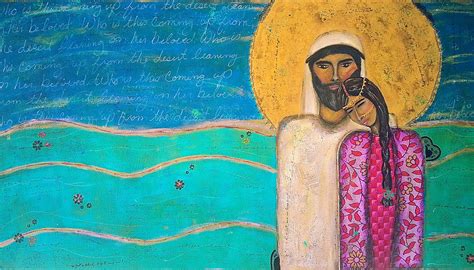
“Who is this coming up from the desert, leaning on her beloved?” Song of Songs 8:5. Credit: Danielle Bilen

Further Delectation

More on Coptic Christmas in Egypt and outside it, and on the history of Kakh and a recipe for making them.

More on icons and icon-making: “Hope and Fragility: An Interview with Coptic Iconographer Stéphane René from Orthodox Arts Journal.

More on Antony and the Desert Fathers from Bishop Erik Varden as part of a new podcast, The Desert Fathers in a Year.

More on Henri Nouwen’s The Way of the Heart.

If you would like to see more entries more regularly and help keep this bestiary free of ads, you are welcome to contribute to the Biscuit Jar.

Sju sorters kakor

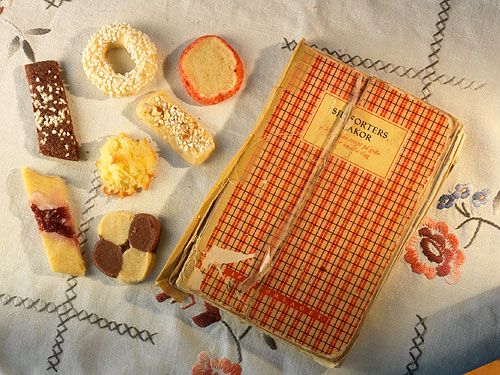
One of my favourite memories of 2024 is the Saturday in late February I joined a group of other artists for a retreat day. We spent part of the morning drinking coffee together near the ruins of a medieval monastery and I found myself in conversation with a lovely Swedish lady. The talk turned to biscuits – as it is apt to do with coffee – and she asked me if I’d ever heard of the Swedish sju sorters kakor (seven types of cookie) tradition? Reader, I hadn’t, but it’s been around since the late 19th century, becoming really popular in Swedish social circles in the first part of the 20th where it inspired the iconic cookbook Sju Sorters Kakor by Ica Provkök.

Photo credit: Paulina Bjork Kapsali

I learned the seven cookies custom is exactly what the name suggests: inviting your friends over for seven kinds of cookie. Why seven, you ask? Well, studies suggest it is the goldilocks zone of hospitality in Sweden: offering your guests only six kinds of cookie might look stingy but more than seven could be construed as over the top. Similarly, the guest’s etiquette is to sample no more than six of the seven types of biscuit offered as to gobble the full seven might suggest your host hadn’t provided enough. If all this sounds like a social minefield, it’s really not intended that way. More an opportunity to showcase seven wonderful cookies at once…

From Bageriet: Covent Garden’s Swedish Bakery

The idea of preparing seven types of cookie to offer your fika (coffee break) guests might sound daunting, but the trick is to use a base dough and add different ingredients to smaller batches to create different species from the same genus. Even with this hack in mind, I didn’t try making seven kinds of cookie on a first go but supplemented the three I’d baked with two professionally baked ones and two alternative recipes from my friend Katka, who had kindly made me some Czech biscuits as a Christmas gift (I fully appreciate that the Czech Republic is not part of Scandinavia but her Linecké Cukroví were a delicious alternative to the Swedish Hallongrottor or ‘Raspberry Caves’).

This plate of offerings was the end result. The pink-rimmed biscuits closest to the centre are courtesy of Bageriet in Covent Garden, which sells many of the traditional biscuits used in sju sorters kakor selections. Their ‘Brysselkex’ (Brussels Biscuits) look like something from a fairy tale and are dry, sugary and delightful. Clockwise around the plate we have my round version of ‘Chokladsnittar’ (Chocolate Slices). I didn’t have any nib sugar to decorate them so I opted for desiccated coconut. Next up we have Katka’s lovely little Linecke Cukrovi, followed by my rendering of Swedish ‘Gaffelkakors’ (fork biscuits) dusted with cinnamon. The biscuits with almonds on are Bagariet’s ‘Pepparnötter’ (Pepper Nuts) – possibly my favourite-tasting of the Swedish biscuits (these are traditional for Christmas and the spice combination is wonderful). Biscuit number six is another Czech masterpiece: a nut-flavoured biscuit in the shape of a star and a delicious equivalent to the Swedish ‘Nötkakor’ (Nut Biscuit). And lastly we have my rather less successful attempt at the Chessboard Biscuits popular in sju sorters selections. They seemed easy in the recipes but I hadn’t factored in the dough’s squidgy-ness, resulting in somewhat skewed boards that would have been less out of place in a surrealist painting.

St Lucia Day illustration by Petra Lefin

It feels especially fitting to write about this Swedish biscuit tradition on the Feast of St. Lucy: a feast that falls at the heart of Advent and coincides with the darkest nights in the Western calendar. While it’s not much celebrated in Britain, in Sweden Luciatag is a high point of the year. Gingerbread and saffron buns are eaten and it’s customary for girls to dress up as Lucy leading a procession of maidens, ‘star-boys’, and ‘gingerbread children’ with glowing lights. Famous for bringing food to persecuted Christians in hiding, Lucy herself is linked with both light and biscuits, the more romantic legends depicting her carrying a plate of baked goods through the catacombs wearing a wreath of candles to illumine her steps. In a country with fewer than seven hours a day of sunlight in winter, this visual reminder of the light putting the darkness to flight – literally and spiritually – provides a vision of comfort and light for the soul when it’s most needed.

And the moral? Well, seven as a number is closely associated with God’s work and spirit in the Bible, from the seven days of creation to the seven spirits and lamps before heaven’s throne. Whether or not the Swedish bakers of the sju sorters kakor traditions were aware of this their carefully specified number of biscuits signifies divine abundance, perfection, and completion. If six is man’s number, seven feels like God’s. And this brings us to the heart of Advent with its calendars and candles. The church’s great season of counting the days till Christ’s coming, and God’s doing for us what we could never do for ourselves. Waiting for humanity to save itself would be exhausting, hopeless even. But Advent is about waiting for God to act for us. “The Lord is good to those who wait for him, to the soul who seeks him…” (Lamentations 3:25) Glad Lucia to all who celebrate it and God Jul (Merry Christmas!) when it comes.

Further Delectation

More about Lucia and the sju sorters kakor tradition in Sweden.

More on Brussels Cookies from The Swedish Spoon, a great baking blog for all thing Swedish.

A little taste of St Lucy’s Day (with beautiful singing!) from Lund University:

If you would like to see more entries more regularly and help keep this bestiary free of ads, you are welcome to contribute to the Biscuit Jar.

Amaretti

My friend Katka appeared on the doorstep early in Advent with a tub of homemade cookies and these rather impressive looking gift biscuits. I saw the tin and thought you might like it for your biscuit blog she texted me with a winking emoji 😉 and she was right. The makers of this particular brand, Amaretti Virginia, have been baking biscuits since the 1860s and are now a household name in Italy and all over the world. Virginia are famous for their soft Amaretti, ‘morbidi’ in Italian, although they also make the crunchier, drier ‘secchi’ too. Both types of classic Amaretti are included in this selection along with Baci di Dama and mini Cantucci.

I’ve always thought of Amaretti as sweet coffee or dessert biscuits so it was a surprise to find that the name means ‘little bitter things’ and derives from amaro, the Italian word for bitter. This is apparently because of the bitter almonds or apricot kernels originally used as a base but if you sampled them without knowing what the name means you’d never guess. The sugar and almond content is so high the soft Amaretti in particular taste like marzipan which gives them a distinctly Christmassy vibe.

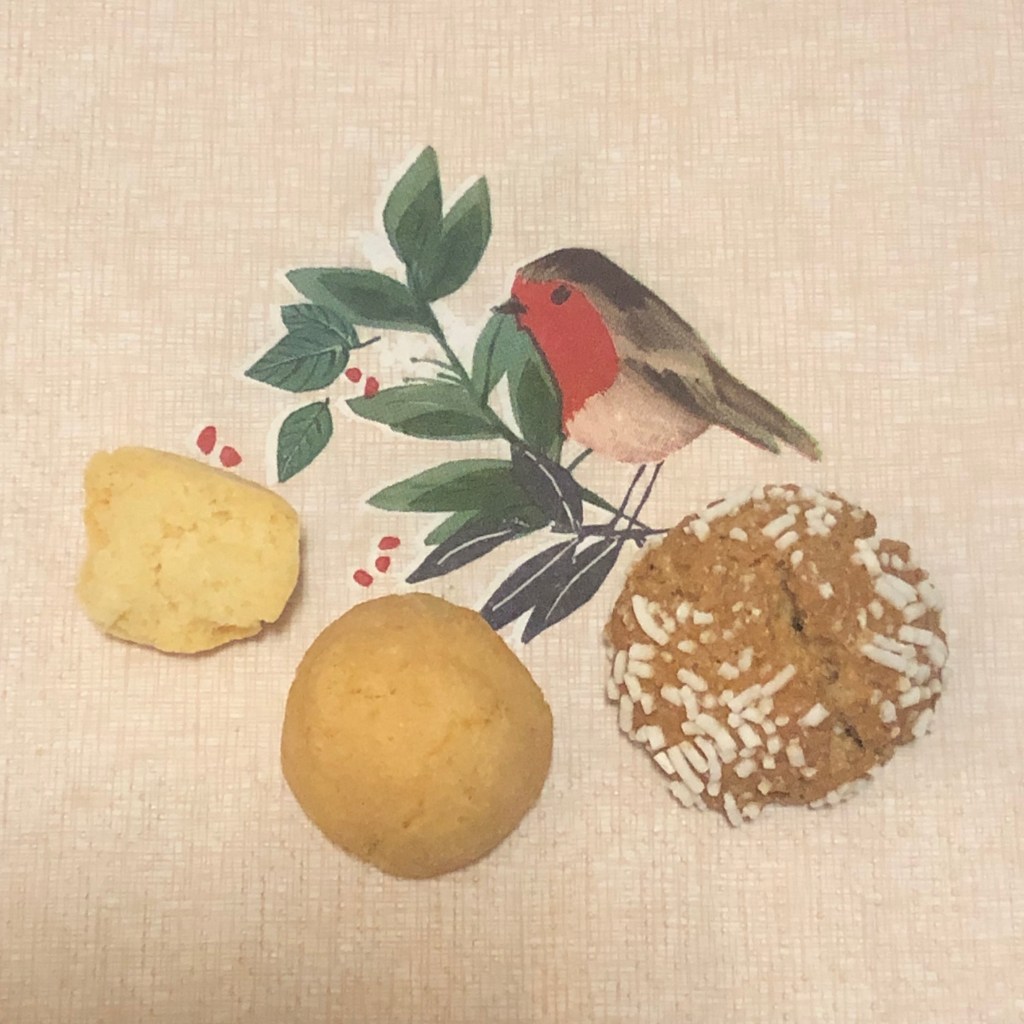
I certainly appreciated the Amaretti travelling to North Yorkshire this Thursday when the train service was subject to cancellations and delays as a result of Storm Pia. After a number of unplanned dramas at Kings Cross (including managing to lose one bag of presents in the crowded station for twenty minutes before recovering it), I eventually arrived in Leeds on a jam-packed service three hours later than planned and without a cup of tea or anything substantial in the way of lunch. But I can honestly say that I spent the journey contentedly, listening to Jonathan Ogden’s music and nibbling on the Amaretti I had stowed away in my hand luggage. Here they are arranged to best advantage on one of the Christmas napkins I’d also brought with me (morbidi on the left and crunchier secchi to the right).

One of my happiest memories of 2023 was making a retreat to a remote part of South Wales, what the old Celtic Christians would have called a thin place due to the amount of prayer that’s gone up here. I went looking for God in the stillness and found him in conversations with various people who crossed my path in the course of the week. One particular chat I keep coming back to was with a lovely Christian father from the Antipodes visiting with his family. Unbeknown to him, he was offering a masterclass in how to deal with disruptions and re-routings. I had heard that their car had developed serious problems on the journey to the retreat place which had left them all stranded in the middle of nowhere for several hours but when he talked about the experience he was full of thankfulness to God for having got them safely to their destination in spite of all the difficulties. “We didn’t even think to pray,” he told me, “but at every point we needed it help just… appeared. We were looked after every step of the way.”

Carningli (Mound of Angels), Pembrokeshire

He kept returning again and again to this theme of the goodness of God as the bedrock of the universe, not denying the pain that is also part of the human experience but focusing on the one who comes to bring us life in all its fullness – the God who is not the author of evil and is always working to bless, heal, encourage and restore. I knew this in my head, of course, but hearing this young Australian father speak so warmly about that goodness made me wonder how much I had allowed that knowledge to permeate my heart.

“Give thanks to the Lord for he is good
His love endures forever…”

Psalm 136

The Psalms are full of declarations of God’s goodness. Not only because it is true but because keeping this fact continually before us actually helps us perceive more of that goodness. I got the chance to practice looking for it in the minuscule and very first world challenges of this week: to see it in the kindness of the station staff, the good humour of fellow passengers, the recovery of my lost luggage and the provision of a seat despite the train being so crowded, in the texts from concerned family and friends who remembered that I was travelling, and of course the Amaretti in my bag… Like the sweet tasting biscuits originally made from bitter ingredients, it’s all a question of where you put your focus.

It also helps to remember that God is not only the ultimate source of all the goodness we see in the world, there’s also so much good he wants to do in it through us. And there are those who need to see God’s goodness at work in this world especially this year. As the season of goodwill, Christmas provides plenty of opportunities for making others’ lives brighter and better, whether giving time or money where it’s most needed or literally or metaphorically drawing together around a warm fire.

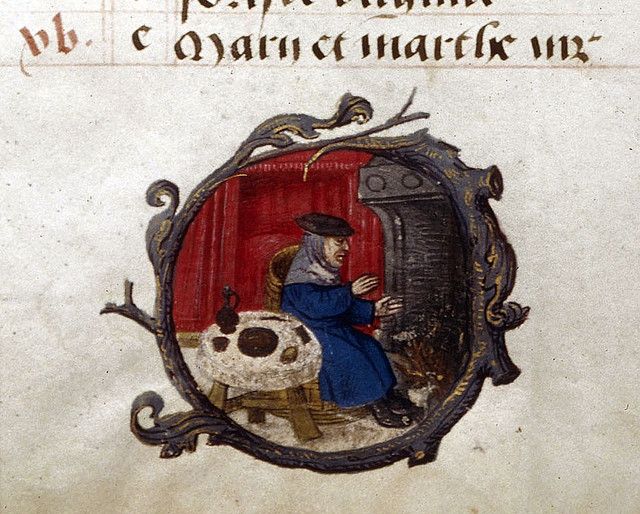
Illustration from a Book of Hours, Latin Belgium c. 1500-1550.

Wherever and however you are spending Christmas this year, I hope your Christmas is a good one. And whatever joys and challenges come your way in 2024, may you know the goodness of God in greater measure.

Further Delectation

Want to have a go at making your own soft Amaretti? I’ve not tried it but Gino D’Acampo’s recipe looks fairly easy.

Angela Ward’s podcast, A Beautiful Thing. Angela has been doing an Advent series on women in the genealogy of Jesus which is well worth a listen.

Finally, a bit of Yorkshire-style Christmas cheer from the wonderful Kate Rusby:


If you would like to see more entries more regularly and help keep this bestiary free of ads, you are welcome to contribute to the Biscuit Jar

Nürnberger Lebkuchen

One of my favourite edible Christmas gifts this year was a simple box of German Lebkuchen. This is the good stuff from Nürnberg, the historical home of these popular Christmas biscuits. As you may know, the medieval season of Christmas extends to Candlemas so I’ve been happily munching my way through them this Epiphany…

My friend Nicki who gifted them to me also sent me an article explaining that it was Bavarian monks who first created these biscuits in the fourteenth century using special wafers called oblaten as a base to build them on. It was an epiphany to her and to me to find out that this was essentially the same wafer used for Communion. Here’s a close-up viewed from the upper and lower sides so you can see it clearly:

It felt a little odd at first, but perhaps the idea that the same wafers used for the blessed sacrament should also be eaten in a mood of festive recreation is not so very strange when you remember the word holiday derives from holy day and connects back to older ideas about the observance of sacred leisure. These ‘traditionally built’ Lebkuchen are a surprisingly light bite given their size, not heavy in their texture but not insubstantial either, combining the Christmassy flavours of chocolate, ginger and citrus peel.

The unusual choice of the oblaten as the foundation for these biscuits got me thinking about foundations in general, which seems a good subject to consider at the beginning of the (modern) year. Unless the Lord builds the house the labourers work in vain, wrote Israel’s King Solomon, famous throughout the ancient world for his wisdom. This week I’ve been reading about the beginning of his reign again, of his magnificent building projects and scholarly works, and the discerning heart that God granted him to govern his people. By wisdom a house is built and by understanding is it established, through knowledge its rooms are filled with every precious and beautiful treasure is one of his many recorded sayings, a beautiful image that encourages me to think about how I want to fill all the ‘rooms’ of the year ahead…

King Solomon meeting the Queen of Sheba, c. 1700.

As Solomon suggests the way we order our lives – what we prioritise and choose to focus on – will determine what we are able to build on and in them. Sometimes the first step to doing this may in fact be digging deeper and even dismantling to support a better structure over time. In a similar way in the gospels Jesus compares the person who hears his words and put them into practice to a wise man who builds his house upon a rock: floods rose, gales blew and hurled themselves against that house, and it did not fall (Matt. 7). Perhaps the monks of Nuremberg saw an aptness in using the wafers used for the body of Christ as the foundation for their biscuits, much as Christ was held by the Church to be the foundation of God’s household, its cornerstone.

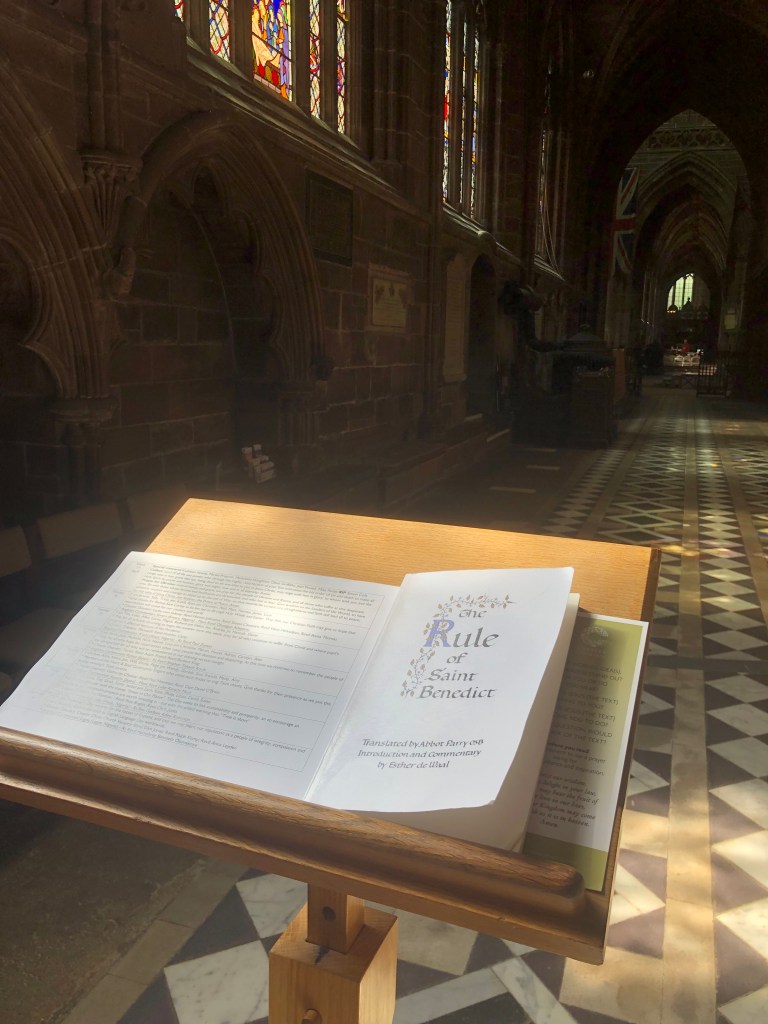
Always we begin again, St. Benedict tells us – author of the Rule that became a foundation text of the monastic culture that so profoundly shaped medieval Europe and generated extraordinary achievements in scholarship and creativity, not forgetting the Lebkuchen. Each year – each morning – can be an exercise in beginning, and if we aren’t quite sure how or what to start it can be helpful to examine our foundations.

Further Delectation

More about the history of Lebkuchen from The Daring Gourmet. (If you’re in the UK and would prefer to buy than make your own, you can get authentic Bavarian brands at a decent price from Lidl.)

Want a little taste of Christmas in Germany? More on how and where to visit Christmas markets in Bavaria.

From oblaten to oblates… As I write this, a kind Catholic friend at the London Library has just appeared with a copy of Esther de Waal’s book on The Way of St Benedict for me. Not a bad read to begin the new year.

Es ist ein Ros Entsprungen, a beautiful fifteenth-century German carol preserved in a monastery in Trier, set in this form by Michael Praetorius and performed by Solomon’s Knot:

If you would like to keep this bestiary free from ads and see more entries more regularly you are welcome to contribute to the Biscuit Jar.

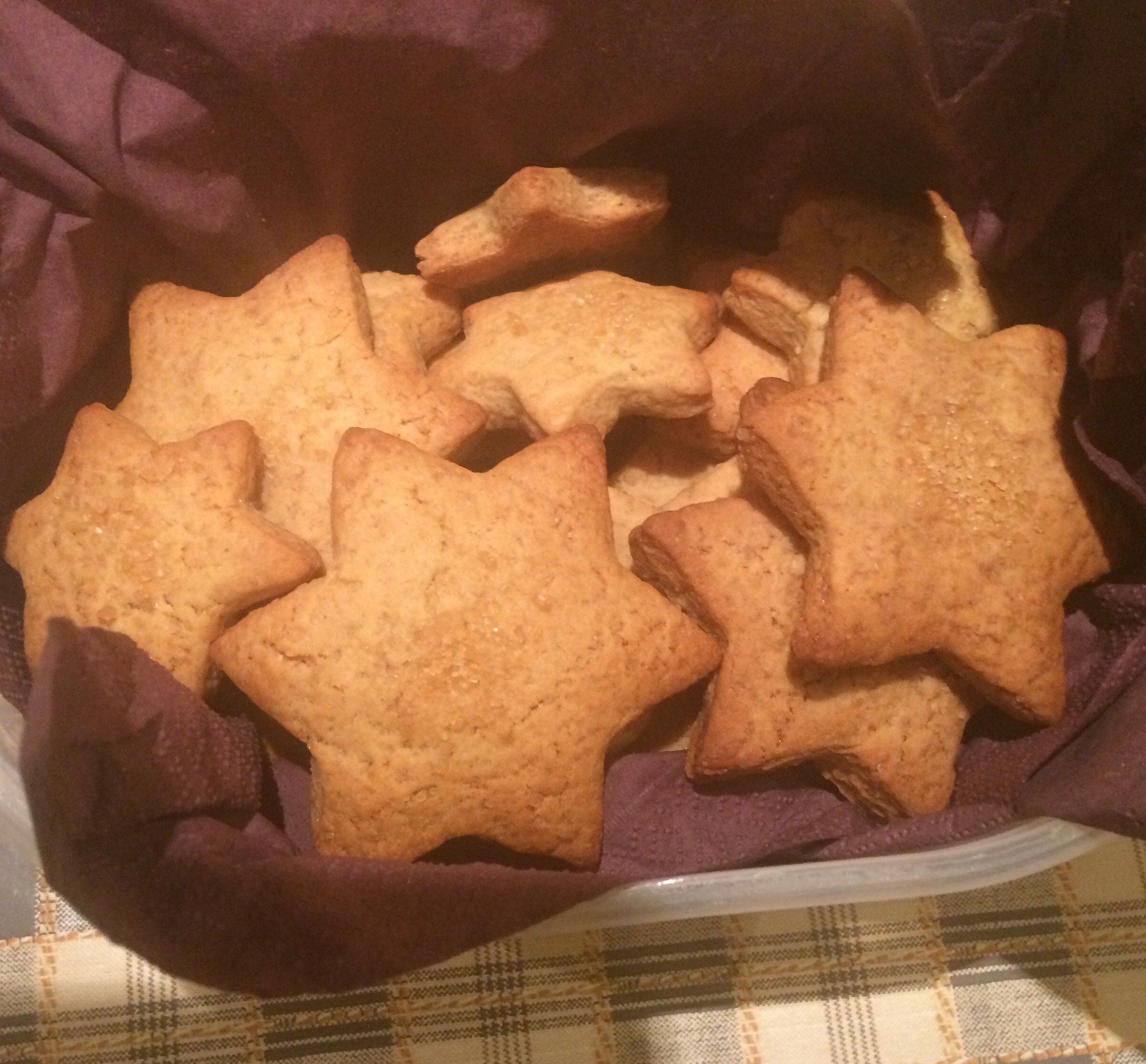
Gingerbread Stars

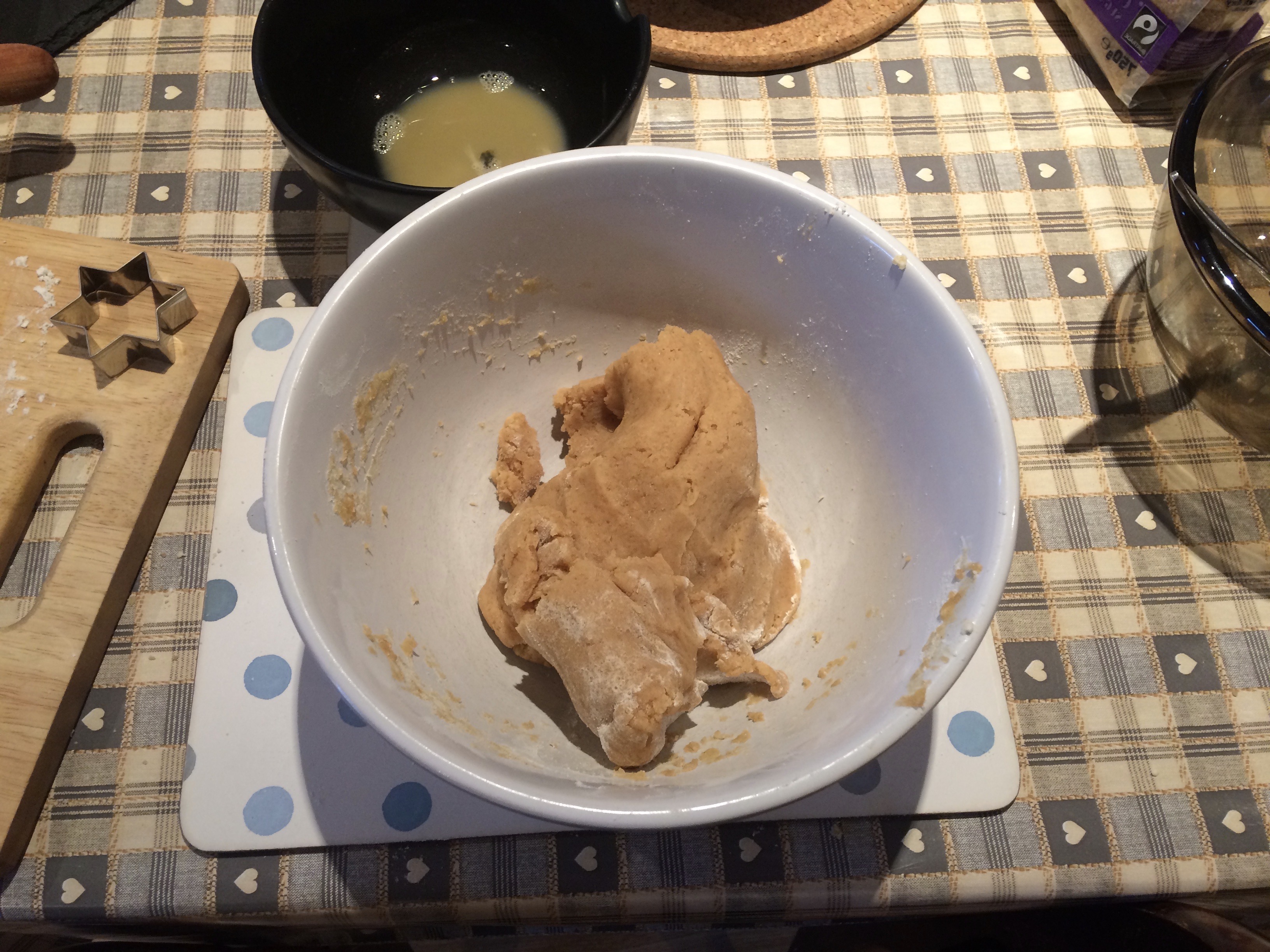
It’s a bit of a tradition for me now to make Gingerbread Stars for Christmas. It’s an inexpensive, easy homemade gift for the holiday season and much appreciated by the recipients. The recipe is my Mother’s and produces more than enough to give to different sets of friends, a tin or two for the workplace and leftovers for house guests. My only addition to the recipe is a little freshly grated ginger as well as the dry ground but it can be made just as well without.

IMG_3139 2Each year I’ve meant to write about the great gingerbread making and each year time has overtaken me. And so each year I’ve taken photos with great optimism — these, from 2016, interposed in my phone’s camera reel with a trip to see the RSC’s King Lear at the Barbican — all ready for a bestiary entry which never gets done…

IMG_3141

This year of course will be different. Instead of a busy, relatively carefree Christmas in company with much of the UK I’ll be having a careful, relative-free one. I know this whole year has been an exercise in letting things go, and I count myself lucky I have a Christmas bubble (bauble?) with nice people in it and that my losses have been extremely mild compared to those of many others, but I did have a little cry on Sunday adjusting to the fact I definitely wouldn’t be travelling up North. It’s been a long year, hasn’t it? And while there will be many challenges to navigate in the new one so many of us wanted to be able to take a break from it all for a few days and escape into something a bit more like the Christmases of the past.

IMG_3151

Gingerbread itself offers a tangible link to Christmases much longer ago. It’s been a treat in Europe since at least the eleventh century, when it was given as a gift by monastic houses or baked as a delicacy in royal kitchens or (later) sold at Gingerbread Fairs. The taste of ginger — like the cinnamon and nutmeg which can also be added — helps convey something of the flavour of those older Christmases. Early modern recipes tend to be lighter and sweeter, but eating and exchanging gingerbread is still a Christmas tradition and still permissible in the time of Covid — a way in which we touch hands, however lightly, with that medieval world.

MedievalCosmology02

If the gingerbread-making evokes the warmth of past Christmases, the stars make me think of the hope of the Christmas story too — one accessible not just to the rich and mighty, but the poor and powerless. Especially for them in fact as we learn in the Magnificat, Mary’s song of wonder at God’s mercy. And in the midst of everything else that’s going on — or not going on — right now, is one astronomical event that will make this particular Christmas memorable for another reason: the conjunction of Saturn and Jupiter on the evening of Monday the 21st of December will be a bright spot on the horizon if the weather is good enough for us to view it and you can find more details on what and how to look for here. It’s the first time a planetary ‘star’ this spectacular has occurred for hundreds of years, which naturally brings to mind the story of the wise men (in Latin, magi) journeying to Bethlehem because of the unusual star that appeared at the time of Jesus’ birth, which modern astronomers think likely to have been a conjunction or near conjunction of planets between 7 and 2 BC. Fittingly enough, its appearance this year coincides with both the Winter Solstice and the day appointed for the Antiphon, O Oriens (O Light), echoing Zechariah’s prophecy of a saviour appearing like a star

to give light to those who sit in darkness and in the shadow of death

As the Clerk of Oxford reminds us, these Advent Antiphons are traditionally sung at Vespers “in the early dusk of a midwinter evening, [as] ancient songs of longing and desire in the darkest time of the year” and in Christ we have a saviour who entered the world just when he was most longed for and needed, and who in the end provides a deeper comfort and more lasting hope than any breakthrough vaccines or changes of politics.

IMG_1245

These songs of hope and longing have a special resonance for me this year. It’s easy to romanticise the medieval celebration of Christmas because of our distance from it, but like Zechariah before us, medieval revellers knew what it was to celebrate in darkness and the shadow of death — aware, as we too are more keenly aware, of the instability of life and its brevity and fragility. Many of our most hauntingly beautiful Carols have come to us from this medieval past as well, with their message of hope and joy even in times of great turmoil and sadness. One written in fifteenth-century England that I know is going to be ringing in my head this week is “This Endris Night I saw a sight, / A star as bright as day…” Thinking of all celebrating this year in less than ideal circumstances, and the hope that shines out brighter than a star in the darkness.

Further Delectation

Make your own gingerbread — so many recipes to choose from! – or explore this fascinating history of the gift-giving of gingerbread in monastic houses.

Listen to this evocative setting of This Endris Night by Ralph Vaughan Williams, or a whole service of medieval carols at Great St Barts (the oldest church in London), or perhaps this lovely rendition of the Magnificat and Wexford Carol if you prefer something a little more early modern.

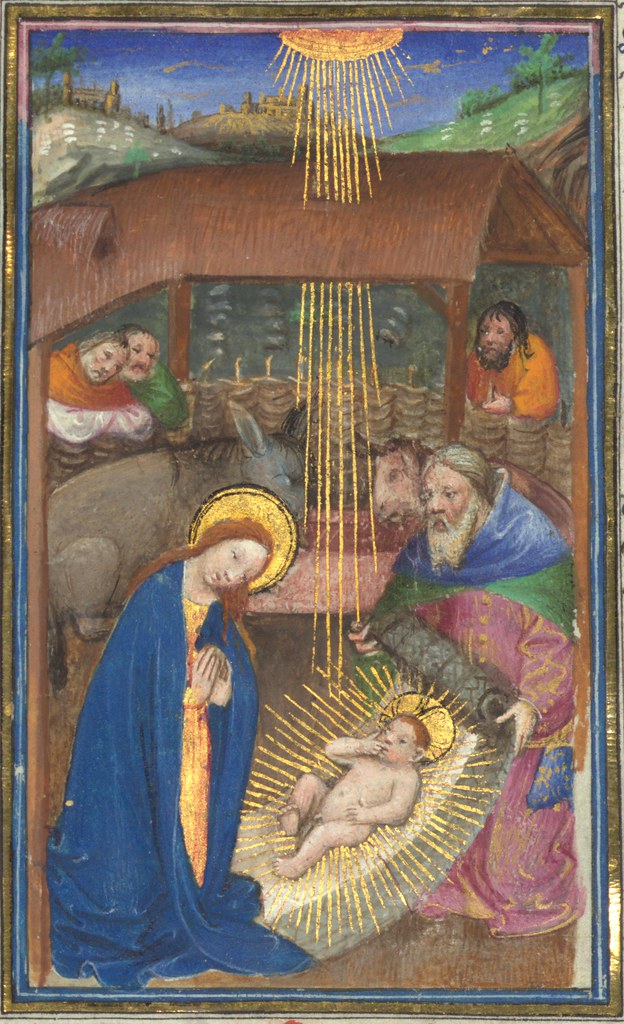
Feast your eyes on this beautiful fifteenth-century nativity detail from the Missal of Eberhard von Greiffenklau (Walters MS W.174, fol. 17v) with the starlight lancing through the thatch of the stable roof as in so many medieval nativity scenes:

iu

If you would like to see more entries more regularly and help keep this bestiary free of ads, you are welcome to contribute to the Biscuit Jar.

Jammie Dodgers

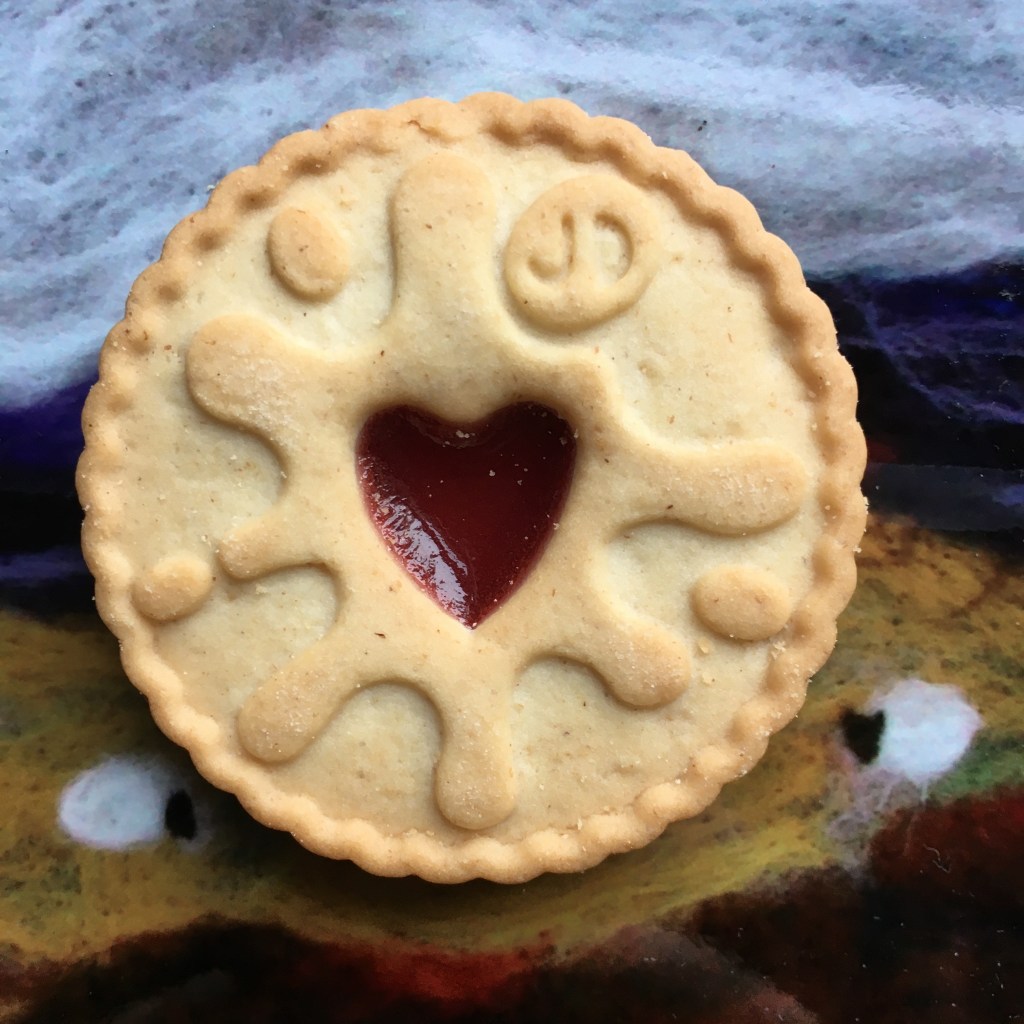
Way back at the beginning of the second lockdown I found myself craving Jammie Dodgers. As luck would have it they were on special at the local supermarket, but it had been so long since I’d bought them I was surprised to find their appearance and branding had undergone a bold cosmetic change. You can still see the old swirl-top pattern I remember in this recent article by Rachel Cooke, which confirms my view that many are turning to comfort biscuits in these trying times. In sympathy with the zeitgeist, the design now resembles a spillage at a jam factory. Still, these ones look very pleased with themselves sat on a plate in my new digs:

The company who make Jammie Dodgers, Burton’s, have been producing them in one form or another since the late 1940s. One — possibly apocryphal — story links them with Roger the Dodger of the long-running Beano comic. When I researched them further however, I found that the same biscuits have been in the news this year for distinctly un-comical reasons and we may find them in even greater demand this festive season if the Delivery Workers Guild goes ahead with its strike. So even comfort biscuits haven’t managed to dodge the shadow of 2020, it seems…

We listen to the evening news with its usual recital of shabbiness and horror, and God if we believe in him at all, seems remote and powerless, writes Frederick Buechner. But there are other times – often the most unexpected, unlikely times – when strong as life itself comes the sense that there is a holiness deeper than [the] shabbiness and horror and at the very heart of darkness a light unutterable.’ The apostle John might have agreed with him: The light shines in the darkness and the darkness has not overcome it, he writes in the prologue to his gospel, written in the glow of the extraordinary life of his friend Jesus of Nazareth.

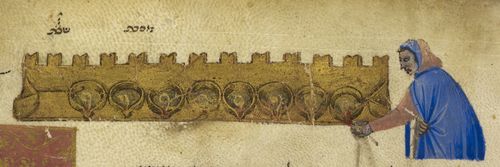
BL Oriental MS 5024 f. 19r

Light overcoming the darkness is also the message of the Jewish festival of Hanukkah, which begins this evening with the lighting of the first candle of the Menorah. Another apocryphal story tells how the Jews took back their temple after the Greek King Antiochus IV captured it in around 164 BC, desecrated the holy places, and made every effort to stop them practising their religion. At the re-dedication of the temple they only had enough of the consecrated oil to last for one day but the supplies miraculously stretched for seven until the new oil could be ready for burning. John gives us a glimpse of Jesus celebrating the festival in winter walking in Solomon’s Colonnade, a long pillared walkway not unlike a medieval cloister.

‘What if God became a human and lived with us?’ is the question John sets out to answer and you can read his gospel and the other gospel accounts of Jesus’ life or watch this recent TV adaptation if you want to know more of what happened along the way. I’ll admit I’m more than a little biscuit-obsessed these days, but to me the heart in the centre of the Dodger’s new splat speaks of the wonder of the Incarnation: of God looking on us with compassion in all our pain and confusion, horror and shabbiness, and sending himself as a human right into the heart of the mess.

BL Harley MS 4382 f.139

Further Delectation

Have a read of the Beano’s biscuit jokes (straight out of the Christmas Cracker school of humour) or have a go at making your own festive Jammie Dodgers.

Help support essential workers this Christmas. Let delivery companies like DHL know you’d like them to look after their drivers better. Ask your MP to support a pay-rise for NHS staff. Or consider whether you could help those on the frontlines of the food poverty crisis.

Prepare for Christmas with this medieval homily and meditation from the Clerk of Oxford’s modern counterpart. Listen to a beautiful twenty-first-century rendition of one of the oldest, loveliest hymns on the incarnation:

If you would like to see more entries more regularly and help keep this bestiary free of ads, you are welcome to contribute to the Biscuit Jar.

Bredele

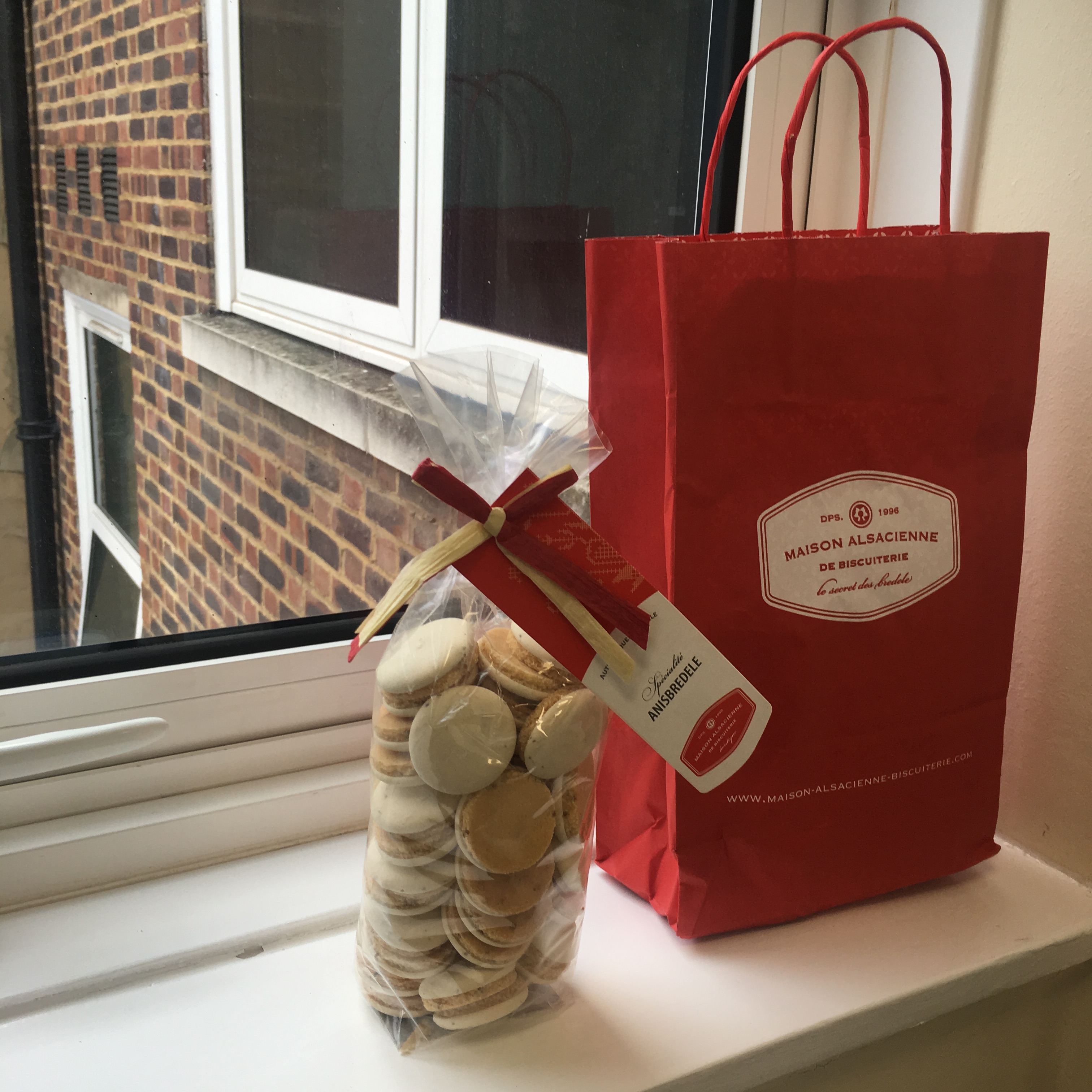
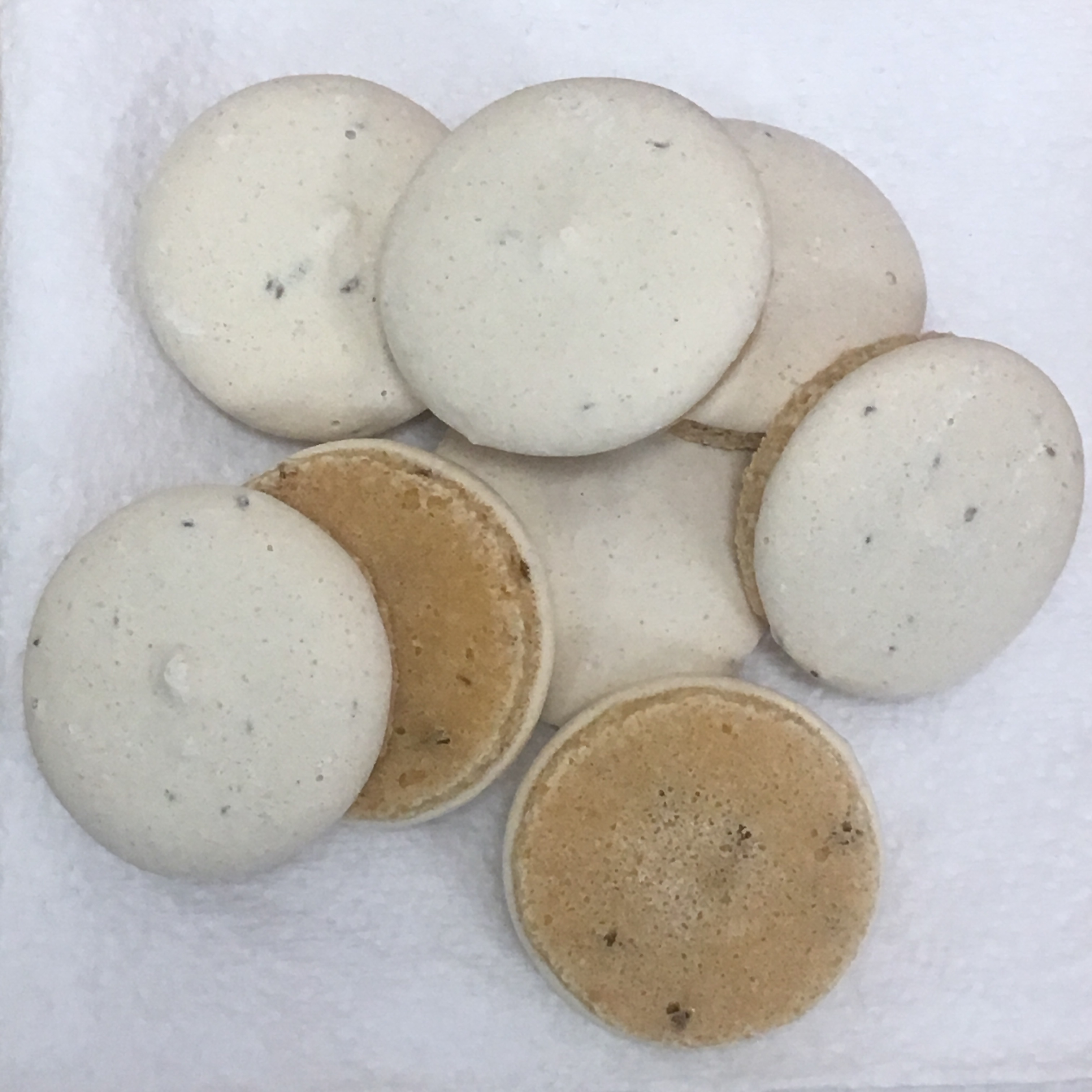
This week’s star biscuit is from the Alsace region of France and a present from my sister and brother-in-law who were holidaying in Colmar. The name, Bredele, means something like ‘little breadies’ in English and sounds more Germanic than Gallic in origin which makes sense given how close Alsace is to the border. The smooth, slightly convex topping looks a bit like a macaron to the casual observer but the consistency is tougher and the biscuit itself very dry and sweet and light. These anisbredele are particularly noticeable for their strong hit of aniseed (green aniseed according to my French colleague). Here they are perched on a windowsill in the office next to their elegant gift bag:

IMG_1184Bredele are treat biscuits enjoyed as Christmas cookies or petits four in France. The earliest recipes date back to fourteenth-century Strasbourg so they come with an excellent medieval pedigree also, but I have to admit I’ve only had one or two so far as liquorice is one of the few flavours I genuinely can’t abide. (This is an eccentricity of my own though and I’m pleased to say they’ve been popular with office mates who don’t share my prejudices!)
fullsizeoutput_8bfIn settling on a medieval-style sentence for the bredele, I couldn’t help remembering the famous line in the Lord’s Prayer: give us this day our daily bread. I doubt the most free-wheeling translator has ever stretched this into daily bredele, but the idea leads to an interesting question: is it OK to ask God for the little things as well as the big?
While it’s possible to under-think prayer maybe the greater danger comes from over-thinking it and in our efforts not to be childish in our prayer requests we can forget to be childlike as Jesus taught. In the gospels he tells his disciples to bring their needs to God as simply and directly as little children to their father and to trust that he is better than the best of human parents and intimately concerned with the smallest details of our lives. This may come as a surprise to those more used to relating to God as Our Emergency Service that Art in Heaven, but it invites us to a conversation about our evolving needs and yearnings with a father who loves to give us good things when we ask.

Further Delectation

Here for the bredele? You can find an aniseed-flavoured bredele recipe here or a  general recipe here for those less fond of aniseed. The clerks and historians can also read about all things bredele-y at bredele.fr

Be a source of delight to others: if you’re lucky enough to be able to bake or buy your own biscuits, you might consider giving some to food banks this autumn. It can make a child’s day when you donate biscuits as well as the usual staples (a good way to be an answer to someone else’s prayers!)

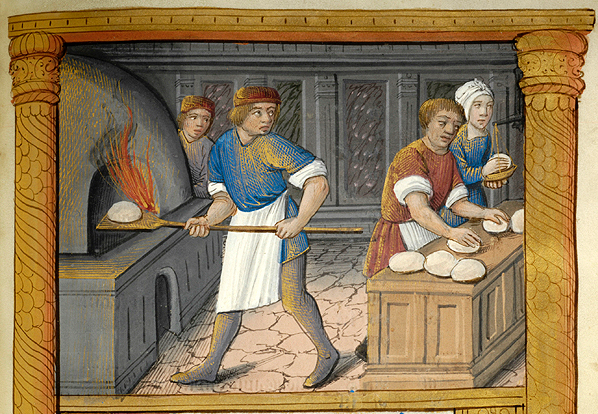
Check out these medieval bakers in a French breviary from the early 1500s. This illustration is for the month of December so perhaps they’re busy making Christmas biscuits (following the astrological calendar, it also sports a fantastical goat in a shell…)

m8.012ra

If you would like to see more entries more regularly and help keep this bestiary free of ads, you are welcome to contribute to the Biscuit Jar

Linecké Cukroví

In the Fourth Week of Advent my Czech friend gave to me… six beautiful handmade biscuits. At first glance they appear to be a daintier kind of Jammy Dodger – a delicate little jam and shortbread sandwich that would look quite at home in Alice’s Wonderland – but a little research reveals that they are in fact a special type of biscuit called Linecké Cukroví traditionally eaten in the Czech Republic at Christmas time. Katka assures me that the ones her mother makes are better, but I think these are perfect and very yummy indeed with a cup of coffee.

IMG_5282
The vivid colour and translucency of the jam reminded me of stained glass, and glass-making too belongs to a tradition of Czech craftsmanship dating back to at least the thirteenth century when it was part of the Kingdom of Bohemia.  It’s also the home of a medieval king long distinguished for his charity at Christmas: Good King Wenceslas, or Vaclav the Good as he is known in Central Europe. The English carol about him taking food to peasants is very new-fangled, but like Britain’s King Arthur it is said that if the Republic is ever in peril his statue in Wenceslaus Square will come to life and lead an army to victory with a legendary sword, bringing peace to the land.

With this in mind, it didn’t take me long to find a spiritual significance for the Linecké Cukroví. In one of the most famous passages of the New Testament St Paul talks about life in this world as an existence in which we only ever apprehend the real nature of things dimly, as if through a glass. ‘For now we see through a glass darkly; but then face to face: now I know in part; but then shall I know even as also I am known…’ This note of longing to know more fully and see better than we do at present is also a guiding theme of the ‘O’ Antiphons which the Catholic and Anglican church pray during this last week of Advent. Today’s Antiphon ‘O Oriens’ speaks of the longing of those walking in darkness looking for the light to come, and tomorrow’s ‘O Rex Gentium’ of the longing for the coming of the king of all nations and the peace he brings: a good sentence for the closing of Advent and these lovely Christmas gifts.

Further Delectation

Take a virtual tour of the stained glass in St Vitus Cathedral, where Wenceslas I is buried.

Have a go at whipping up your own Feast of Stephen with this Linecke Cukrovi recipe or some more Christmas biscuit recipes from around the world.

Enjoy these Advent Antiphon poems by Malcolm Guite or listen to Will Todd’s The Call of Wisdom a particularly beautiful album for Advent recorded by Tenebrae choir.

Music-making was a large part of Christmas celebrations in the Middle Ages. This beautiful Bohemian nativity scene is tucked away in a Cistercian book of liturgical music (image via Switzerland’s Central Library in Lucerne).

11331793206_cb0a2f61a1_b.jpg

If you would like to see more entries more regularly and help keep this bestiary free of ads, you are welcome to contribute to the Biscuit Jar