One of my favourite memories of 2024 is the Saturday in late February I joined a group of other artists for a retreat day. We spent part of the morning drinking coffee together near the ruins of a medieval monastery and I found myself in conversation with a lovely Swedish lady. The talk turned to biscuits – as it is apt to do with coffee – and she asked me if I’d ever heard of the Swedish sju sorters kakor (seven types of cookie) tradition? Reader, I hadn’t, but it’s been around since the late 19th century, becoming really popular in Swedish social circles in the first part of the 20th where it inspired the iconic cookbook Sju Sorters Kakor by Ica Provkök.
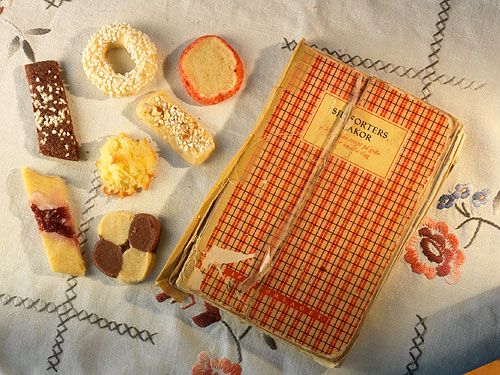
I learned the seven cookies custom is exactly what the name suggests: inviting your friends over for seven kinds of cookie. Why seven, you ask? Well, studies suggest it is the goldilocks zone of hospitality in Sweden: offering your guests only six kinds of cookie might look stingy but more than seven could be construed as over the top. Similarly, the guest’s etiquette is to sample no more than six of the seven types of biscuit offered as to gobble the full seven might suggest your host hadn’t provided enough. If all this sounds like a social minefield, it’s really not intended that way. More an opportunity to showcase seven wonderful cookies at once…


The idea of preparing seven types of cookie to offer your fika (coffee break) guests might sound daunting, but the trick is to use a base dough and add different ingredients to smaller batches to create different species from the same genus. Even with this hack in mind, I didn’t try making seven kinds of cookie on a first go but supplemented the three I’d baked with two professionally baked ones and two alternative recipes from my friend Katka, who had kindly made me some Czech biscuits as a Christmas gift (I fully appreciate that the Czech Republic is not part of Scandinavia but her Linecké Cukroví were a delicious alternative to the Swedish Hallongrottor or ‘Raspberry Caves’).

This plate of offerings was the end result. The pink-rimmed biscuits closest to the centre are courtesy of Bageriet in Covent Garden, which sells many of the traditional biscuits used in sju sorters kakor selections. Their ‘Brysselkex’ (Brussels Biscuits) look like something from a fairy tale and are dry, sugary and delightful. Clockwise around the plate we have my round version of ‘Chokladsnittar’ (Chocolate Slices). I didn’t have any nib sugar to decorate them so I opted for desiccated coconut. Next up we have Katka’s lovely little Linecke Cukrovi, followed by my rendering of Swedish ‘Gaffelkakors’ (fork biscuits) dusted with cinnamon. The biscuits with almonds on are Bagariet’s ‘Pepparnötter’ (Pepper Nuts) – possibly my favourite-tasting of the Swedish biscuits (these are traditional for Christmas and the spice combination is wonderful). Biscuit number six is another Czech masterpiece: a nut-flavoured biscuit in the shape of a star and a delicious equivalent to the Swedish ‘Nötkakor’ (Nut Biscuit). And lastly we have my rather less successful attempt at the Chessboard Biscuits popular in sju sorters selections. They seemed easy in the recipes but I hadn’t factored in the dough’s squidgy-ness, resulting in somewhat skewed boards that would have been less out of place in a surrealist painting.

It feels especially fitting to write about this Swedish biscuit tradition on the Feast of St. Lucy: a feast that falls at the heart of Advent and coincides with the darkest nights in the Western calendar. While it’s not much celebrated in Britain, in Sweden Luciatag is a high point of the year. Gingerbread and saffron buns are eaten and it’s customary for girls to dress up as Lucy leading a procession of maidens, ‘star-boys’, and ‘gingerbread children’ with glowing lights. Famous for bringing food to persecuted Christians in hiding, Lucy herself is linked with both light and biscuits, the more romantic legends depicting her carrying a plate of baked goods through the catacombs wearing a wreath of candles to illumine her steps. In a country with fewer than seven hours a day of sunlight in winter, this visual reminder of the light putting the darkness to flight – literally and spiritually – provides a vision of comfort and light for the soul when it’s most needed.

And the moral? Well, seven as a number is closely associated with God’s work and spirit in the Bible, from the seven days of creation to the seven spirits and lamps before heaven’s throne. Whether or not the Swedish bakers of the sju sorters kakor traditions were aware of this their carefully specified number of biscuits signifies divine abundance, perfection, and completion. If six is man’s number, seven feels like God’s. And this brings us to the heart of Advent with its calendars and candles. The church’s great season of counting the days till Christ’s coming, and God’s doing for us what we could never do for ourselves. Waiting for humanity to save itself would be exhausting, hopeless even. But Advent is about waiting for God to act for us. “The Lord is good to those who wait for him, to the soul who seeks him…” (Lamentations 3:25) Glad Lucia to all who celebrate it and God Jul (Merry Christmas!) when it comes.
Further Delectation
More about Lucia and the sju sorters kakor tradition in Sweden.
More on Brussels Cookies from The Swedish Spoon, a great baking blog for all thing Swedish.
A little taste of St Lucy’s Day (with beautiful singing!) from Lund University:
If you would like to see more entries more regularly and help keep this bestiary free of ads, you are welcome to contribute to the Biscuit Jar.


 The Biscuit Bestiary