I don’t normally shop in Fortnum and Mason’s in Holy Week – or in many other weeks – but they produce some rare and special biscuits not easy to find elsewhere. And so a few days ago, I ventured into their gleaming, plush, oppressively crowded store once again in search of an elusive biscuit quarry. The magnificent tin they came in is tall enough to house an umbrella, which I may use it for once the contents have been eaten…

At £14.95 a pop, Fortnum’s Violet Biscuits were no idle purchase but a deliberate pursuit of a creation that caught my eye. Violets for me conjure images of Wordsworth’s She Dwelt Among the Untrodden Ways, in which the poet describes the beautiful, sheltered, overlooked life of a young woman whose death he mourns as ‘a violet by a mossy stone’. And although I wasn’t consciously thinking about it at the time, I later remembered that the flower is also the name of one of my grandmothers who also died young. So young her name is the only thing I really know about her.

“There is no end to the biscuits that we like to invent, and this particular example is a true original. The crisp butter biscuits are subtly flavoured with French crystallised violets for a gently aromatic taste…” is what Fortnum’s have to say about the Violet Biscuits in their marketing. (Crystallising in this context means treating cut flowers with a sugary compound.) As well as the ingredients you would expect from a regular butter biscuit, they contain violet fragments and indigo and carmine colouring. You can see the flecks of crystallised violet in the mixture but it was the taste that was the real surprise. To me these biscuits looked and sounded delicate but when you bite into them you get a powerful, almost medicinal, hit that I can only describe as an old fashioned sweet shop taste (think Swizzels’ Parma Violets which are still produced today apparently). Far from shrinking from your taste buds, these violets could definitely hold their own against a cup of Earl Grey and maybe even a cup of coffee.
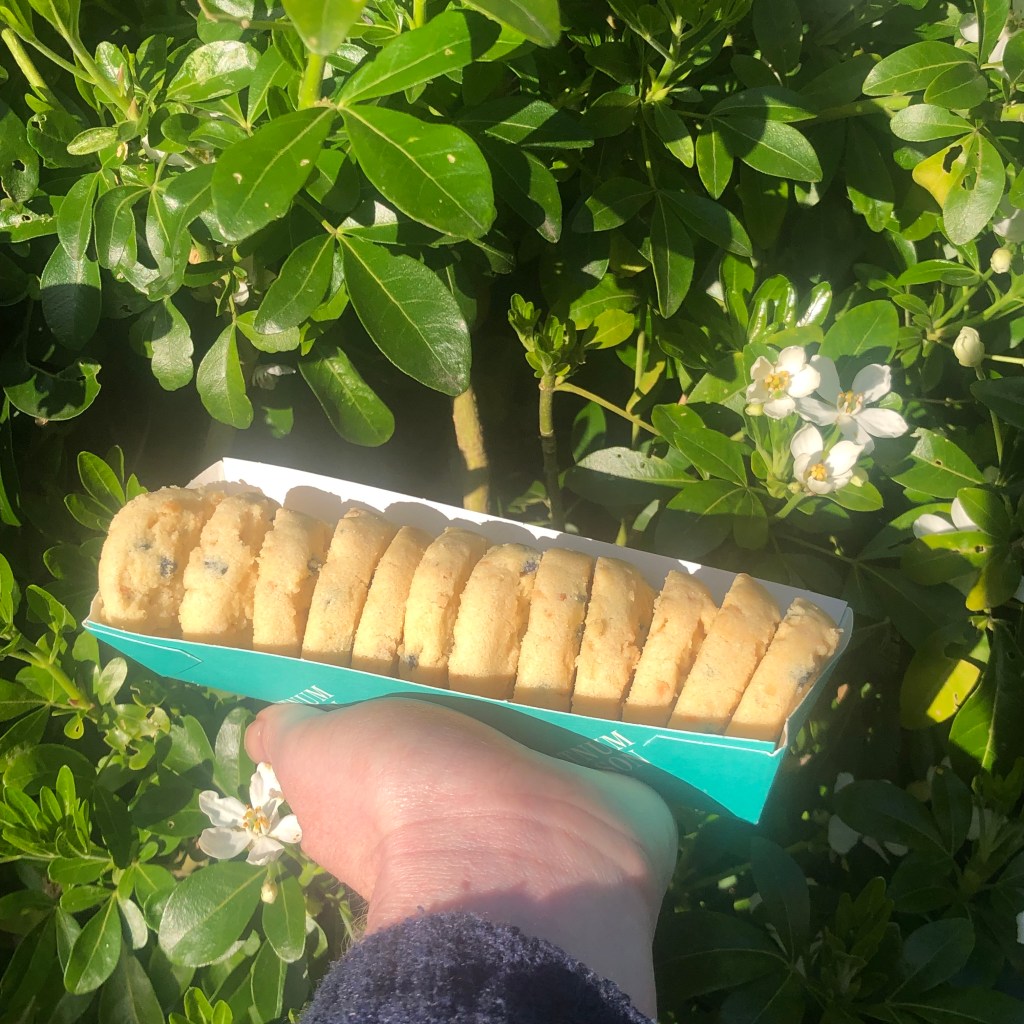
So what have these Violet Biscuits to do with Holy Week? Well, for me it was the continuation of a journey that started with a flash of purple. A purple scarf to be exact and the comment of a young woman called Anna, whose church I was visiting, that purple was the colour of the robe the Roman soldiers draped Jesus in hours before he was led away to his crucifixion. An ugly moment in a series of ugly moments culminating in the appalling spectacle of the cross. I don’t know why but when she said that I found myself moved by that flash of purple. I think because it felt like a tangible link to him. The robe itself is mentioned in all four gospels. In Matthew it is described as a scarlet robe. Luke doesn’t mention a specific colour but uses a word that can mean white but is more often translated elegant or splendid, but in both Mark and John it is purple.
Purple was an expensive colour in the ancient world (and the medieval one for that matter), the colour of royalty and empire, particularly of Roman power. Tyrian Purple, a dye named after its traders from Tyre, was painstakingly produced one drop at a time from the glands of two different kinds of shellfish and restricted over time to persons of more and more influence. Shifting perceptions of colour may help to explain the gospels’ chromatic variations (although this different take on it by James Bejon is lovely too). Pliny, born around 20 years after Christ, describes imperial purple as the colour of clotted blood. Like the violet of these biscuits, the robe was (a) costly, or had probably been so once, and (b) some kind of scarlet-purple. It also would have made an impact like the strong medicinal taste these edible violets had, a connection also brought out in the medieval Anglo-Norman etymology of the word violet (and indeed, the flowers were used in medicine as well as baking).

Where the soldiers got the robe from isn’t clear but what is clear is that they were using it to make sport of their celebrity prisoner, stripping him of his clothes before dressing him in it and fashioning a circlet of thorns to ‘crown’ him too. In doing so they were mocking his claim to be the King of the Jews, the title he would shortly be crucified under and which he accepted from Pilate, the Roman governor of Judea, while stating that his kingdom was different from any earthly king’s. The encounter between Jesus and Pilate is an extraordinary one, not least because of Jesus’s behaviour under questioning. When he answers, it is collectedly, speaking always from a place of quiet assurance. When he keeps silent, the governor finds it baffling. “Don’t you realise I have power to free you or to crucify you?” Pilate asks the prisoner, bewildered. He becomes increasingly bewildered the more he questions him.
It is in John’s gospel that Jesus’s appearance in the robe is most striking, as Pilate brings him out and presents him to the crowd with the words Ecce Homo (Behold the Man). They are words that suggest Pilate was not without a sense of the drama of that moment, but he could not have anticipated how they would echo on down the years. To look at a thing is very different from seeing a thing, Oscar Wilde once wrote, and for the artist as for the contemplative the command to look becomes an invitation to pass from looking to seeing. The invitation to look – or to look again – becomes an invitation to consider what we may have missed previously.

Not surprisingly, that image of Jesus standing alone in his purple robe has been so frequently depicted by artists painting what they see, that it is now, quite literally, iconic. This is how much of the Orthodox Church depicts the bruised and bloodied figure of Christ before Pilate and the crowd. And yet it is traditional for these icons to use a different title from the one you might expect in the circumstances. Not Christ the Suffering Servant (although he is that) or Christ the King (although he is that as well) but Christ the Bridegroom. How so?
Commentators usually link this decision to the image of Christ in the Parable of the Ten Bridesmaids. However, it is the power of icons as all symbols to become rich repositories of meaning over time. As I considered the story again this Holy Week, I was reminded of one of the most famous medieval mystics’ writings on the Passion, Julian of Norwich. A remarkable woman who lived a life of religious seclusion as an anchoress for much of her life and who in seeking to understand the Passion better was granted an unusual series of beholdings in a vision of Jesus’s sufferings, later written as her Revelations of Divine Love. In one extraordinary dialogue in the text, Christ tells Julian that not only did he gladly undergo all his suffering for the sake of his creatures but Every day He is redy to the same if it myght be. For if He seyd He wold for my love make new Hevyns and new Erth, it were but litil in reward, for this might be done every day if He wold, withoute any travel. But for to dey for my love so often that the noumbre passith creature reson – it is the heyest profir that our Lord God myght make to manys soule. (Every day He would be ready to do the same, if he could. For if He said he would for my love make new Heavens and new Earth, it would be a little thing in comparison to suffer every day for me. It wouldn’t be hard for him. To die for my love so often the number passes reason is the greatest offer our Lord God could ever make to the souls of humanity). Perhaps it is her own revelation, her paraphrase, of one of the Bible’s great prophets and visionaries: “He shall see the fruit of his soul’s suffering and be satisfied; by his knowledge my righteous servant shall justify many”. Either way we seem to catch a tiny glimpse in it of the face of the blissful Bridegroom looking at us through the blood and the bruises, the scarlet and the purple. The one who, as the author of the Book of Hebrews says, “for the joy set before him endured the cross,” who both wore – and deserves to wear – the costliest robe.

Further Reflection
Some of the readings from Plough that have kept me company this Holy Week: In the Holy Land, Seeking the Solace of the Cross and His Cross is Every Tree: The Poetry of the Passion by Chris Zimmerman.
One of Orthodox composers John Tavener’s most haunting pieces, ‘Christ the Bridegroom’.
A link to the Middle English text of Julian of Norwich’s Divine Revelations if you want to read it and a Julian-inspired reflection on suffering and love. And here is an icon of her (rather charmingly I found out she is traditionally depicted with the little cat who kept her company in her cell!)

If you would like to see more entries more regularly and help keep this bestiary free of ads, you are welcome to contribute to the Biscuit Jar.
 The Biscuit Bestiary