Croquants aux Amandes et Miel

Ash Wednesday. A cross like a kiss on the forehead and the season of Lent has begun: that 40 day journey of reflection starting in the wilderness and ending at the empty tomb. In the Middle Ages, Lent was a big deal for both devout and nominal Christians if only because of the strictness of the Lenten fast. As well as fasting from meat, the list of forbidden foods included traditionally biscuity ingredients like eggs and butter, hence the wild flurry of pancake-making on Shrove Tuesday. (For those interested, the British Library’s Great Medieval Bake Off: Lent Edition has some fun recipes to get you through a medieval fast!)

It may surprise a reader familiar with the modern custom of giving up of sweet foods for Lent but nuts and sugar (and wine) were allowed. I hadn’t intended to write about another Provencal biscuit so soon after the Navettes but on finding these deliciously crunchy Croquants Aux Amandes et Miel (Crisped Biscuits with Almonds and Honey) in my room the other day, I realised providence had led me to the perfect biscuit for Ash Wednesday. These Croquants, a present from my sister and brother-in-law, hail from the Abbey of Sénanque –a Cistercian monastery dating back to the twelfth-century. The place is famous for its lavender and the monks who tend it are also skilled at bee-keeping, making honey another Sénanque specialty.

The Croquants look like miniature biscotti, leading me to suspect they would go particularly well with strong black coffee and as my usual coffee haunt was closing early yesterday, I decided to decamp to a quiet pub and see if I could get a coffee there instead. The friendly bar staff looked on in some amusement as I whipped out my phone for an attempt at an arty shot of the candle, coffee and biscuit! Dipping it in coffee was exactly the right thing to do as it softened up at once but kept its shape, which was impressive. Without the coffee, they would be incredibly dry, but also very sweet and almond-y.

The adjective ‘Croquant’ which gives these biscuits their name is usually translated ‘crisp’ or ‘crunchy’, calling to mind the ashes of Ash Wednesday. In the ancient world to cover yourself in ashes was a sign of profound grief and distress. Today the ashen cross of Lent is a mark of penitence – of sorrow for our sins and a desire to return to God, as well as an acknowledgment of how short our little lives are, to paraphrase wise Master Shakespeare, and how much we need his mercy. Through the Lord’s great mercy we are not consumed (Lamentations 3:22)

From a human perspective, the place of ashes speaks of emptiness and endings, but in God’s it can become a crucible that transforms and transcends even the deadest of ends. If there is a promise we could take from the Croquant, it might be Isaiah 61 where those who mourn are promised a crown of beauty for ashes. I learnt recently the Hebrew here suggests working in and through the devastation to bring both beauty and holiness: a priestly head-covering or bridal decoration drawn up and out of the very places that seem most desolate to us. This year, as we start out again on the long road to Easter, may it be an encouragement to give God our ashes and see what he does.

If you would like to see more entries more regularly and help keep this bestiary free of ads, you are welcome to contribute to the Biscuit Jar

Navettes

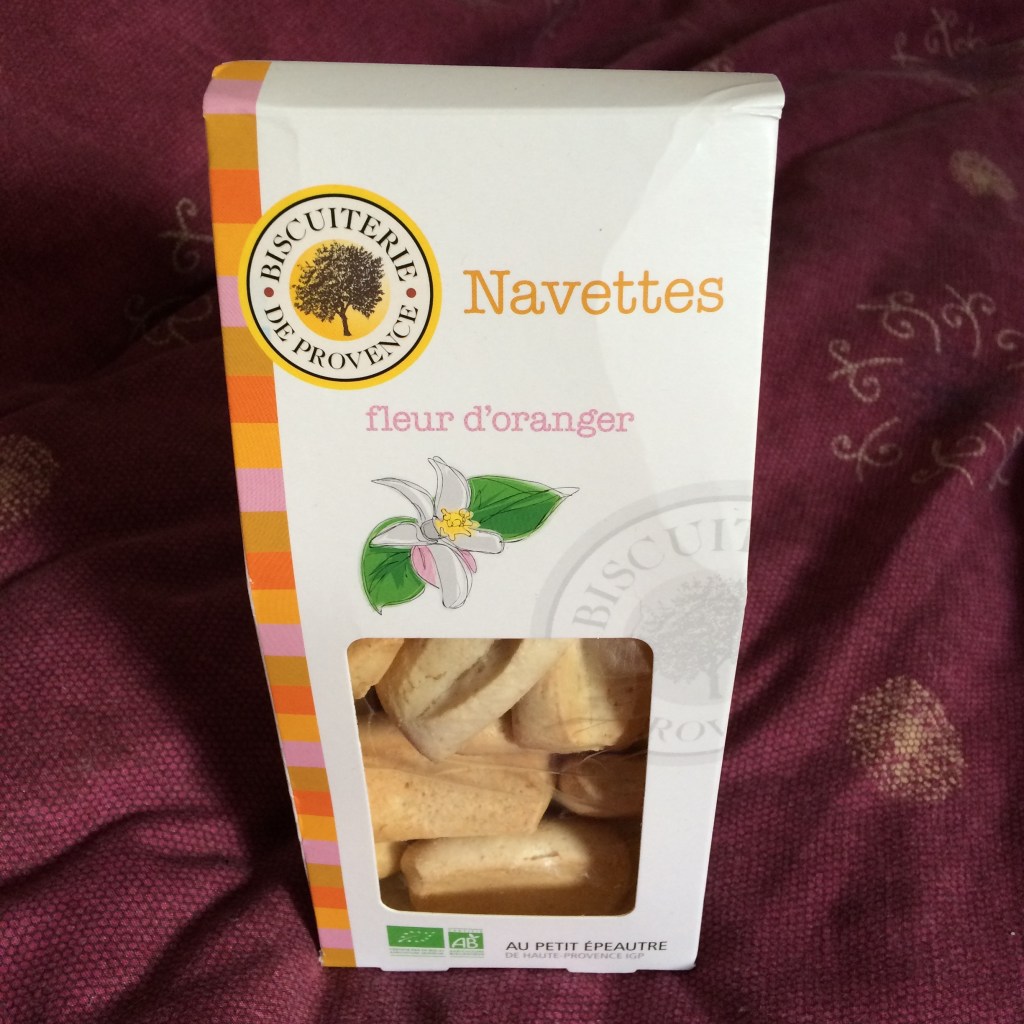
For Candlemas this year I’m revisiting the Navette, a biscuit I first came across seven years ago thanks to some kind Californian friends who brought me a packet of them from a holiday in Nice. Everywhere else in France the first choice of treat to celebrate it would be a pancake but in Provence they eat this special type of biscuit whose name means “little ships”. They look a little like a little ship too or at least a primitive sailboat.

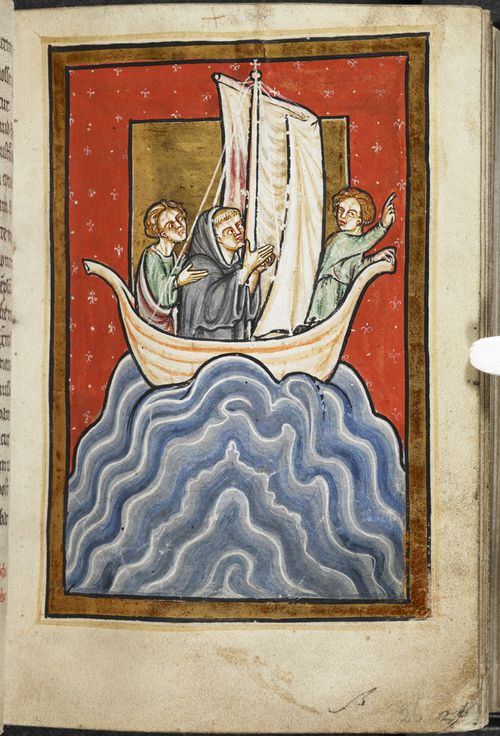
The legend that gave rise to the invention of the Navette is almost certainly apocryphal: the voyage of Mary, Martha and Lazarus (or in some versions three Marys) to the coast of Southern France. Civic pride probably played a part in the eagerness of medieval Christians to link their city’s or region’s history to that of the early Church in some way, but I admit that the reason the biscuits have been associated with Candlemas is not clear to me (answers on an e-postcard!) These are made to the classic fleur d’oranger recipe popular in Marseilles. With their subtle citrus notes, it’s the biscuit equivalent of a Lady Grey tea.


Aesthetically, Candlemas must be one of the most memorable feasts of the Christian year even if it’s not quite in the same league as Easter and Christmas. I know I’ll never forget the wonder I felt the first time I celebrated it with a sea of glimmering lights in Durham cathedral. In the medieval Church, Candlemas marked the end of the Christmas season with a special procession and the blessing of candles commemorating Mary’s “churching” (i.e. the rites of purification prescribed for Jewish mothers forty days after childbirth) and Jesus’s presentation in the Temple. The child’s parents were obliged to bring an offering with them and their choice of pigeons or turtledoves shows they were not wealthy people. To a casual onlooker, and probably to Mary and Joseph themselves, their entrance with the newborn Yeshua might have seemed uneventful, but God prompted Simeon and Anna to recognise its significance and speak of the child’s extraordinary future, encouraging and preparing them for what was to come. It’s also the occasion for the beautiful prayer of Simeon, now referred to as the Nunc Dimittis:

Lord, now lettest thou thy servant depart in peace
according to thy word.
For mine eyes have seen
thy salvation;
Which thou hast prepared
before the face of all people;
To be a light to lighten the Gentiles
and to be the glory of thy people Israel…

Luke 2:29-32
C15th illustration of Simeon and Anna with the Holy Family from Pierpont Morgan Library. MS M.117

Clearly Simeon had already had an inkling that he would have a part to play in welcoming the Messiah, but for all we know Anna may only have recognised hers in the moment it arrived. It’s moving to think of these two elderly servants of the Lord – both prophets in some sense – waiting their whole lives for this meeting. How easily they might have missed it if their focus had been in the wrong place at the wrong time. If the Navette carries a message for us today, and if it can be linked to the celebration of Candlemas, it might be something to do with being attentive to divine appointments in our own lives, wherever and however we find them in our comings and goings.

Scenes from The Life of St Cuthbert, Durham

Further Delectation

More on celebrating Le Chandeleur (or “Crepe Day”) in France.

My favourite discovery this week (and just in time for St. Valentine’s Day…) send a medieval postcard!

A beautiful blog post from the Clerk of Oxford on the history and customs of medieval Candlemas, and some music to listen to in celebration of the feast. You could also take a look at this sweet film for kids or Michael Card’s Now That I’ve Held Him in My Arms – both retellings of the story from the perspective of Simeon.

If Candlemas be Fair and Bright… Like St Swithin’s Day in folklore, Candlemas also doubles as Groundhog Day for some people as a forecast for the weather!

If you would like to see more entries more regularly and help keep this bestiary free of ads, you are welcome to contribute to the Biscuit Jar

Florentines

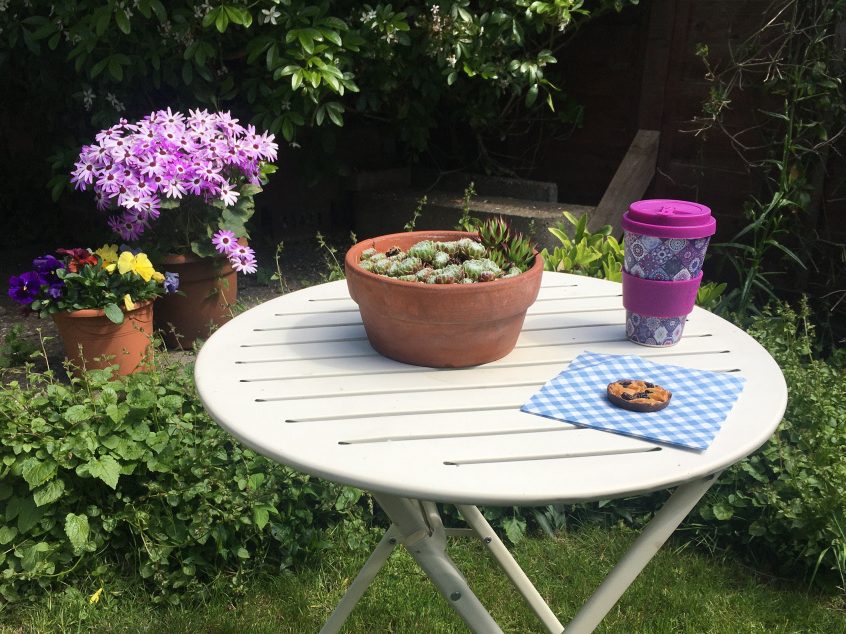
I’m writing this post on the rattling train from Kings Cross to Edinburgh. It’s the first time I’ve been out of London since September so I’m very much looking forward to Narnia and the North (or Northallerton, anyway). It’s also National Biscuit Day, which I’d forgotten about until this morning when this wonderful thread of biscuity homages to history reminded me. This week felt like we had the first day in a hundred years in which it was sunny enough to sit in the garden without a coat on for more than two minutes, and what better biscuit to celebrate that little glimpse of summer than one of these excellent dark chocolate Florentines my friend Katka gave me?

Although I don’t often get the opportunity to sample them these days, Florentines are one of my favourite biscuits so I was pleased to discover no less a personage than Delia Smith arguing that they’re the best biscuits in the world. I love Felicity Cloake’s description of them as ‘delicate webs of nut and candied fruit’. These specimens are particularly nice with coffee, although a bit sticky to eat because of the caramel. Like macarons, they’re notoriously difficult to make well – I had a go myself a few years ago and they came out looking like flapjacks that had lost their way.

From the name you might be forgiven for thinking the Florentine’s origin is Italian when in fact most experts agree it was likelier to have been cooked up in France by the chefs at Louis XII or Louis XIV’s court when the Medici family came to visit. To make things even more complicated, this particular recipe is an English tribute from Thomas Fudge’s bakery and has been in use for more than a hundred years in Dorset.

Perhaps this particular Florentine is the nearest thing you’ll get to fusion-cooking in the biscuit world. In the medieval world, it’s the nearest thing you’ll get to a florilegium, a collection of literary extracts selected like choice blooms for the reader (the word itself means a gathering of flowers, the same as an anthology). Both derive from the Latin florens with its connotations of blooming and flourishing. This makes it a good choice of biscuit for “the joly tyme of May,” as Chaucer’s narrator in the Legend of Good Women puts it, the favourite month of the medieval love poets.

“Look, the winter is past,
and the rains are over and gone.
The flowers are springing up,
the season of singing birds has come,
and the cooing of turtledoves fills the air.
The fig trees are forming young fruit,
and the fragrant grapevines are blossoming…”

That sounds a lot like a fourteenth-century dream vision, but in fact it’s straight from the pages of The Song of Songs: a love song, first and foremost, but the church fathers always liked to read it as a picture of Christ and the church or the individual soul. A poem about love and loss, waking and dreaming, finding and searching. Because the God of the bible is not some remote figure approached through set formulas, but a person we can seek and who seeks us in our own desert places and gardens. In finding him – or perhaps in allowing ourselves to be found – there’s a perennial invitation to bloom.

Further Delectation

Eat your Florentines with The Florentine, another great fusion of Anglo-Italian culture in Firenze.

School’s out, you say? (For the yes argument, see Chaucer’s Legend of Good Women; for no, this learned little essay on a thirteenth-century florilegium).

Enjoy this beautiful May miscellany from the Clerk of Oxford or this lovely illustration for Maying in late medieval France from the Très Riches Heures du Duc de Berry

If you would like to keep this bestiary free from ads and see more entries more regularly you are welcome to contribute to the Biscuit Jar.

Bredele

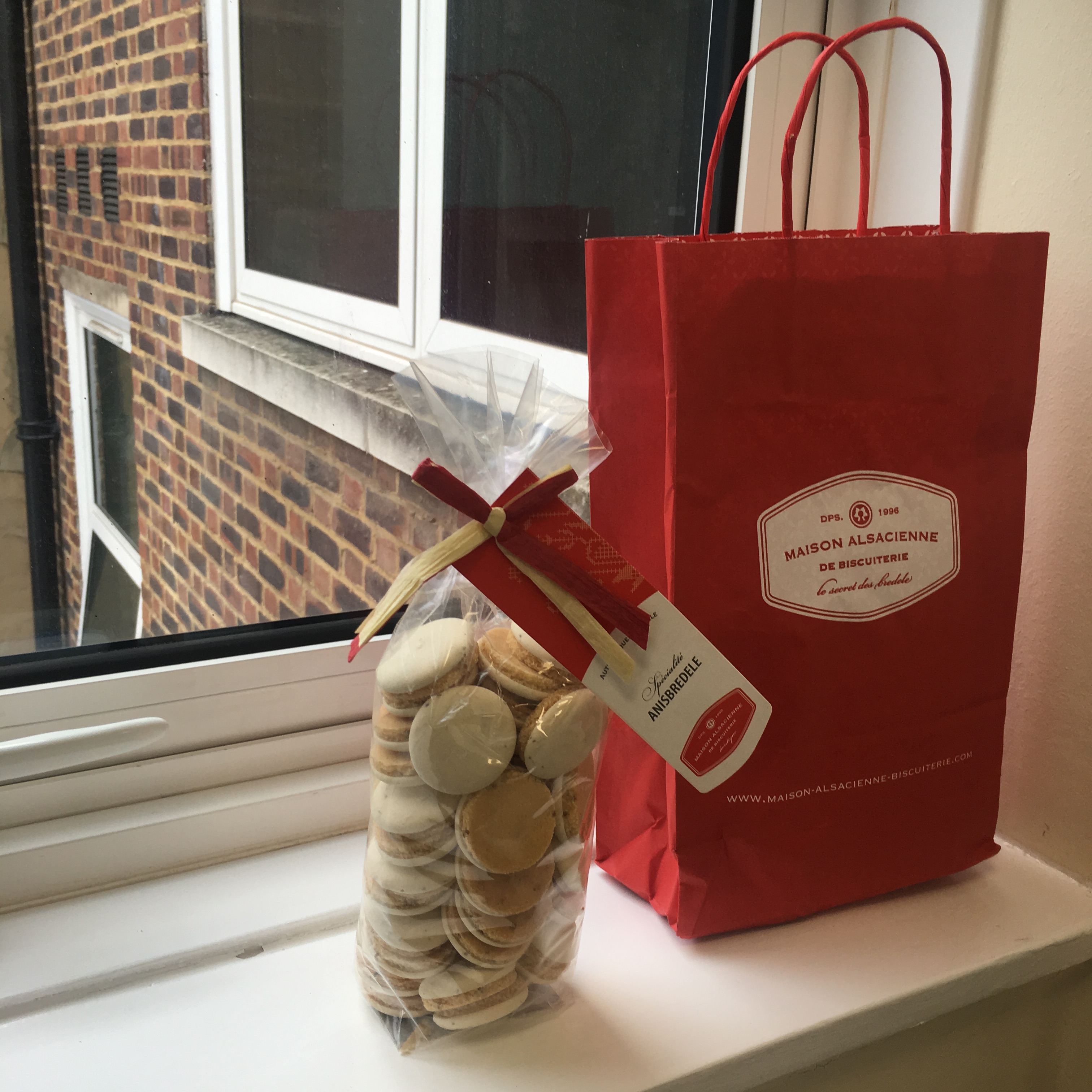
This week’s star biscuit is from the Alsace region of France and a present from my sister and brother-in-law who were holidaying in Colmar. The name, Bredele, means something like ‘little breadies’ in English and sounds more Germanic than Gallic in origin which makes sense given how close Alsace is to the border. The smooth, slightly convex topping looks a bit like a macaron to the casual observer but the consistency is tougher and the biscuit itself very dry and sweet and light. These anisbredele are particularly noticeable for their strong hit of aniseed (green aniseed according to my French colleague). Here they are perched on a windowsill in the office next to their elegant gift bag:

IMG_1184Bredele are treat biscuits enjoyed as Christmas cookies or petits four in France. The earliest recipes date back to fourteenth-century Strasbourg so they come with an excellent medieval pedigree also, but I have to admit I’ve only had one or two so far as liquorice is one of the few flavours I genuinely can’t abide. (This is an eccentricity of my own though and I’m pleased to say they’ve been popular with office mates who don’t share my prejudices!)
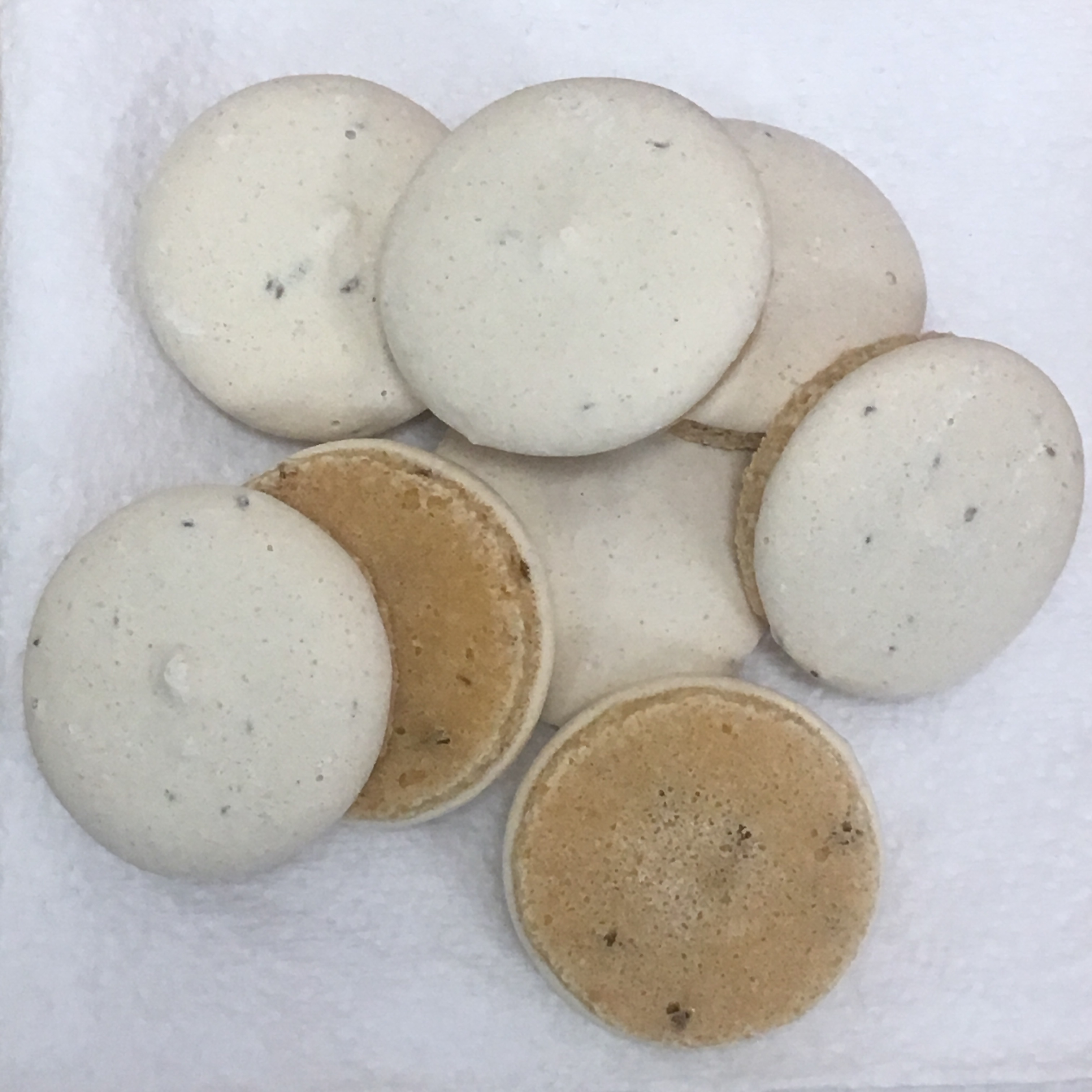
fullsizeoutput_8bfIn settling on a medieval-style sentence for the bredele, I couldn’t help remembering the famous line in the Lord’s Prayer: give us this day our daily bread. I doubt the most free-wheeling translator has ever stretched this into daily bredele, but the idea leads to an interesting question: is it OK to ask God for the little things as well as the big?

While it’s possible to under-think prayer maybe the greater danger comes from over-thinking it and in our efforts not to be childish in our prayer requests we can forget to be childlike as Jesus taught. In the gospels he tells his disciples to bring their needs to God as simply and directly as little children to their father and to trust that he is better than the best of human parents and intimately concerned with the smallest details of our lives. This may come as a surprise to those more used to relating to God as Our Emergency Service that Art in Heaven, but it invites us to a conversation about our evolving needs and yearnings with a father who loves to give us good things when we ask.

Further Delectation

Here for the bredele? You can find an aniseed-flavoured bredele recipe here or a  general recipe here for those less fond of aniseed. The clerks and historians can also read about all things bredele-y at bredele.fr

Be a source of delight to others: if you’re lucky enough to be able to bake or buy your own biscuits, you might consider giving some to food banks this autumn. It can make a child’s day when you donate biscuits as well as the usual staples (a good way to be an answer to someone else’s prayers!)

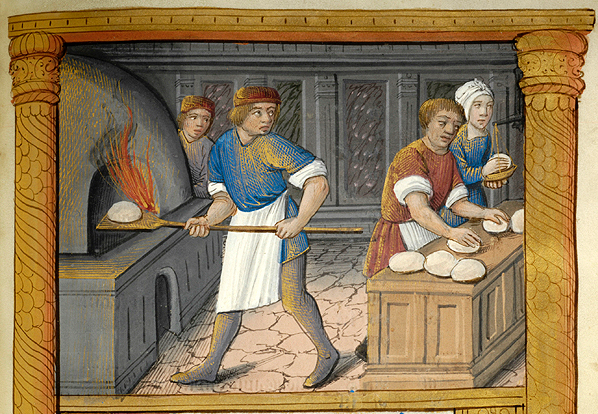
Check out these medieval bakers in a French breviary from the early 1500s. This illustration is for the month of December so perhaps they’re busy making Christmas biscuits (following the astrological calendar, it also sports a fantastical goat in a shell…)

m8.012ra

If you would like to see more entries more regularly and help keep this bestiary free of ads, you are welcome to contribute to the Biscuit Jar

Franska Vafflor

It’s been a long, long time since our last biscuit. Five weeks to be exact but the good news is that the fast is soon to be followed by a feast of new entries from the continent. First, these wonderful Franska Vafflor from Olivia, a Danish-made biscuit whose name translates as French Waffles. As I haven’t been able to find an equivalent biscuit in France I’m wondering whether these waffles stand to France as English muffins to England. These ones are sandwiched with vanilla cream and are the closest thing to a doughnut I’ve ever had in biscuit form. The outer layers have the texture of crisp fried pastry and while they taste very nice indeed I recommend you stop after three to avoid a sugar rush.

IMG_1160.JPGThe abundant richness and sweetness of the Vafflor feels especially appropriate for this day in the Anglican Church’s Calendar, in which we celebrate a man who is perhaps the sweetest of all seventeenth-century writers, Thomas Traherne. I first met him through his Centuries of Meditations, which are full of passages like this one:

“You never enjoy the world aright, till the Sea itself floweth in your veins, till you are clothed with the heavens, and crowned with the stars: and perceive yourself to be the sole heir of the whole world, and more than so, because men are in it who are every one sole heirs as well as you. Till you can sing and rejoice and delight in God, as misers do in gold, and Kings in sceptres, you never enjoy the world. Till your spirit filleth the whole world, and the stars are your jewels; till you are as familiar with the ways of God in all Ages as with your walk and table: till you are intimately acquainted with that shady nothing out of which the world was made: till you love men so as to desire their happiness, with a thirst equal to the zeal of your own: till you delight in God for being good to all: you never enjoy the world…”

Reading the meditations feels like escaping from the smog of the big city into the open country on a clear autumn night. Almost at once you’re breathing easier and seeing further, instead of crowded trains or cramped ceilings the roof above you is a net of stars. And you feel again what a strange and wonderful thing it is to be alive and to have a little seat as a sentient spectator in the theatre of this vast, sprawling, mind-dazzling universe (you see, it’s catching…) Traherne’s writings are suffused with his awareness of a ‘joy unspeakable and full of glory’, to quote the apostle Peter. Centuries on, his attempts to speak of that glory can still move us now.

While the Centuries itself was never published in his lifetime, its theme of revelling in the joy of existence is the more remarkable when you consider its author’s upbringing amid all the dread, anxiety and upheaval of a Civil War. ‘A Christian is an oak flourishing in winter,’ Traherne writes, echoing the opening of the Psalter with its declaration that those who delight in God’s law are like trees planted by a river. You may have to dig deep for it, but the joy is still there waiting to be found.

Further Delectation

I can’t think of much more delectable than the Centuries themselves. You can read them for free here.

While I couldn’t find a recipe for Franska Vafflor these ones were made by Karen Volf.     (This Danish vanilla butter cookie recipe looks jolly nice too!)

And not forgetting the middle ages, here’s a little image of Bartholomew Anglicus contemplating the beauty of the world in BL MS Royal 17 E III:

bl-royal-ms-17-e-iii.jpg

That’s all for this week, folks… Stay tuned for more biscuits in future.

If you would like to see more entries more regularly and help keep this bestiary free of ads, you are welcome to contribute to the Biscuit Jar

Galettes Bretonnes

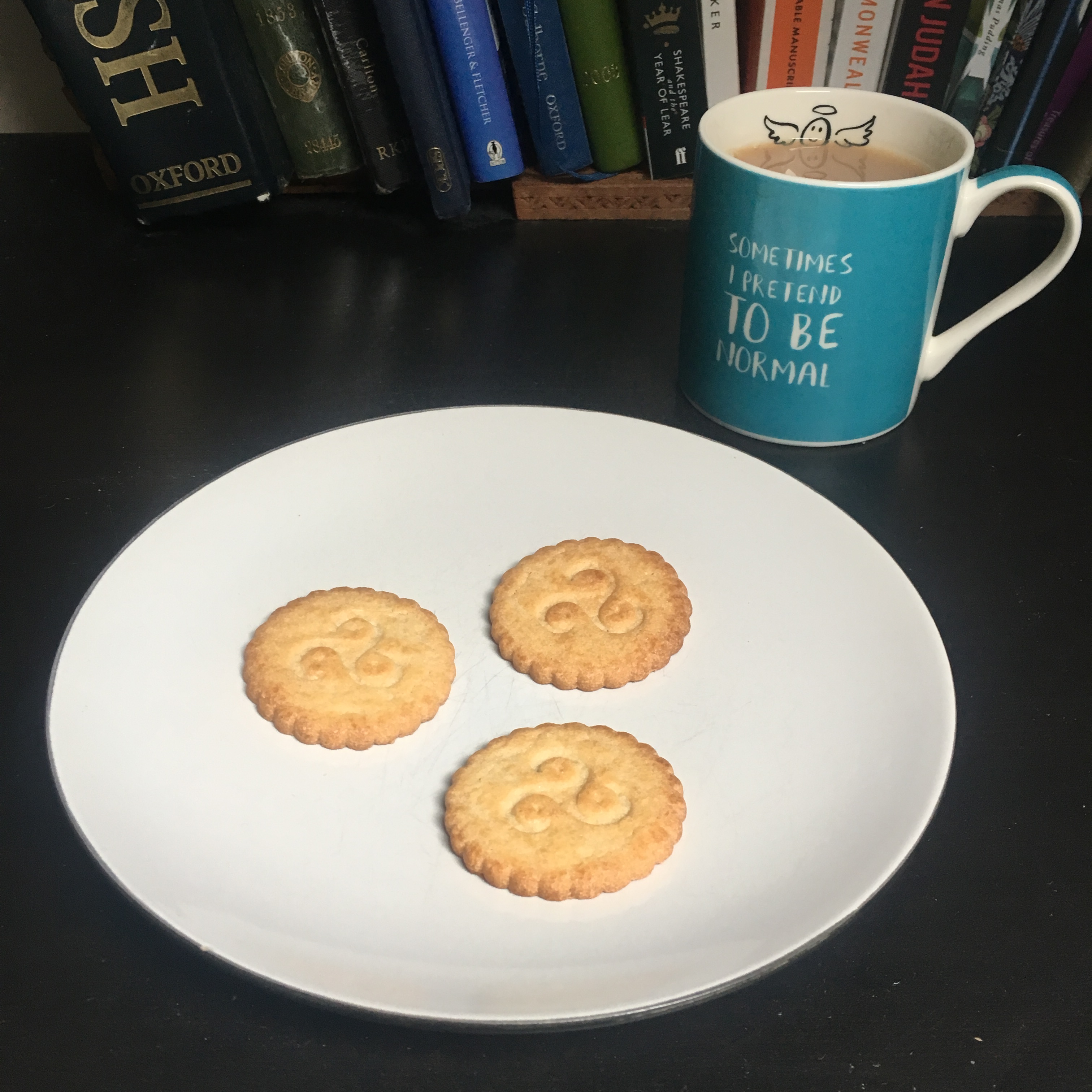
These excellent Galettes Bretonnes were another offering from my friend Olivia and if you get the chance to make their acquaintance too I thoroughly recommend it. Given the French are better known as coffee than tea drinkers I had thought to pair them with a cafetière of French coffee, but the glowing write-up they received on A Nice Cup of Tea and A Sit Down encouraged me to put them through their paces with a nice cup of tea instead:

IMG_0673

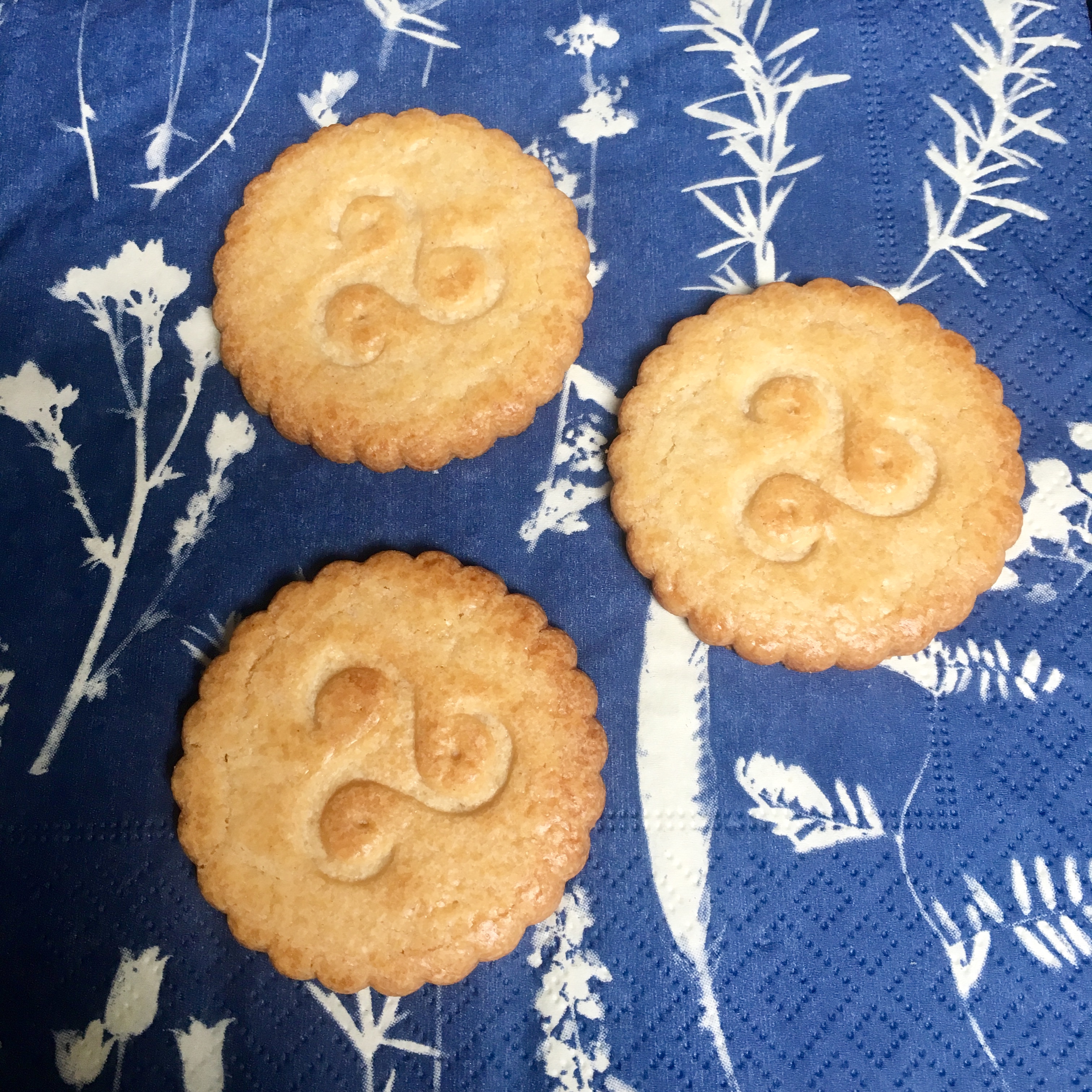
As the name suggests, these Galettes are based on a traditional recipe from Brittany and I must confess to chomping my way through five in succession as soon as my iPhone had captured their likenesses. They are very buttery indeed with a croissant-like sheen and like a croissant the grease has a tendency to rub off on your fingers. While this might sound off-putting they really do taste as delicious as proper croissants too, and impressively so given that they had already been left to sit on the shelf for several weeks. Frankly, if this is what mass-produced Galettes taste like, I can only imagine the bliss awaiting those destined to eat the freshly baked version in a Breton kitchen…

Brittany was sometimes called Little or Lesser Britain in the Middle Ages to distinguish it geographically from Greater Britain and you can see a nod to its Celtic heritage in the Galette’s three-spiralled Triskelion. It was the Celts of Greater Britain who first brought Christianity to Brittany after the Fall of the Rome, and like those of Wales and Cornwall (whose language is closer to Breton) went on to shape its art and history in radical ways. The Christian faith may not have seemed entirely strange to the pre-Christian Celts given that both cultures shared a belief in immortality and a spiritual world infusing and underpinning the material one. You might even argue that, in their own distinctive blend of poetry and mysticism, the Celtic pagans had already created an imaginative space for the new faith to enter long before its missionaries did.

IMG_0674

The Triskelion itself offers one intriguing possibility of this as a prefiguring of the idea of Divinity as Trinity. In Celtic mythology ultimate realities are always triune or triad – one reason early Celtic Christians would, I suspect, have had no problem with the idea that the Trinity had always existed outside of time and before the birth of Christ. 

“There are four things I like about the Trinity. First, I love having a father in God. Second, I love having a friend and brother in Jesus. Third, I love having a comforter and guide in the Holy Spirit. And fourth… I love the fact that it’s a mystery. God in three persons. Three persons – one God. It’s a mystery and I love it. Why would I want to spoil things by trying to explain it?”  (Adrian Plass)

I like these things too, and find it cheering that a point of doctrine that proved so difficult for theologians to wrestle with could be simply and instinctively embraced by a bunch of Celtic bards. Each tradition has its own strengths, but perhaps the greatest lesson Celtic Christianity has to teach us is to be good stewards of mystery. If the fear of the Lord is the beginning of wisdom, perhaps a respect for mystery is the beginning of love. 

Further Delectation

Intrigued by the Christian and Celtic? Peruse the incomparable Book of Kells (now digitised and available to read online from Trinity College Dublin) or listen to this setting of a Celtic Prayer by John Michael Talbot, a modern music-making monk.

Can’t get over to the sunny coasts of Greater and Lesser Britain right now? Have a go at making your own Breton biscuits or book yourself a magical, mysterious evening in with Marie de France’s Breton Lays.

It’s hard to write about French medieval culture today without thinking of the fire in Notre Dame recently and the brave pompiers who worked so hard to save her. Courtesy of the Met Museum, here’s a beautiful image of the cathedral in its medieval prime from my favourite fifteenth-century manuscript, Jean Fouquet’s Hours of Etienne Chevalier:

D4OJpo9X4AcdM9M

If you would like to see more entries more regularly and help keep this bestiary free of ads, you are welcome to contribute to the Biscuit Jar