Party Rings. Ring-shaped, icing glazed in colourful stripes on brittle dry shortcake biscuits. Eaten en masse at children’s parties and not many places else although I did come across a mini packet of them in Piccadilly yesterday. These mini rings are a new development on the maxi ones first circulated by Fox’s Biscuits in the 1980s. It had been years since I’d seen one much less eaten one so they seemed blander looking to me. I’d remembered the icing stripes and colours then had a much lairier 80s vibe…


A little research on the internet took me to the art hub of Hwa Young Jung, a photographer in Manchester with a sideline in rather charming biscuit illustrations. As she had a fascinating chronicle of the transformation of the Party Ring I knew nothing about, I quote here directly from her on her flickr stream because it’s the most comprehensive history I’ve come across:
Party rings were a product of the 1980s fashion for the newly developed chemical food dye system that enabled more lavish colours to be incorporated into the manufacture of biscuits. This made them a very popular choice for children's parties, where not only could the colours amuse, but the holes in the middle enabled them to be placed on a finger, often resulting in "ring races". These involved each child taking five rings and placing one on each finger of a hand. They would then proceed to eat them as fast as possible, with the inevitable danger of biting a finger a bit too hard. The crisp, hard sheen on the icing is because of the use of carob bean gum — the carob, or locust bean, is also sometimes used as a chocolate substitute.
Because of the demographic popularity of the product, most "party ring children" are now of university age, and many universities have societies to appreciate such confectionery items. These societies came to notoriety in 1999 when Fox's Biscuits changed the packaging of party rings, causing petitions, heavy leafleting campaigns and a sit-in outside their production plant in Batley, West Yorkshire. A standard pack of party rings consists of a long plastic tray containing five biscuit wells, each holding four biscuits of the same pattern, making twenty biscuits per pack. Fox's decided to remove the purple/yellow biscuit because the dyes used had been linked to certain health problems. Instead of replacing them, they removed them completely, leaving only sixteen biscuits per pack. Through their determination, the university societies not only managed to have the purple/yellow biscuit reinstated (using newer, safer dyes), but many societies received a letter of apology from the managing director of Fox's Biscuits...

I was at university in this fateful year and can safely say I would never have leafleted Batley or attended a sit-in to protest the changing packaging of the Party Ring, even if I’d known about one. Neither had I any clue the Party Ring – a cheerfully, some would say outrageously, colourful creature of the 80s – should have been issued with a health warning, but clearly one that paled into insignificance alongside the Mad Cow Disease and Salmonella scares.
This history makes more sense of the political manifesto printed on the Party Rings’s packs or the Party Ring Promise as Fox’s call it: no artificial flavours, no artificial colours, no artificial preservatives, tick, tick, tick… And all on a 91 calories budget.

The best take on Party Rings I’ve read so far was an artificial one: a spoof news item about the holy grail of biscuit collectors being a Party Ring without a hole in it. The association of Party Rings with the grail also occurs in this blog about biscuits and parenting, whose Mum-author described them as the holy grail of children’s parties (despite the muted colours apparently toddlers still go wild for them).
The grail reference is a nod to a very medieval tale that took on a life of its own after being set down in unfinished form in Chretien de Troyes’s twelfth-century Arthurian romance, Perceval. The holy grail in his story is a serving dish treated with the sanctity of a relic. In later tradition it became the vessel in which Jesus’s friend Joseph of Arimathea is supposed to have collected drops of Christ’s salvific blood, although this detail doesn’t appear in any of the gospels.

Perceval, the hero of the romance, is a goodhearted but somewhat self-willed and ignorant boy whose first encounter with a party of knights in the remote forest he lives in leads to his mistaking them for angels. When they kindly explain his error, Perceval sets his sights on becoming a knight himself and receives valuable advice from an older knight, Gorneman de Gorhaut, in how to act like one. But whether Gorneman’s advice is faulty or Perceval himself is simply unable to apply it with discernment, it later leads him to make one crucial mistake.
This is a riddle-like, indeed myth-like, part of the story in which Chretien describes the boy’s meeting with a man fishing in a river. Having been invited to stay at the man’s house nearby, Perceval discovers it is a splendid castle. His host turns out to be crippled – grievously wounded in a battle, as Perceval later discovers – and he is known as the Fisher King. During the sumptuous dinner they enjoy a mysterious procession appears with beautiful servants carrying a shining grail and bleeding lance. Perceval is longing to know who is fed from the grail but is too polite to ask. Later on he finds out he made a grave mistake in not doing so when he discusses the experience with his cousin. Here’s a part of their conversation taken from Chretien’s story, translated from the medieval French by Nigel Bryant:
"… And did you see the grail?"
"I saw it clearly."
"Who was holding it?"
"A girl."
"Where did she come from?"
"From a chamber."
"And where did she go?"

"
To another chamber."
"Did anyone go ahead of the grail?"
"Yes."
"Who?"
"Two boys, that's all."
"What were they holding?"
"Candlesticks full of candles."
"And who came after the grail?"
"Another girl."
"Holding what?"
"A little silver trencher."
"Did you ask where they were going?"
"Not a word crossed my lips."
"God help me, so much the worse. What's your name, friend?"
And the boy, who didn't know his name, guessed and said it was Perceval the Welshman - not knowing whether it was true or not. But it was true, though he didn't know it. And hearing this, the girl stood up before him and said bitterly:
"Your name is changed, my friend."
"To what?"
"Perceval the Wretched! Oh, hapless Perceval! What a disaster that you failed to ask all this! You would have healed the good crippled king - he would have regained the use of his limbs and the rule of his land - and you would have profited greatly..."
Many of the lessons that Gorneman teaches Perceval are good and necessary to his maturing physically, emotionally, and spiritually, but in the matter of social conditioning, Perceval’s efforts to adopt courtly manners and not talk too much leads him to abandon one childish instinct that could have benefited the whole kingdom. Because he fears appearing as a fool – a typically adult fear – Perceval never allows himself to question what he sees and hears, being more concerned with blending in and keeping up his public image.
Which takes us back to the Party Rings’ journey away from damaging kinds of artificiality to the natural unselfconscious responses we see in children: “Truly I tell you,” said Jesus to his disciples when he found them jockeying with each other for position: “Unless you change and become like little children you will never enter the kingdom of heaven…”
Perhaps it’s no accident that over time the Grail legend developed in such a way that it was the knights who cherished this childlike purity of heart who came nearest to achieving the Quest, which is in essence the search for wholeness and healing. Here’s one of my favourite re-imaginings of the story by Terry Gilliam in which the king’s wound is healed through the actions of a childlike ‘fool’, movingly told here by the late great Robin Williams:
I was very willing to give Mr Williams the last word, but two things have happened in the week after writing this post which have given me more material. On Monday I spent a quiet day in the Royal Foundation of St Katharine, which is the nearest place one can find to a forest hermitage in East London, and browsing the library I picked up a book of essays by Simone Weil and my eye chanced on this mention of the Grail:
Not only does the love of God have attention for its substance; the love of our neighbour, which we know to be the same love, is made of this same substance… The capacity to give one’s attention to a sufferer is a very rare and difficult thing; it is almost a miracle; it is a miracle... In the First Legend of the Grail, it is said that the Grail (the miraculous vessel which satisfies all hunger by by virtue of the consecrated host) belongs to the first comer who asks the guardian of the vessel, a king three-quarters paralysed by the most painful wound: “what are you going through?”
It’s a good question.
The second, most unexpected, thing was opening one of the later packets of Party Rings in a tea and biscuit break this afternoon and actually finding the ‘Holy Grail’ in with it – or a Holy Grail; Here’s the evidence for any doubting Thomases:

Naturally I headed down to the kitchen to show G. – who confessed herself underwhelmed by the miracle – but it certainly cheered me up on an otherwise rather gloomy day, which I think must have been the divine intention. And if a bumbling biscuit-lover like me can discover the grail without searching for it, anyone can… So I leave you on this even higher note and with the hope that whatever healing and wholeness you’re seeking, you’ll hit upon the right question – or even just the right packet – to reveal it.
Further Delectation
Fancy reading more? The story of Perceval and its medieval continuations can be found in Nigel Bryant’s The Complete Story of the Grail (2015) published by Boydell and Brewer.
Make your own Party Rings (recipe courtesy of Prue Leith from the Great British Bake-off).
For those new to Arthurian legend: the Frequently Asked Questions on Rochester University’s Camelot Project may be helpful. The project offers an accessible compendium of Arthurian fiction’s fantastic facts including this short history of superlative Grail knight, Sir Galahad.
One Ring to rule them all? C S Lewis’s excellent essay on youth, parties and power, The Inner Ring (1944) – just as relevant today as it ever was.
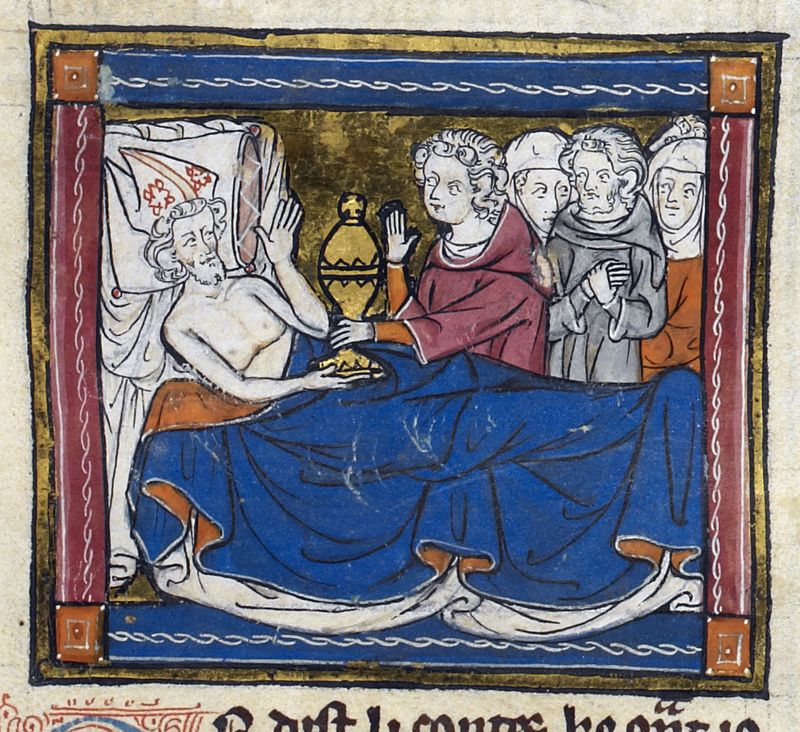
Feast your eyes on these beautiful illustrations from the grail quest stories from some of the Arthurian manuscripts at the British Library, of which this early fourteenth century image from BL MS Royal 14 E. iii, f. 86r is one:
If you would like to see more entries more regularly and help keep this bestiary free of ads, you are welcome to contribute to the Biscuit Jar.
 The Biscuit Bestiary