So in England we’re expecting fireworks tonight, and I’m not talking about the American election. Guy Fawkes’ Night, or Bonfire Night as it’s better known, has been celebrated here since 1605 to mark a failed act of terrorism. James I (VI of Scotland) had scarcely been two years on the throne when a bunch of English conspirators decided the only way to return the country to its Catholic roots was by blowing up king and parliament on one of James’s state visits. His agents arrested the infamous Fawkes, ‘a very tall and desperate fellow‘, beneath Westminster Palace after he was unable to explain what he was doing in the cellars there with thirty-six barrels of gunpowder. And that might have been the end of the story if Parliament had not passed an act requiring ‘a Public Thanksgiving to God every Year on the Fifth Day of November’ to commemorate the foiled plot – an act that has been observed every year since in one form or another.

These days Guy Fawkes Night has less to do with thanksgiving (or anti-Catholic sentiment) and more to do with family fun. I can still remember the excitement as a child, letting off rockets and Catherine wheels in the back garden, or joining other families for the fireworks displays at the local school. These were warm times of gathering in what could be a drab, dark month. Interestingly, the 6th of November marks the beginning of winter in the medieval calendar so perhaps the celebration on the 5th offer us the chance to ring the changing seasons with a bang rather than a whimper (or both, if you’re spending it soothing an anxious pet).

There aren’t many British foods associated with Bonfire Night but Parkin is one of them: a dense, sticky ginger cake made in Yorkshire with oatmeal and treacle. Lottie Shaw’s Bakery produces a biscuit version I heartily recommend after being gifted some by my friend Paula. (Every purchase helps the Yorkshire Air Ambulance, which saves lives in the National Parks.)

How Parkin came by its name is a bit of a mystery but the word itself is a diminutive form of Peter. (Those with an interest in medieval history may be familiar with the name because of Perkin Warbeck, a dubious fifteenth-century claimant to the throne who tried to persuade the English establishment he was one of the lost Princes in the Tower). British food historian Neil Buttery suggests the cake recipe dates to the early 1800s and the industrial revolution, but a few online sources suggest the first mention of Parkin was in a court case in the West Riding in 1728 where a woman pleaded guilty to stealing oatmeal in order to make some!
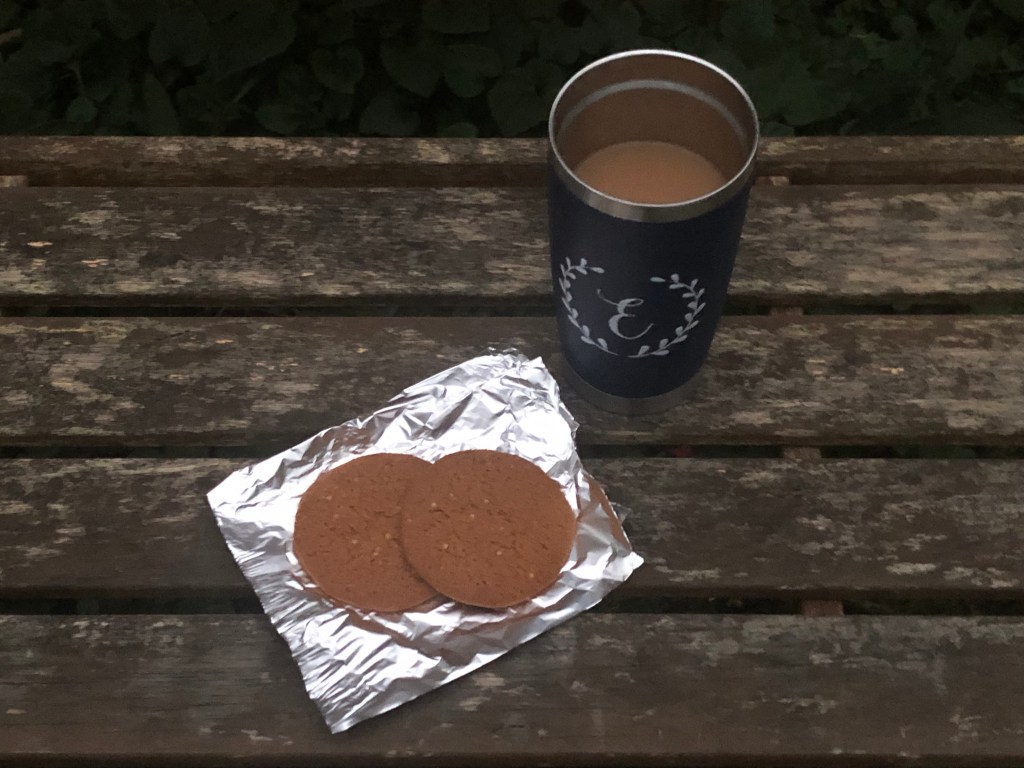
Strong flavours of dark sugar and ginger give these Yorkshire Parkin Biscuits their fantastic kick. The first pack I tried were larger and chewier but these have a brittleness which evokes the feeling of being hardened in fire. The edible equivalent of a dram of whisky, it’s perfect if you’re out in the cold watching fireworks (or trying to shake off a cold indoors): a biscuit to warm the cockles and fire the senses, ideally with a strong cup of tea (Yorkshire Red or Gold).
For the meaning, my thoughts turn naturally to the apostle Peter: an unschooled fisherman who enters the gospel narratives as Simon but receives the name Peter from Jesus (“you are Cephas (Peter), and on this rock I will build my church…”). Peter could be dense as a rock at times and headstrong, but his are the faults of the whole- not the half-hearted follower. We see this in his exchange with his master at the Last Supper, where he refuses to allow him to wash his feet. “Unless you let me wash your feet, you have no part with Me,” Jesus tells him. “Then Lord,” Peter exclaims, “not just my feet but my hands and head as well!”
Peter thought his commitment to Jesus was rock solid, which is why what happened later that evening would shake him to the core. Despite all of his protestations of being ready to die for his friend and rabbi who he believed to be the Messiah, he disowned him in the space of a few minutes in the courtyard of the house where Jesus was taken for questioning after his arrest in the Garden of Gethsemane. Three times he denied that he had had any association with his master to ward off the awkward questions of a servant girl as he was warming his hands by a fire. Before this point it seems he’d forgotten Jesus’s own prediction that Peter would disown him, until the third time his denial rang out and Jesus turned and looked him in the eye.

In the bleak hours he must have spent contemplating his sorry betrayal, did Peter remember Jesus’s words to him earlier that same evening: “Simon, Simon, Satan has asked to sift each of you like wheat. But I have prayed for you, Simon, that your faith will not fail. And when you have turned back, strengthen your brothers…” Jesus seems to have found it easier to forgive his friend than Peter would find it easy to forgive himself. Before he’d even turned away, he had laid out a path for Peter to return and when after his death and resurrection they met again, he deliberately offered Peter the chance to overwrite his story of betrayal with one of re-commitment, creating three opportunities for him to publicly affirm his commitment to him over the flames of another fire.
Why did the gospel writers record this instance of Peter’s weakness instead of glossing over it? Not for the pleasure Satan sought, of cutting him down to size. God knows our littleness, the very worst of which we are capable, and still calls us into the best he wants to build with, and in, us. Which is why Peter’s story, in the end, led him to abandon any illusions about his own strength and put his trust in another’s. David’s prayer might have found an echo in his own heart in the joy of his return and restoration: “Lead me to the rock that is higher than I.”
Further Delectation
More about the origins of Parkin and the traditions of Bonfire Night for the historians among us.
Your pet not quite themselves this evening? The Pet Classics programme, courtesy of Classic FM, is a wonderful tradition in itself and may help calm them. Callers write in with feedback from every kind of pet imaginable. Who knew Classical Music (or fireworks) had a noticeable effect on stick insects?
And finally, if you can’t get out to a display tonight, a little royal fireworks music to eat your Parkin biscuits with, courtesy of Mr Handel:
If you would like to see more entries more regularly and help keep this bestiary free of ads, you are welcome to contribute to the Biscuit Jar.
 The Biscuit Bestiary