Chocoline Cookies

This week’s biscuit hails from the furthermost reaches of Eastern Europe, another find from intrepid biscuit hunter Gareth, who crossed the borders of Latvia a few weeks ago to retrieve it. He did say that the biscuit selection in Belarus wasn’t as varied as he was expecting, but I was quite impressed by the specimens below and the packaging is so bright you can almost see it glowing:

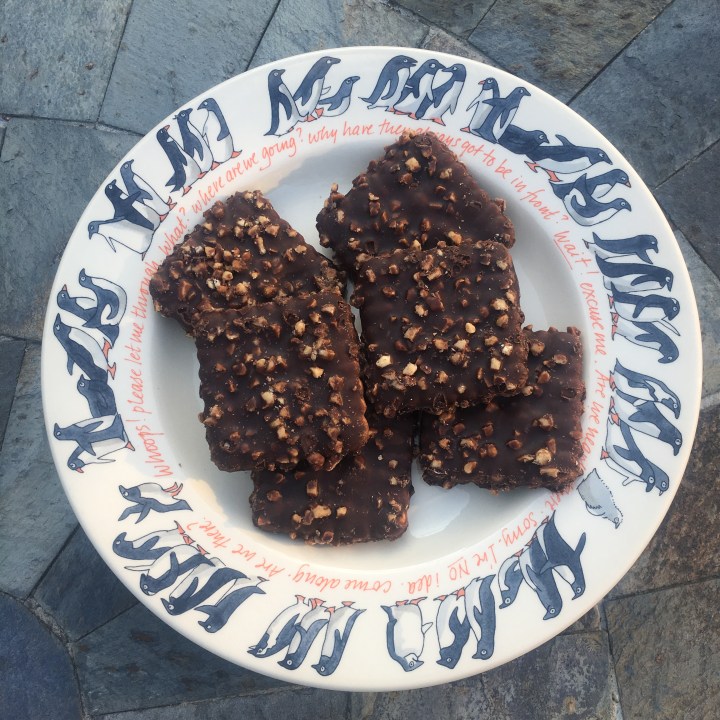
IMG_0701Chocoline cookies are produced by a company in Minsk, whose name seems to be Chocoladovo transliterated from Belarussian. This particular incarnation of Chocoline is topped with a scattering of milled roast peanuts partially coated by a layer of soft chocolate, and the dimensions (5cm squares to about 8 or 9mm depth) seemed a bit unusual to me, probably because British brands look and feel chunkier. The peanut version was less crunchy in texture than I’d expected from the picture and the coating more sugary than nutty, but they were pleasant enough with a coffee after noon or dinner and thin enough to justify eating three or four at a push, or maybe six if you’re a penguin…
IMG_0726
I was a bit stumped for a moral until I reflected that the rocky surface of the Chocoline fitted well with Jesus’s Parable of the Sower, in which the seed sown on rocky soil represents those who receive God’s word with joy but fail to develop deep roots, believing for a while then falling away when they face temptationThere are many lessons we could take from this but perhaps the most positive is that temptations have one up-side as far as self-knowledge goes: you only really know how firm your principles are or how deep your roots go when they’re tested.

Titivillus
Titivillus was the devil responsible for scribal errors too. Here he is bothering St Bernard de Menthon…

My favourite Middle English morality play, Mankind (c.1470), portrays the drama of temptation through a more extended allegory, a popular way of depicting the spiritual life in the medieval period. In it the dim but loveable Mankind – a sort of gardening Everyman – successfully withstands the temptations of four Vices until the devil Titillivus (only visible to the audience) appears to harden the soil, nick his spade and inflict him with an urgent need to piss when he should be praying. Thus disrupted and distracted, Mankind succumbs to the persuasions of the Vices who have a tendency to steal the show as craftily as Titillivus steals the shovel. But the audience’s amusement at their uproarious behaviour fades as their true nature is revealed and they eventually succeed in persuading Mankind to put a noose around his neck and hang himself as ‘the new fashion’. (Fortunately, his old friend Mercy arrives just in time to save him.)

Temptation tests our character, but what if you take the test and fail? What if some rocky terrain you weren’t expecting exposes some lack or shallowness you’d rather not own, pitching you into disgrace or despair of things ever changing? Jesus understood this sadness, I think, when he said temptations would inevitably come, and in general he had much kinder words for the tempted than those doing the tempting. Failure can be a lonely place, but as the story of Mankind shows sometimes it takes a fall from grace to show us what grace really is. And, like Mercy, he has a habit of running in when the rest of the world runs out, God bless him.

Further Delectation

Watch the vices in action in this production of Mankind at the Festival of Early Drama.

Listen to this spectacular choral setting of Psalm 51, Misere Mei Deus (‘Lord, Have Mercy on Me’) performed by the Tenebrae choir. (You may also enjoy the story of its release to humankind, thanks to a well-known musical genius with perfect recall!)

Thinking of making your own raid on the biscuit barrels of Belarus? Have a read of The Lonely Planet’s Online Guide to learn more about one of Europe’s new ‘it’ destinations.

If you would like to see more entries more regularly and help keep this bestiary free of ads, you are welcome to contribute to the Biscuit Jar

Doris Tryffeli

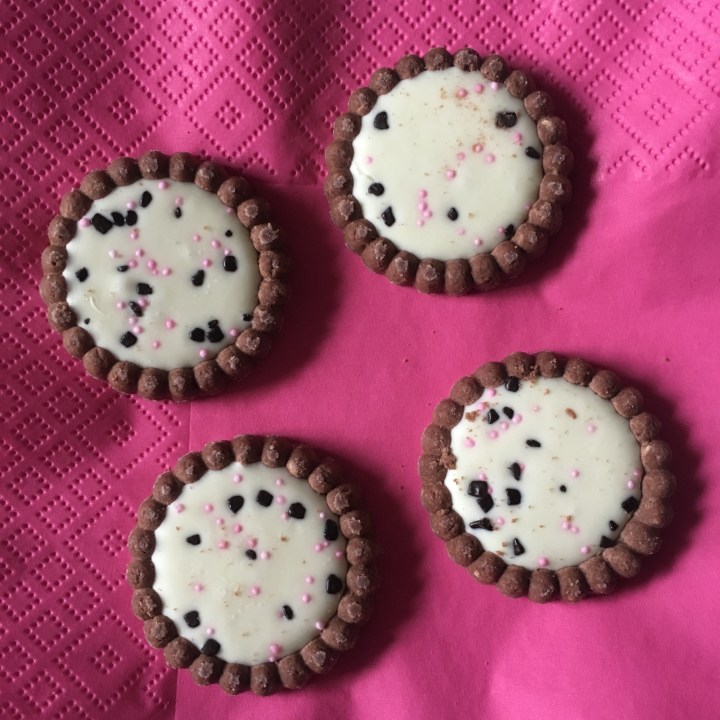
I was indeed blessed to start this year of our Lord with a great backlog of biscuits, a number of generous patrons having sent me new specimens over the last few weeks. Special mention must be made of the hand-iced ‘bee’ biscuit procured by my sister from an artisanal baker and some home-baked mint chocolate chip cookies courtesy of my friend Dana in the Golden State. Our biscuit today comes from even further North as a gift from my friend Gareth in Latvia. These Doris Tryffeli (Doris Truffles) hail from Finland and are popular there and in the surrounding countries of the Baltic region. Described by its manufacturer, Fazer, as ‘the classic biscuit at feasts’, Doris promises to ‘win your heart over with its soft truffle flavoured filling and delicious cocoa on the sides’, so it seemed a good choice to mark the Feast of St Valentine…

IMG_0136

There’s no denying that little Doris is a bit of a show-stopper, from its decorative base of gently cocoa-flavoured biscuit to the exciting icing centre which somehow manages to appear perfectly set on the outside and perfectly gooey when you bite into it. The random speckling gives it a naturalistic look and the ornate chocolatey edging an elegance I can only describe as Rococoa. To be honest I’ve never seen or sampled a biscuit like it; the tartlet casing is reminiscent of a Chocolate Bourbon, but the filling could be straight out of a Mr Kipling’s Festive Bakewell.

Whether or not it has the capacity to win hearts, Doris has certainly won the admiration of the friends I’ve introduced it to so far and is a rather intriguing emissary from a country I know very little about. I know still less about Finland’s medieval history, but the way Finns mark this red letter day is rather wonderful: Ystävänpäivä, as they call it, means Friends’ Day in Finnish and is marked by celebrating one’s friends with little cards and gifts. Forget the Romantic Valentine’s Day or even Galentine’s Day, Ystävänpäivä is a feast for everyone who has ever been a friend to anyone, and how better to celebrate it than with a Doris?

But shouldn’t this be a feast for lovers, you say? Isn’t the whole concept of True Love medieval? Well, yes and no… Of course we have Master Chaucer to thank for the association of romantic pairing with this feast and many fine (and foolish) traditions associated with it, but Valentine’s Day itself was celebrated long before Chaucer’s Parliament of Fowls in commemoration of a Roman martyr. An elusive figure historically, we don’t know much about Valentine except that he died helping others to live, which leads us back to Finland, biscuits and the sacred offices of friendship as, as Jesus himself put it, ‘Greater love hath no-one than that he lay down his life for his friends.’

Further Delectation

Learn more about the different ways Valentine’s Day is celebrated across Scandinavia.

Despite his Roman origins, Valentine has some interesting links with medieval England and North Europe. Read more about the medieval Valentine’s Day – or mine some poetry to help you celebrate with your sweetheart – courtesy of the Clerk of Oxford.

Bored with all this talk of courtly love? Read Master Aristotle on friendship.

Feast your friends in the manner of Bodleian Library MS Bodley 264:

feasting

If you would like to see more entries more regularly and help keep this bestiary free of ads, you are welcome to contribute to the Biscuit Jar

The Chocolate Hobnob

If I had a favourite commercially mass-produced biscuit it might just be the chocolate hobnob. Not that there’s anything wrong with an unvarnished hobnob per se, but the only way to improve on a biscuit this satisfying is to enrobe it in a reservoir of chocolate. Despite McVitie’s controversial assertion that true cognoscenti will serve a chocolate hobnob oat-side up, most people I’ve spoken to prefer to keep the chocolate uppermost. Here’s a rare glimpse of an uneaten specimen warming itself in the late autumn sun:

IMG_5123 2

Unsurprisingly, the upgraded hobnob performs well in the biscuit leagues, regularly beating the bourbon and vying with the chocolate digestive for the top spot in the UK charts. Taste is key when it’s down to the wire and this biscuit is so moreish it’s quite possible to eat three in one sitting without discomfort.

The plain hobnob we looked at in the previous entry; in pondering the deeper meaning of the chocolate hobnob the first question is what, if anything, is the spiritual significance of the chocolate part? Chocolate isn’t mentioned in any of the bestiaries I’ve come across, but from a consumer’s perspective I feel confident in suggesting it can only signify love as the richest, most magically transformative and generally satisfying ingredient in the cupboard. Chocolate makes everything taste better and covers over a multitude of errors in the oven. And while it would be a sin to call a plain hobnob an error there’s no doubt that without the chocolate it would be a lot rougher and scratchier round the edges. It’s the chocolate that smooths all that over – like love. 

To extend the parallel further, it’s usually when we come into contact with others for any significant amount of time that we also come into contact with our own ‘scratchy’ places: hidden resentments, irritations and lack of love. It’s where the difference between real and imaginary love becomes painfully apparent: how we treat the actual, flawed specimens of humanity we’re forced to hobnob with in everyday life is so often the real measure of the heart. There’s a reason it’s easier to be kind to people at a distance, where kindness doesn’t have to be sustained for as long and doesn’t cost as much. Want to check your love? Have a hobnob. 

Further Delectation

Hold your breath, make a wish… If you don’t have a ticket to see McVities’ reservoir of chocolate, you can at least get a glimpse of Willy Wonka’s:

And for medievalists especially, a splendidly colourful patchwork of bestiary-like images from Amiens MS 399, courtesy of Damien Kempf

If you would like to see more entries more regularly and help keep this bestiary free of ads, you are welcome to contribute to the Biscuit Jar